Nyc Subway

September 26, 2017

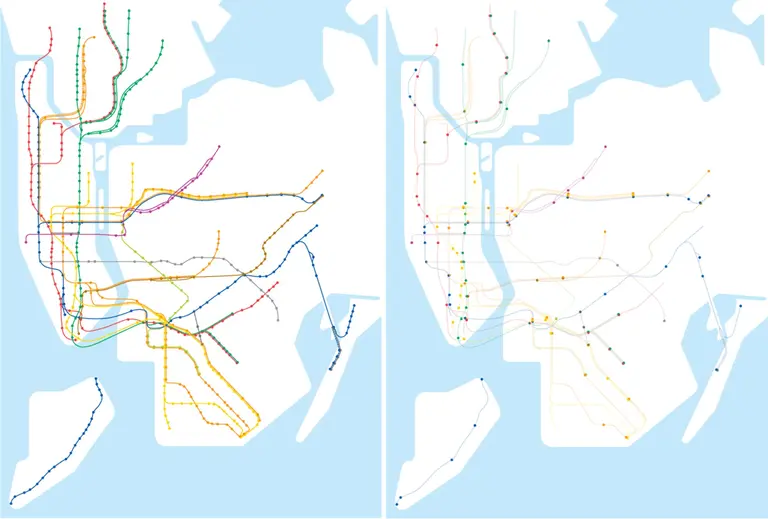
Map shows less than 1/4 of NYC subway stations are accessible

Out of NYC's 472 subway stations, only 117 are fully accessible, a major problem considering more than 800,000 or one-in-ten New Yorkers have a physical disability (and this doesn't take into account those who get injured or are with a stroller). The reason for this is that our subway system was built starting in 1904, long before the Americans with Disabilities Act (ADA) became law in 1990. To highlight the issue, the Guardian put together these startling maps that show worldwide metro systems in their entirety as compared to versions that only include fully accessible stations.
Get all the facts
September 25, 2017

MTA to provide more honest stats about subway service with new digital dashboard

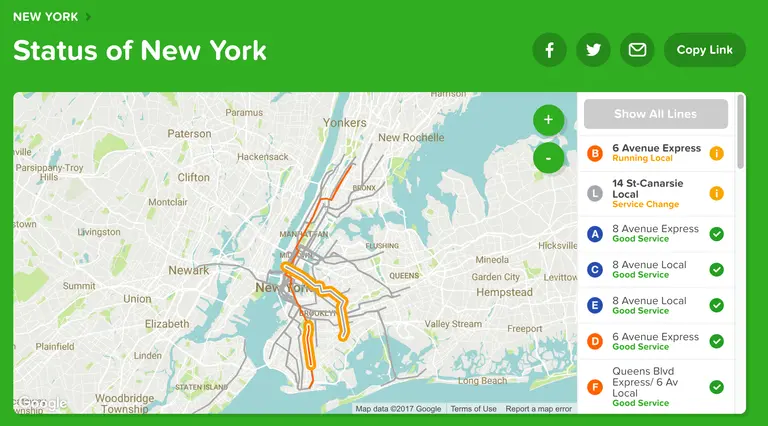
While your train will probably still be delayed and overcrowded, the reasons behind your slow commute may soon become clearer. The Metropolitan Transportation Authority managers will present statistics to the agency's board on Monday that reflect the rider’s experience, rather than MTA staff. As the Daily News reported, the MTA will unveil a digital dashboard that informs strap-hangers how much longer than usual they will wait for a train and how many minutes are spent on delayed trains. Plus, the new service will provide a tally of major incidents.
Find out more

September 21, 2017

Eight months after opening, Second Avenue Subway still doesn’t have its safety certificate

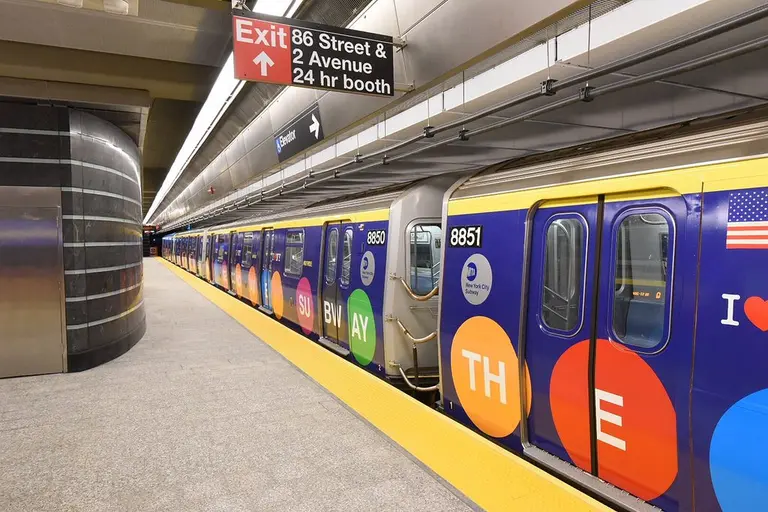
When the Second Avenue Subway opened this past New Year's Day, it was nothing short of a miracle. Not only had the $4 billion infrastructure project been 100 years in the making but in the months leading up to its deadline, there was much talk about delays related to the system’s “rigorous testing schedule" not being met. As it turns out, the testing wasn't met; the Times tells us that when the train opened on January 1st, "the fire alarm system was still being tested and more than 17,000 defects found during inspections had not been fixed." And eight months later, the train is still operating under a temporary safety certificate.
Get all the details
September 7, 2017

Governor Cuomo’s new ‘Keep It Clean’ initiative doubles the fine for subway littering

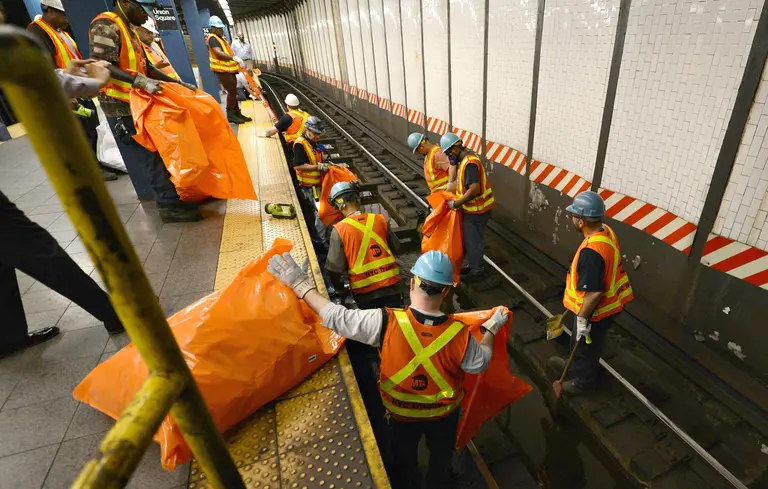
A week from today, those who litter in the subway system will face a $100 penalty, double the current $50. The increased fine is part of Governor Cuomo's newly announced "Keep It Clean" initiative, which will discourage subway littering through a new public awareness campaign. Each year, 700 fire-related track incidents are caused by littering. And in just the past six months, incidents related to standing water conditions (litter hinders the MTA's ability to pump out millions of gallons of water daily) increased by 56 percent.
Learn more and watch the MTA's new PSA
August 30, 2017

City workers missed over 17,000 hours of work due to subway delays this year

New Yorkers employed by the city have missed 17,143 hours of work because of transit delays and malfunctions, according to the Daily News. A new analysis by the Independent Budget Office (IBO), shows that city workers are on track to miss nearly 26,000 hours of work for the entire year, an increase of almost 30 percent from previous years. The report found the incident that caused the most city workers to be late happened in January when city workers lost a total of 1,075 hours after water spilled onto the tracks at West 4th Street-Washington Square station.
Find out more

August 28, 2017

‘Citymapper’ app translates confusing MTA alerts into easy-to-read alternative directions

With subway disruptions and delays becoming a part of daily life in New York City, even lifelong New Yorkers sometimes have trouble finding alternative routes when their F train switches to a different line. Thankfully, there’s now an app that aims to make commuting in NYC a little less confusing. Citymapper, a transportation software start-up based in the UK, uses artificial intelligence to recommend new routes in response to MTA alert statuses. As CityLab reported, the app’s “bot” reads the complicated message from the authority and uses the relevant information to offer a clearer route change to avoid the problem.
Find out more
August 14, 2017

Cuomo to offer a congestion pricing plan to fund transit repairs

With New York City’s subway system currently in a state of emergency, public officials and advocates have been developing ways to pay for its urgent repairs. According to the New York Times, Governor Cuomo is planning to release a congestion pricing plan as a way to provide a dedicated source of funding for the transit system, as well as a way to reduce traffic on some of the country’s busiest streets. Ten years ago, Mayor Bloomberg pushed for a similar plan, charging drivers $8 to enter the most congested parts of Manhattan during peak commuting hours, but the legislation faced resistance and was never brought to a vote.
Find out more
August 10, 2017

Cuomo gives Con Ed one year to repair the subway’s power system

Just in the past month, power problems caused 32,000 subway delays, prompting Governor Cuomo to direct "Con Edison to take significant and immediate actions to improve the subway's power reliability and prevent future service failure," according to a press release. Less than two months after declaring a "state of emergency" for the subway system, Cuomo's given Con Ed and the MTA one year to identify and repair the problems, the most comprehensive power review ever done, leaving them on the hook to inspect 470 manholes, 1,100 boxes, and 221 power substations at street level and 1,100 energy distribution rooms, 300 signal relay rooms, 15,000 track circuits, 11,000 signals, 13,750 insulated joints, 11,000 trip stops, 220 interlockings, and 1,800 switch machines below ground. The cost? It's not yet been officially calculated, but Con Ed chairman John McAvoy says it's likely to be tens of millions of dollars.
Get all the info
August 8, 2017

New renderings of proposed Triboro Corridor, 17-stop outer borough light rail and linear park

Back in June, the Regional Plan Association (RPA), an urban research and advocacy organization, in conjunction with the Rockefeller Foundation, announced a design competition asking for proposals that would transform various areas of the New York metropolitan region. One of the four ideas chosen to receive $45,000 was a transportation alternative that would serve the Bronx, Queens, and Brooklyn. As 6sqft reported, the proposal, developed by New York-based firm Only If along with Netherlands-based firm One Architecture, focuses on using a light rail to move passengers between the outer boroughs to alleviate some of the overcrowding that has plagued the current subway system with delays. On August 4, the organizations held an event at Fort Tilden to mark the opening of a public presentation of the selected proposals. "4C: Four Corridors: Foreseeing the Region of the Future" spotlighted this plan to strengthen the Triboro Corridor, a plan to address the future of the suburbs, and more.
See the renderings and learn more
August 8, 2017

‘X-ray’ subway station maps help navigate NYC’s complex underground paths

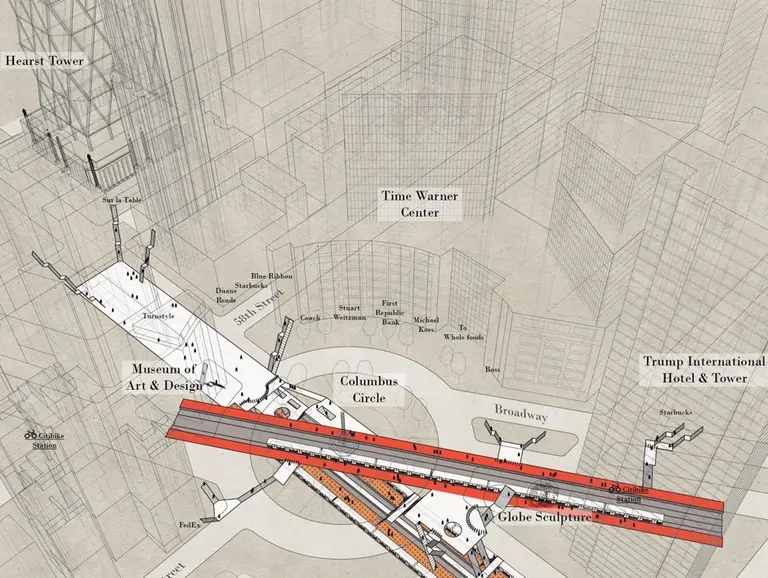
While the official map of the New York City subway clearly labels which station comes next, it’s not very good at showing the actual geographic distance between stations or what the paths and tunnels look like in order to take the right exit. Like many New Yorkers, architect Candy Chan developed a love-hate relationship with the subway. As CityLab shares, after feeling constantly lost when trying to navigate the city underground, Chan created Project NYC Subway, which includes photographs, architectural drawings, and a series of three-dimensional sketches that display what the complex stations really look like.
See the x-ray-esque drawings
August 7, 2017

De Blasio wants to tax rich New Yorkers to fund subway repairs

Continuing this summer’s subway saga, Mayor de Blasio announced a plan on Sunday that would tax the wealthiest 1 percent of New Yorkers to fund the system’s much-need repairs and renovations. The proposal, which requires Albany’s approval, would also provide half-price MetroCards for low-income straphangers. As the New York Times reported, the “millionaires tax” would increase the tax rate of the city’s wealthiest residents to 4.4 percent from roughly 3.9 percent for married couples with incomes over $1 million and for individuals who make more than $500,000 annually.
Find out more
July 28, 2017

Cuomo wants to fund subway fixes with $600K corporate station naming rights

Subway image via WikiCommons On Tuesday the Metropolitan Transportation Authority revealed an $800 million emergency rescue plan for the city’s beleaguered subway system. As 6sqft reported, the MTA board has been scrambling for new ways to pay for the plan amid increasing dissatisfaction with fare hikes, even as the agency says they'll need to raise fares by roughly 4 percent every other year as part of their long-term financial plan. According to Crain's, Gov. Andrew Cuomo spoke Thursday about a possible corporate sponsorship alternative: For $600,000, a donor can publicly “adopt" a station to help pay for amenities and improved cleaning; for $250,000, a “Partnership Council” membership would help raise money for improvements without the donor's name attached to the station.
Who wouldn't want to adopt a subway station?
July 27, 2017

MTA board members seek an end to routine fare hikes, mulls selling subway station naming rights

The Metropolitan Transportation Authority revealed on Tuesday an $800 million emergency rescue plan to fix the city’s failing subway system, which includes hiring 2,700 workers, removing some seats and adding additional train cars. And on Wednesday the MTA board grappled with ways to pay for the plan, with some members calling for the agency to end its routine fare and toll hikes and find revenue through other means. However, according to the New York Times, the authority’s chief financial officer, Robert Foran, said the agency needed to continue to raise fares by roughly 4 percent every other year as part of their long-term financial plan.
Find out more
July 26, 2017

Brooklyn politicians want to decriminalize subway turnstile jumping

According to the Daily News, in 2016, roughly 92 percent of persons arrested for fare evasion were people of color, many of whom were also low-income and ended up spending at least one day in jail. With this in mind, State Senator Jesse Hamilton of Crown Heights and Assemblywoman Tremaine Wright of Bed-Stuy, both Democrats, will introduce legislation to decriminalize turnstile jumping cases. Instead of the offense warranting an arrest, misdemeanor charges, and a $100 fine, they propose the MTA's Adjudication Bureau handle it as a civil matter.
All the details ahead
July 26, 2017

MTA announces $800M emergency rescue plan for a distressed subway system, includes removing seats

After months of what has seemed like rapidly accelerating deterioration, scary incidents, complaints and finger-pointing, the Metropolitan Transportation Authority revealed on Tuesday an $800 million emergency rescue plan for the city’s beleaguered subway system, the New York Times reports. Some key solutions identified for the initial phase of the plan, called "MTA Moving Forward," included taking out seats on some cars–Boston’s transit system has done this in some cases to make room for more commuters. When asked when riders would begin to see the benefits of the plan, MTA chairman Joseph Lhota said that key parts of the plan’s initial phase would be implemented “relatively quickly.”
A hefty tab and a bitter feud
July 24, 2017

De Blasio urges Cuomo to ‘take responsibility’ for MTA

The ongoing public debate over whether the state or city controls the subway continued this weekend when Mayor de Blasio, riding a Manhattan-bound F train on Sunday, demanded Governor Cuomo “take responsibility” over the Metropolitan Transportation Authority. The mayor’s comments come after Cuomo and Joseph Lhota, the recently appointed chairman of the MTA, called on de Blasio and the city last week to contribute more money to the authority for repair work. As the New York Times reported, de Blasio said the MTA has a lot of money that they’re not spending, including the $2.5 billion contributed by the city in 2015, to the MTA's 2015-2019 capital plan.
Find out more
July 21, 2017

Cuomo says New York City is responsible for subway system, not the state

Although New York City’s subway is currently in a state of emergency, no government official seems to want to take ownership of the failing transit system. Governor Cuomo and Joseph Lhota, the recently appointed chairman of the Metropolitan Transit Authority, called on Mayor de Blasio and City Hall to contribute more money for repairing the subway system on Thursday, citing a law that puts the city in charge of the track system. As the New York Times reported, Lhota and the MTA are preparing an emergency plan to deal with the subway, expecting more funds to come from the city. The plan, which Cuomo ordered the MTA to create within 30 days, is set to be completed by the end of next week.
Find out more
July 19, 2017

MTA considers ban on subway dining; snacking might be ok

After an upper Manhattan track fire this week reminded them that trash catches fire, the Metropolitan Transit Authority is considering limiting the all-too-familiar practice of stuffing one's face with hot, messy food while riding the subway. The New York Times reports that MTA chairman Joseph J. Lhota said Tuesday that he'd like to curb inappropriate eating as a way to eliminate fires caused by the ensuing litter.
Have another french fry. For now.
July 14, 2017

The Urban Lens: Tour the grimy and crime-ridden subway of 1981

6sqft’s ongoing series The Urban Lens invites photographers to share work exploring a theme or a place within New York City. In this installment, we share a set of vintage photos documenting the NYC subway in 1981. Are you a photographer who’d like to see your work featured on The Urban Lens? Get in touch with us at [email protected]. Grim, gritty, grimy--these are just a few of the adjectives one could use to describe New York City in the 1980s. Homicide rates were at near-record highs, the crack epidemic had exploded, the police force had dwindled after the recession, and government mismanagement left the city on the brink of bankruptcy. At the time, a 22-year-old photographer from Florida named Christopher Morris was interning at the photo agency Black Star. According to TIME, he saw the graffiti-covered subway, dark, dank, and dangerous, as a battleground that "proved an opportunity to work on something of a domestic front line." Now an award-winning photojournalist, Morris recently rediscovered this set of shots that he took over six months in 1981, during which time he devoted himself to this unique, seedy underworld.
See his photo series ahead
July 10, 2017

Here’s what will change as the ‘summer of hell’ for commuters begins

Eight weeks of infrastructure repairs at Penn Station officially began Monday, affecting commuters using the Long Island Rail Road, Amtrak and New Jersey Transit. Amtrak will close some of the station’s 21 tracks for renovations, which will force the MTA to cancel or divert 15-weekday trains between 6 a.m. and 10 a.m. Overall, there will be a 20 percent reduction in the number of trains to Manhattan from NJ and Long Island. To minimize the impact on riders, the MTA has offered discounted fares and transit alternatives like ferry and bus service (h/t NY Times).
Find out how your commute will be affected
July 6, 2017

VIDEOS: Watch footage from the Third Avenue El train’s last days in 1955

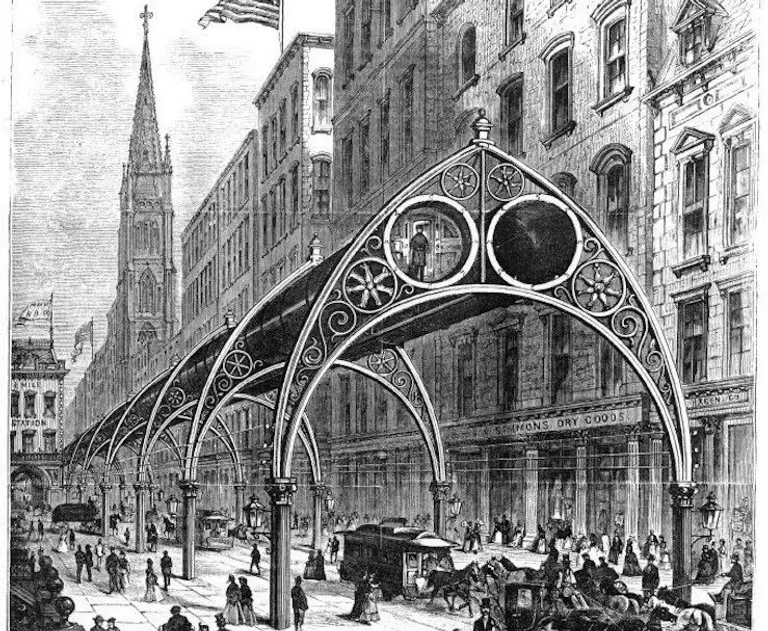
As a solution to Manhattan's rapid population growth and street congestion in the late 1800s, railroad companies decided to better serve their passengers by elevating the trains above ground. Originally, four elevated lines ran the length of Manhattan, but after complaints about the trains blocking light and emitting extremely loud noise, they suffered from a decrease in ridership. The elevated trains that ran along Second, Sixth and Ninth Avenues were all demolished between 1939 and 1942. The one line that stood its ground for a bit longer was the Third Avenue El, which was constructed between 1875 and 1878 and ran from South Ferry to Chatham Square before closing for good in 1955.
See the final days of the El train
June 29, 2017

Cuomo declares a ‘state of emergency’ for the NYC subway, gives MTA $1B for repairs

During a press conference Thursday, Governor Cuomo declared a state of emergency for the Metropolitan Transportation Authority and announced that he would sign an executive order to expedite the process of fixing the system. The governor’s announcement comes just two days after a subway train derailed at 125th Street, injuring over 30 people. His plan includes committing an additional $1 billion in the MTA’s capital plan and reviewing the system’s decades-old equipment.
Find out more
June 28, 2017

Overcrowding and ‘dwell time’ are why NYC’s subway system is failing

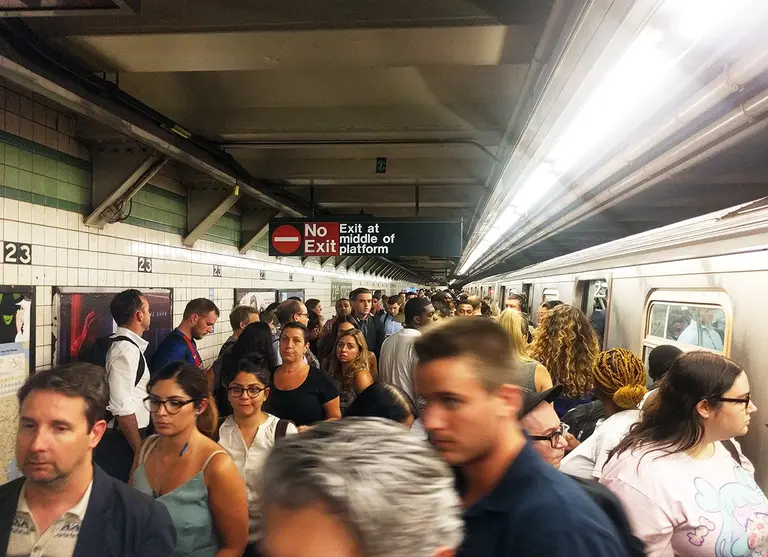
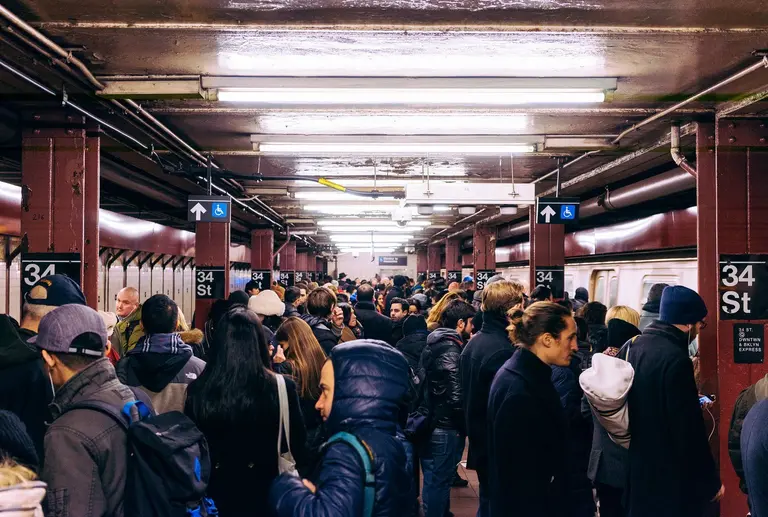
It seems every day brings New Yorkers new subway drama, train delays and disappointment. While this week's A-train derailment, which injured dozens of people, is being blamed on human error, not a track defect, the system is still over 100-years old. And despite its signals and tracks in need of a definite upgrade, the biggest cause of subway delays is overcrowding. According to the New York Times, overcrowding now accounts for more than one-third of the nearly 75,000 subway delays across the system each month.
Learn more here
June 28, 2017

17-stop outer borough light rail proposed as a NYC subway alternative

While pols and officials twiddle their thumbs and shift blame for the subway system's current state of chaos, the Regional Planning Association (RPA) and Rockefeller Foundation are actively looking for long-term solutions to help ease the city's transportation woes. As first shared by DNA Info, earlier this year the two organizations put out a design competition asking participants to develop proposals that could transform various areas of the New York metropolitan region. Four ideas were awarded $45,000 by the RPA and Rockefeller, one of which included a transportation alternative that would exclusively serve the Bronx, Queens, and Brooklyn.
more details here
June 27, 2017

In the 20th century, the subway system used professional sniffers to keep New Yorkers safe

Image © 6sqft The city's subways of today have machines that can test air samples and look for potentially dangerous gas build-up or biological and chemical agents. However, before such technology was invented, the city hired James “Smelly” Kelly to walk the tracks using just his nose and a few homemade inventions, to find and report any leaks or hazardous smells. As Atlas Obscura discovered, Kelly and his team would walk underground for allegedly ten miles of track each day, and by the end of his career, it is said Kelly walked over 100,000 miles of track.
Find out more