NYC extends pied-à-terre tax deadline again amid lawsuit

Credit: Rebecca Hankins on Unsplash
New York City has once again extended the deadline for homeowners notified they may be subject to the new pied-à-terre surcharge, giving them nearly three additional weeks to apply for an exemption. A Tuesday court filing shows that the Department of Finance (DOF) has moved the deadline from September 18 to October 6, after previously pushing it back four weeks from its original August 21 deadline earlier this month. The extension comes as legal proceedings continue over a lawsuit filed by a coalition of property owners challenging the rollout of the surcharge. After a Staten Island Supreme Court judge granted a temporary restraining order to pause the surcharge, the city appealed the decision, which stayed the order while a higher court reviews the matter.
Approved in May, the tax applies to individuals who own second homes valued at over $5 million if they are one- to three-family homes, and over $1 million if they are condos or co-ops.
The surcharge fulfills one of Mamdani’s key campaign pledges to raise taxes on wealthy New Yorkers. Gov. Kathy Hochul, who previously opposed the tax, reversed course as the city grappled with a multibillion-dollar budget gap, later saying the surcharge could generate at least $500 million in annual revenue for the city, as 6sqft previously reported.
However, as the city began sending notices to homeowners who may be subject to the tax last month, some New Yorkers who said they should not qualify found themselves receiving notices anyway.
There were also several instances of individuals with only one primary NYC residence being notified that they may be subject to the tax, including both regular New Yorkers and elected officials.
Karen Young, a NYC resident since 1972, told New York Times that she received a letter warning that she may be subject to the surcharge, while Council Member Gale Brewer, who has lived full-time in her Upper West Side townhouse since 1994, said she found her name on the list.
This confusion was amplified by the DOF’s release of its twice-yearly publication of the names and addresses linked to nearly one million taxable properties, in accordance with the new law.
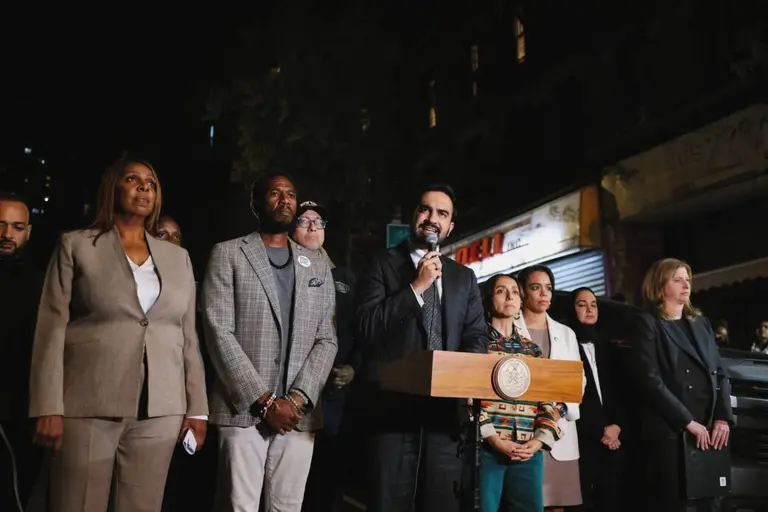
In a press conference, Mamdani clarified that the release of the city’s property tax roll fulfilled a state law requirement and covered most non-rental residential properties in the city, not just those likely to be subject to the surcharge.
He added that those properties make up only a small portion of those included in the lists. The vast majority fall below the threshold for the surcharge, while the surcharge only applies to properties that are not the owner’s primary residence.
Days later, the DOF changed its website, adding “The vast majority of properties and units listed in the roll will NOT be subject to the surcharge.”
Amid the confusion, the administration extended the exemption deadline by four weeks on August 1, giving eligible property owners until September 18 to submit their applications.
Property owners now have until October 6 to submit the necessary documents. According to The Real Deal, nearly 11,000 exemption applications have been started, with roughly 2,900 granted so far.
The second extension comes as oral arguments in a lawsuit brought against the city by a group of homeowners who allege that a “chaotic” rollout of the measure caused widespread confusion are set to begin Monday, August 31.
The plaintiffs, homeowners Rachel O’Brien, Carmine Morano, and Simon Hedley, are represented by Randy Mastro, a former deputy mayor under Eric Adams. They argue that the city violated state law by sending 17,000 letters to homeowners notifying them that they may be subject to the surcharge.
Additionally, they argue that the initial list of more than 900,000 addresses published by the DOF as potentially subject to the surcharge unnecessarily forced NYC residents to prove that they are not liable for the tax.
On August 10, a State Supreme Court judge on Staten Island granted the plaintiffs a temporary restraining order, briefly pausing the tax rollout. City officials quickly filed an appeal, which stays the judge’s order pending review by a higher court.
According to the court filing, the city argues that none of the homeowner plaintiffs, including Kenneth Fishel of Legacy Real Estate, are subject to the surcharge and therefore suffered no harm from being included on the list.
The filings also reveal the latest figures on how many homeowners may be subject to the surcharge, with some questioning whether the measure will be able to generate the $500 million in annual revenue it was originally projected to deliver.
DOF initially identified approximately 26,000 properties that met the tax’s value thresholds. Before sending notices, the agency used property tax exemptions, co-op and condo abatement records, and available state income tax information to determine that more than 8,000 of those properties appeared to be primary residences, according to amNY.
Additionally, on August 12, months before the agency would regularly receive it, the state provided DOF with preliminary 2025 income tax information. After comparing the data with the properties that received notices, the agency revised its initial determination for 630 property owners whose tax returns established the property as their permanent home.
Roughly 580 more properties were exempted based on a combination of their 2025 tax extension information and 2024 tax returns.
As of August 24, the city estimates that roughly 13,000 properties may be subject to the surcharge. However, thousands of exemption submissions are still being reviewed, and the additional time gives even more homeowners a chance to prove their exemption.
During a Wednesday press conference, Mamdani said his administration remains confident that the surcharge will generate the projected $500 million in annual revenue. He also explained how the city is now categorizing properties as it continues reviewing its initial list.
Two of the categories involve properties for which DOF does not have enough information to determine whether they are the owner’s primary residence, he said.
One includes properties owned by a corporate entity, such as an LLC or trust, which accounts for roughly 6,400 households. The third includes properties for which DOF does not have a 2025 tax return indicating whether the property is a primary residence, accounting for roughly 4,400 households.
“We continue to be confident in that assessment of what the annual revenue will look like,” Mamdani said. “By my last count, I think we sent out less than 20,000 you-may-be-subject-to letters. At the time we sent those out, we did not have access to the 2025 income tax filings.”
Randy Mastro told the Times that the city’s filing is “an admission” that the rollout “was a massive screw-up,” arguing that the city had to “do a do-over” and “tell thousands of NYC homeowners who should never have received threatening notices in the first place that the city now recognizes that they live in their own homes.”
He added that the city should have used 2025 tax data as the basis for the first round of notices rather than 2024 data. He also argued that, because some individuals will not file their 2025 taxes until the final deadline of October 15, the city should have extended the exemption deadline to October 16 rather than October 6.
RELATED: