NYC begins notifying pied-à-terre owners about new tax

Photo by Brett Wharton on Unsplash
New York City has begun alerting pied-à-terre owners about a potential surcharge, marking the first step toward implementing the city’s new tax on non-primary luxury homes. Mayor Zohran Mamdani and Department of Finance (DOF) Commissioner Richard Lee last week announced that the city has started notifying property owners by mail that they may be subject to the new tax. The annual tax, approved in May, applies to one- to three-family homes valued at $5 million or more and condominiums and co-ops valued at $1 million and above, whose owners maintain a separate primary residence. The rollout has come under heavy criticism, with some homeowners claiming they received notices despite not qualifying for the new tax.
“When I came into office, I made clear that our City would need long-term solutions to our city’s long-term fiscal challenges,” Mamdani said. “On Tax Day earlier this year, I promised that we would tax the rich, and with our new pied-à-terre tax, that is exactly what we have done.”
“Today is the first step in implementing this tax and collecting critical revenue to fund our parks, schools and libraries. We will diligently implement this law and ensure that we collect what working New Yorkers—and this city—deserve.”
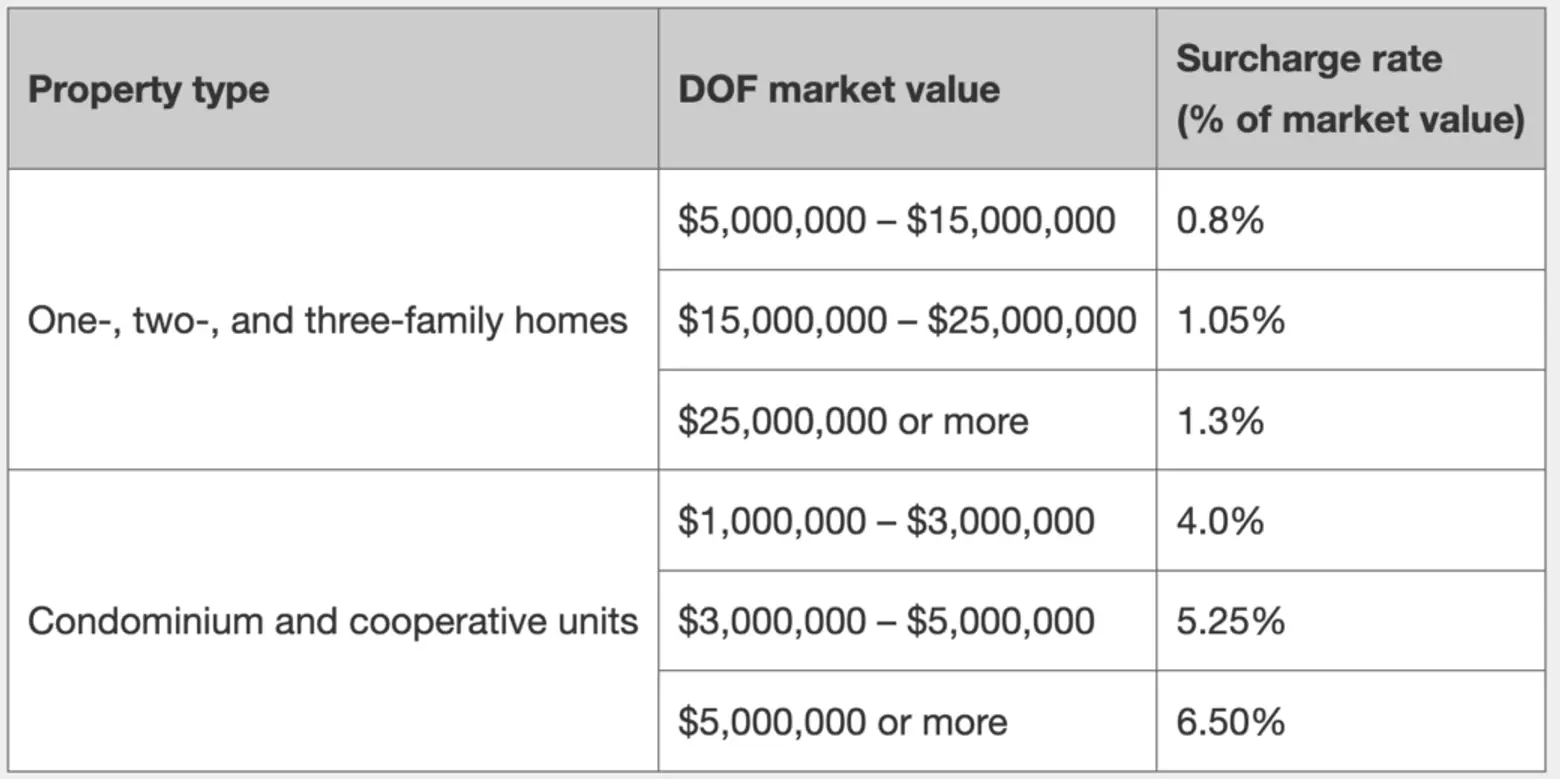
For property tax years 2026-2027 and 2027-2028, the surcharge will apply as follows:
First proposed by Gov. Kathy Hochul in April, the tax fulfills one of Mamdani’s key campaign pledges to raise taxes on wealthy New Yorkers. The governor said the surcharge could generate at least $500 million in annual city revenue. The reversal came as the city grappled with a multibillion-dollar budget gap.
An April report from city Comptroller Mark Levine found that the tax could generate up to $500 million annually, but several factors could reduce the final revenue. The comptroller’s analysis identified several factors, including exemptions for rented units and “behavioral responses” to the tax, that could reduce annual revenue to between $340 million and $380 million.
With notices now going out to owners, along with a new dedicated city website detailing guidelines and exemptions, the tax is moving forward.
The DOF site features frequently asked questions, an eligibility tool, detailed guidance, and instructions for submitting documentation.
According to Bloomberg, the city will notify pied-à-terre owners in a letter what they owe by August 30. The appeal period for owners to contest the tax will be just 30 days.
The Mamdani administration has also funded 13 new positions within DOF to administer the program and assist property owners, along with 11 additional positions at the Office of Administrative Tax Appeals to handle administration of the surcharge.
Additionally, DOF has prepared extensive resources to help property owners navigate the surcharge and appeals process. Customer service representatives and 311 operators have been trained to answer questions, while a secure online account allows owners to protect sensitive information, upload documentation, and track their submissions.
The department has also created a dedicated team to review inquiries and supporting documents, along with specially trained staff to handle complex or unique cases. Internal review procedures have also been established to ensure determinations are made consistently.
“The Mamdani administration and DOF are committed to implementing the new non-primary residence property surcharge fairly and efficiently,” Lee said. “As implementation continues, we will ensure the process is carried out transparently and with careful consideration at every step.”
However, despite the city’s preparation of resources ahead of the rollout, some homeowners have criticized the notifications. Several long-time New Yorkers who live at only one address have reported receiving notices that they may be subject to the surcharge.
In accordance with the new law, the city’s Department of Finance published the names and addresses linked with nearly one million properties. The publication of taxable properties happens twice a year.
Jody Kriss, founder of real estate investment firm and developer Kriss Capital, and Carol Ott, owner of Habitat Magazine, told The Real Deal that they and people they know had received notices. Ott said she has lived in her home since 1997.
Similarly, Karen Young, a primary NYC resident since 1972, told the New York Times that she received a letter warning that she may be subject to the surcharge. Young said her five-story Upper West Side home is the only residence she has lived in since 1997.
Even city officials have been caught up in the rollout. Council Member Gale Brewer said she found her name on the list despite living full-time in her Upper West Side townhouse since 1994. She told The Times that she “can’t figure out why” she was listed.
The lists cover most non-rental residential properties in the city, not just those likely to be subject to the tax. In fact, the majority fall below the threshold required for owners to be eligible for the surcharge, with roughly 24,000 properties valued below $5 million, according to an analysis by the Times. Additionally, the surcharge would only apply to properties that are not the owner’s primary residence.
Confusion surrounding the lists has left property owners uncertain about whether they will need to pay the tax. At a Wednesday press conference, Mamdani said that only property owners who have received notices are subject to the surcharge. He clarified that those owners represent only a small portion of the properties included on the lists.
“The tax property role that was posted last week is a reflection of all properties across NYC, not a reflection of those specifically that the pied-à-terre tax will be levied upon,” he added.
During Wednesday’s press conference, Mamdani was asked whether the DOF could have conducted “more due diligence” and used a “stronger filter” before sending out the letters.
DOF Commissioner Richard Lee said the agency used “existing information” to identify potentially affected homeowners, adding that in some cases, it may not have had updated information for individual property owners.
Moving forward, both Mamdani and Lee recommended that property owners who are unsure about the surcharge visit the city’s website or call 311. More information about the pied-à-terre tax, including eligibility requirements, documentation instructions and how to file an appeal, can be found here.
Editor’s Note 7/31/26: This story has been updated with information about criticism from residents who say they received notices about the potential surcharge despite being ineligible for the tax.
RELATED: