NYC announces one-year ban on generative AI for public school students through 8th grade
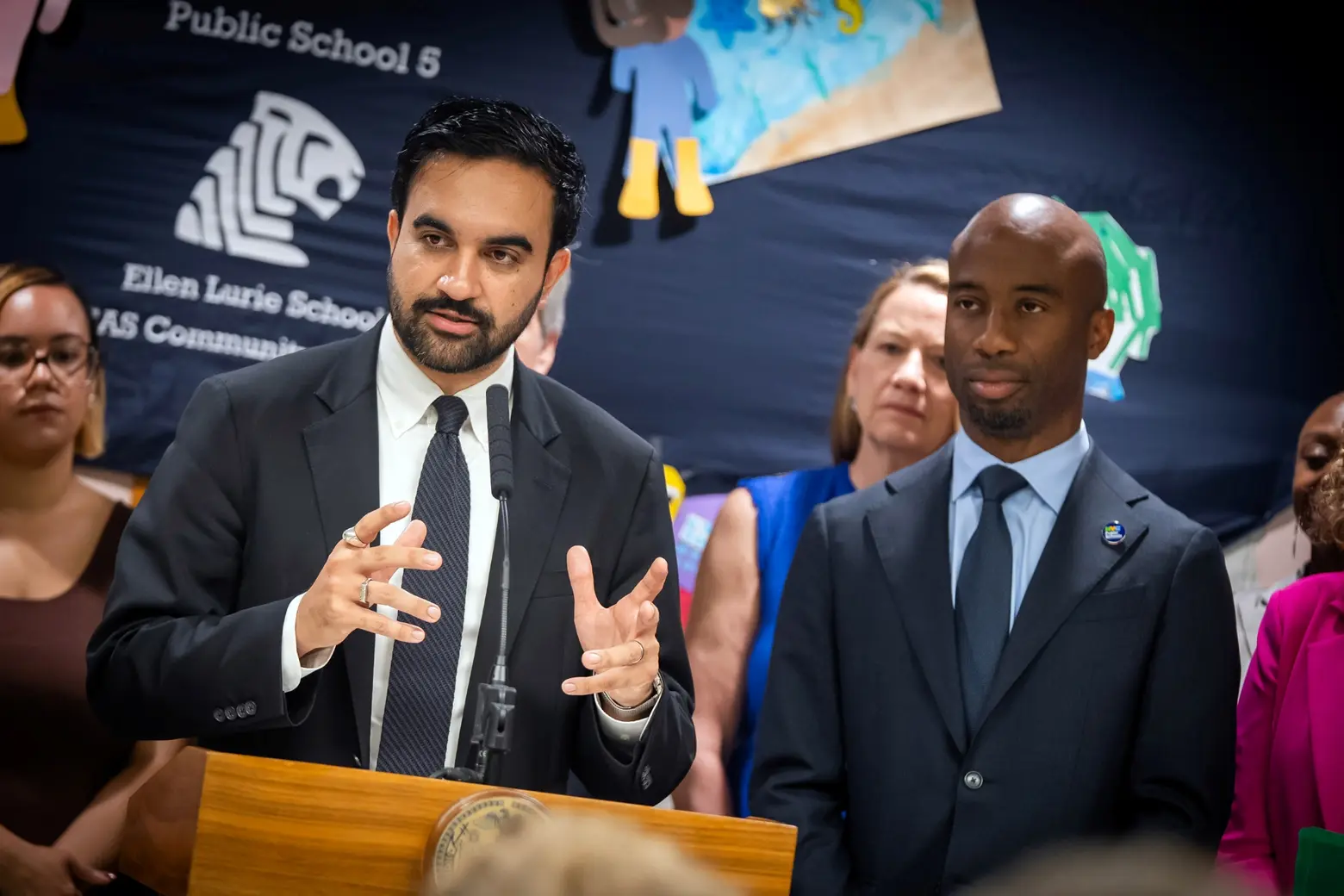
Credit: Ed Reed/Mayoral Photography Office on Flickr
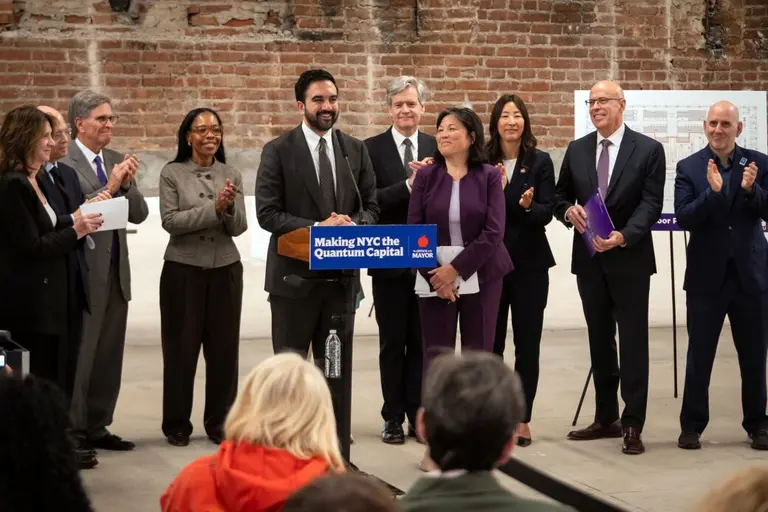
Roughly 600,000 New York City public school students will not be allowed to use generative artificial intelligence in the classroom for at least one year, under new guidelines announced by Mayor Zohran Mamdani on Wednesday. The mayor and NYC Schools Chancellor Kamar Samuels announced a ban on student-facing generative AI use for students in preschool through eighth grade, the largest school system in the country to do so, as well as new screen-time limits for students in second grade and younger. As first reported by the New York Daily News, high school students will have restricted access to AI but will receive twice-yearly AI “critical thinking” modules focused on the risks of relying on the technology.
“Children need teachers and human connection in order to learn and grow. They need to develop skills alongside their peers, build relationships with educators and wrestle with tough problems on their own,” Mamdani said.
“The tech industry wants us to believe that A.I.-powered early education is not only inevitable, but necessary. We do not see it that way.”
The action marks the most significant student-facing AI moratorium in the country, covering roughly two-thirds of the school system’s total enrollment. Under the moratorium, which covers the 2026-2027 school year, software that allows students to use generative AI, including companion chatbots, will be banned for the next year as city officials assess the technology’s impacts.
For up to 50,000 high school students in general education classes, or about 5 percent of the public-school student body, five limited AI pilots will be introduced.
Each pilot will be offered in a maximum of five classes per high school, with all sessions taking place under the direct supervision of a trained educator and using “carefully vetted” AI tools.
The programs were selected based on comprehensive safety and data privacy standards, an emphasis on teacher-guided instruction, and a commitment to keeping students as the primary thinkers in the classroom.
English language arts classrooms will use Quill to support close reading, text analysis, and the use of evidence to support claims. Students will be able to use Quill for no more than 15 minutes per week.
Math classrooms will use Edia for step-by-step coaching and prompt students to explain their reasoning. It will be available to students for no more than 20 minutes per week.
Brisk Teaching will be accessed through “teacher-created” activities, providing guided practice using teacher-selected texts or videos, with objectives and guardrails set by the teacher. Students will use Brisk Boost for 10 to 20 minutes once or twice per week.
Students across several subjects will use Playlab to help them engage with assignment-specific applications and examine AI outputs for bias and reasoning. No more than two assignments per marking period will use Playlab.
Intel AI-Ready Schools will be used across multiple subjects to help students identify community problems and develop AI solutions through semester-long projects. Students will use the tool for one period per week.
Teachers can use AI for instructional planning and operational tasks, but not for grading or counseling.
Exceptions to the policy will be granted for assistive technology used by students with disabilities, multilingual learners, and students participating in career-readiness programs, such as computer science.
Students in second grade and below will have their one-to-one screen time restricted. Students in third through fifth grade will have recommended caps of 30 minutes per day, while those in sixth through eighth grade will have recommended caps of 45 minutes per day.
Moving forward, all technology used in city public schools will undergo a thorough review and be banned if its functionality is deemed not beneficial to learning. The review will include assessments of vendor accountability, safety and transparency standards, ethics, evidence of learning design and instructional impact, prior research, and ongoing user feedback.
During the 2026-27 school year, the city will form a new Technology in Schools Coalition comprising students, educators, parent leaders, elected officials, advocates, union partners, and experts to assess the impact of the moratorium and pilots. The group will then publish a report with recommendations for future school years.
“As Chancellor and as a parent, I believe our job is to protect what makes learning work, while ensuring every child has the critical thinking skills they need before graduating,” Chancellor Kamar Samuels said. “We’re putting guardrails in place to protect the human connection, curiosity, and creativity that help children grow.”
“We’re standing firmly in our belief that innovation does not mean more technology, and over the next year, we will lead with evidence to make sure technology serves learning—not the other way around,” he added.
The new policy comes just over a week before the school year begins. Though initially slated for release in June, education officials delayed the new AI guidance following pushback from parents and advocates, as well as a bipartisan group of City Council members, according to Politico.
The draft guidance used a “traffic light” framework, giving AI technology a “green light” for tasks like lesson planning but a “red light” for grading.
Samuels said the school system “missed the mark” with the initial draft guidance and pledged to take a stronger approach to AI use among younger children. He also asked principals to wait on purchasing educational software until the Department of Education revised the guidance.
RELATED: