Affordable Housing

July 6, 2015

VIDEO: Airbnb Is Just a Charity for Struggling Real Estate Moguls, Says New Ad

The city's fight against Airbnb continues to rage on, and this latest video created by ShareBetter jabs at the home-sharing company's gross neglect when it comes to preserving much-needed affordable housing. Satirically dubbed "Save the Moguls," the 60-second spot likens the multi-billion dollar powerhouse to a charity trying to being relief to the anguish that real estate bigwigs face when it comes to sustaining their extravagant lifestyles. "What would you do if you saw a real estate mogul right in front of you, all alone, clearly suffering?" the video posits. "They need your help to keep the sharing economy alive. By renting out just one of the hundreds of apartments and homes they've listed on Airbnb, you can join the fight against affordable housing."
Watch the video here
June 30, 2015

Rent Guidelines Board Approves Freezes on One-Year Leases for First Time in History

In a historic decision made last night, the Rent Guidelines Board voted 7-2 last night to freeze rents for the first time on one-year leases for New York City’s more than one million rent-stabilized apartments. The board, entirely appointed by Mayor Bill de Blasio, also moved to increase rents on two-year leases by just two percent, the lowest in the board's 46-year existence. The decision follows last week's lackluster vote at the state level to only extend but not strengthen rent regulations. "Cuomo betrayed us, the RGB can save us," tenants chanted at the meeting.
Find out more here
June 29, 2015

‘Poor Doors’ No Longer Allowed with New Rent-Regulation Bill

Thanks to a provision added to the newly extended and altered 421-a tax abatement passed last week, developers looking to segregate their wealthy tenants from their affordable rate renters will have to think again. According to The Post, Mayor de Blasio inserted a reform into the tax program plan that would ban the practice in which developers build a separate entrance for folks occupying the cheaper, below market-rate apartments in their buildings—better known as "poor doors."
More on the move here
June 25, 2015

2,000 NYCHA Apartments Are Vacant Despite 270,000-Name Waiting List

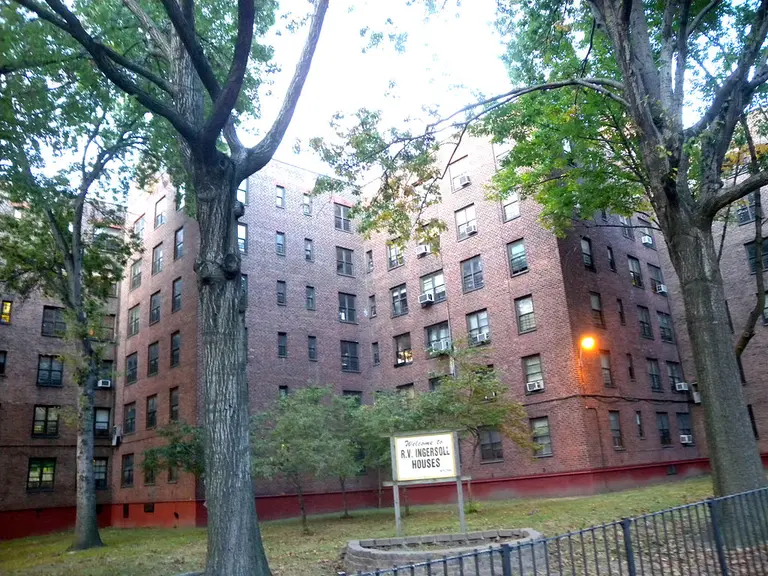
Photo via Wiki Commons For many New Yorkers, public housing is the only affordable way to live in the city, but despite an ever-growing waiting list, thousands of these homes are sitting empty, according to a report in the Wall Street Journal about an audit of NYCHA by Comptroller Scott Stringer. At a release of the findings yesterday at the Raymond V. Ingersoll Houses in Brooklyn, Stringer said: "Even though 270,000 New Yorkers are on the waiting list for housing, desperate to put a roof above their heads, we found that NYCHA is sitting on over 2,000 apartments they identify as vacant." The audit shows that 1,366 apartments are empty awaiting repairs, and 967 are between tenants.
More audit findings ahead
June 8, 2015

Harlem Rents Jump 90 Percent over the Past 12 Years, Bed-Stuy Not Much Better at 63 Percent

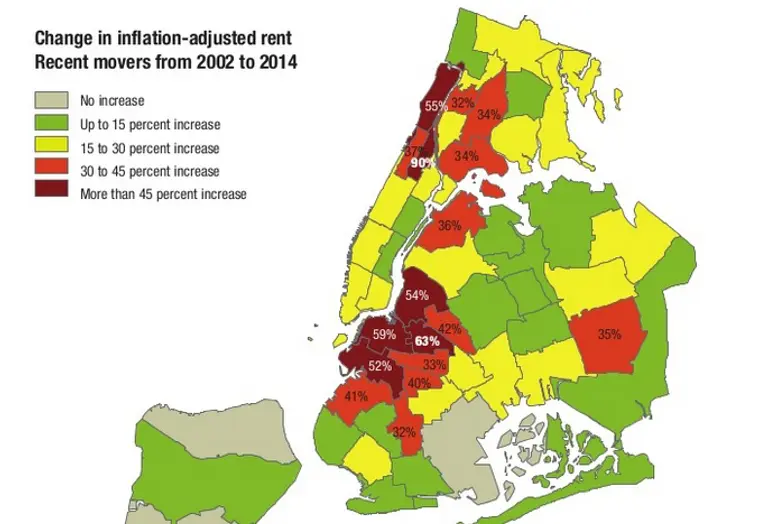
Take everything you think you know about "affordable" alternatives to pricey neighborhoods and throw it out the window. This map from the Community Service Society (first shared by the Daily News) analyzes newly released census data that compares median rents between 2002 and 2014. The data is drawn from a New York City Department of Housing Preservation and Urban Development survey of 18,000 New Yorkers every three years who had recently moved, which "eliminates the tendency of lower rents paid by long-time tenants to smooth out market changes and mask the changes that affect tenants who are looking for a place to live," according to CSS. The report shows that rents citywide have increased 32 percent over the past 12 years, not a new or surprising figure. But it also shows drastic increases in neighborhoods that have been traditionally thought of as more affordable. Central Harlem saw the biggest jump at 90 percent; the average rent in 2002 for new residents was $821 and now it's skyrocketed to $1,560. Other no-longer-affordable neighborhoods are Bed-Stuy at a 63 percent increase and Washington Heights/Inwood at 55 percent. The other 'hoods topping the list include less surprising areas like Brooklyn Heights/DUMBO/Fort Greene at 59 percent and Williamsburg/Greenpoint at 53 percent.
More findings from the report
May 19, 2015

Mayor’s Plan to Revamp the City’s Public Housing Addresses Disrepair and Need for Revenue

Mayor de Blasio is expected to announce today the rollout of a ten-year plan to improve the city's debt-and-disrepair-riddled public housing. According to the New York Times, plan items include–perhaps most notably–the leasing of land within a number of housing complexes to developers; other items include the transference of some New York City Housing Authority (NYCHA) employees (and the $90 million a year it costs the agency to pay them) to other city agencies and increased rents as well as higher parking fees for residents.
Find out how the mayor plans to shore up the city's public housing
May 14, 2015

City Council Announces New Task Force on Tracking and Preserving Affordable Housing

City councilman Mark Levine announced Wednesday the creation of the Affordable Housing Preservation Taskforce, which will track existing affordable units across the city on the brink of becoming market rate. The task force is the latest in an effort to address the monumental task of preserving the city's affordable housing. According to Crain's NY, the 14-member task force, which will be led by Council Speaker Melissa Mark-Viverito, will work with residents, landlords and nonprofits to identify buildings headed toward market rate rent status. Rent regulation, for example, stipulates that rent can only be raised by a certain percentage each year as set by the New York City Rent Guidelines Board.
More on the new task force
May 7, 2015

To Increase Affordability, Mayor de Blasio Wants to End 421-a for Condos and Up the Mansion Tax

From the onset, Mayor de Blasio has been extremely vocal about his plan to add 200,000 units of affordable housing over 10 years, 80,000 of which will be new construction. Though many feel this is an arbitrary number, backed up by no data as to where the units will be, the Mayor seems committed to reforming current policies to reach his goal. And after months of speculation, he has revealed his planned changes to the city's 421-a tax incentive program, which is set to expire in June. According to the Times, under his proposal, the controversial tax would no longer apply to condo projects (to understand the logic behind this decision just look at the $100 million sale at One57 that received the tax abatement). But it would apply to new rental projects, which would have to have apartments for poor and working-class residents make up 20 to 30 percent of the building in order to qualify for city tax breaks. It would also extend the abatement from 25 years to 35 years. Another part of the overhaul is to eliminate so-called poor doors. De Blasio also wants to up the city's mansion tax. Currently, home sales over $1 million are subject to a 1 percent tax, but de Blasio proposes adding an additional 1 percent tax for sales over $1.75 million, as well as a third 1.5 percent tax for sales over $5 million. He estimates this will bring in an extra $200 million a year in tax revenue, money that would be allocated to affordable housing programs.
More details ahead
April 30, 2015

A Record $11.9B Has Gone into Building New Condos, but Few Apartments Actually Produced

The NYC luxury real estate market is as hot as ever and developers are scrambling to get in on the action. The Daily News reports that a record breaking $11.9 billion was poured into new developments last year, a 73 percent jump over the last 12 months, and up $5 billion over the previous record (source: New York Building Congress). While this rise may seem like great news in a city facing a serious housing crisis, the bounty going towards new construction isn't doing much to remedy it. The paper adds that though spending is way up, the bulk of the cash is being funneled "into delivering only a few massive high-end pads with luxe finishes targeted at the global elite."
Find out more here
April 21, 2015

The Rise of Single People Hurts Affordable Housing

NYC's affordable housing crisis makes headlines daily, but while most are quick to point to the exploitation and mismanagement of existing apartments as the root of the cause (which to a great degree it most certainly is), the Washington Posts asks us to consider the effect single folks have on a city's housing inventory. Today, more and more folks are living longer and marrying later (if at all), and living alone at any given age no longer carries the stigma it once did decades ago. 26 percent of modern American households consist of just one person now, compared to the 1940s when this number topped out at just seven percent. While this dynamic shift seems more like a cause for celebration (yay, we're evolving and defying convention) it does have some serious implications when it comes to available housing. "Our housing stock wasn't built for a society full of singles," says reporter Emily Badger.
more on the issue here
April 21, 2015

Extell’s ‘Poor Door’ Building Receives a Staggering 88,000 Applicants

Poor doors be damned. It looks like the anger and public outcry swirling around Extell's new 50 Riverside Boulevard condo didn't do much to deter New Yorkers from vying for a low-income unit at the building. The Times reports that the development company received a whopping 88,000 applications for the building's 55 affordable apartments after they opened up the lines back in February. The overwhelming demand is most certainly a win for developer Gary Barnett, who found himself in the hot seat for creating a separate entrance for low-income tenants, away from the market-rate residents. When speaking to the paper, Barnett called the whole poor door ordeal a “made-up controversy” adding to that “I guess people like it. It shows that there’s a tremendous demand for high-quality affordable housing in beautiful neighborhoods."
So do poor doors really matter?
April 20, 2015

Going Green and Curbing Gentrification: How the Bronx Is Doing It Differently

“Ladies and gentlemen, the Bronx is burning." The infamous phrase, uttered in a 1977 broadcast of a Bronx fire, has stuck in the mind of many New Yorkers even today. Indeed, the Bronx saw a sharp decline in population and quality of life in the late 1960s and 1970s, which culminated in a wave of arson. By the early 1980s, the South Bronx was considered one of the most blighted neighborhoods in the country, with a 60 percent decline in population and 40 percent decline of housing units. Although revitalization picked up by the '90s, the Bronx never quite took off like its outer-borough counterparts Brooklyn and Queens. While media hype, quickly rising prices and a rush of development has come to characterize those two boroughs, the Bronx has flourished more quietly. The borough, nevertheless, has become home to growth and development distinct from the rest of New York City. Innovative affordable housing, adaptive reuse projects, green development and strong community involvement are redefining the area. As Bronx Borough President Ruben Diaz Jr. said during this Municipal Arts Society discussion in 2014, this is "The New Bronx."
Keep Reading About What's Going on in the Bronx
April 16, 2015

New Clinton Hill Building with $1,064 Two-Bedroom Apartments Now Taking Applications

Clinton Hill rents may be skyrocketing, but there are a handful of units coming up sure to bring some peace of mind to those worried that the neighborhood is turning into another haven for the rich. DNA Info reports that a brand new building coming up at 490 Myrtle Avenue at Hall Street that will boast a terrace, veggie garden, reflecting pools with cabanas and $1,064 two-bedroom apartments. The building is sited along one of the more rapidly gentrifying areas of the neighborhood, just a block away from the Pratt Institute along a stretch of Myrtle Avenue that is about to see a serious boom in new developments and green space.
Find out more here and if you qualify for one of the units
March 30, 2015

Airbnb Continues to Thrive Even as New York City Wages Battle

The city and the hotel industry have been waging war against Airbnb since last September in an effort to both preserve affordable housing and to protect hotel operators throughout the city. Though millions of dollars have been spent by both parties campaigning for change, apart from a couple of rulings ousting affordable renters for putting their apartments on the home-sharing site, not much has changed. Airbnb has failed to sway lawmakers, and the group leading the anti-Airbnb movement, ShareBetter, has only kept Airbnb from changing a state law that prohibits tenants in buildings with three or more units from renting out their home for short stays. In fact, according to Crain's, Airbnb is thriving in NYC with now more than 27,000 rooms and apartments on its site.
Find out more here
March 26, 2015

Mayor’s Affordable Housing Plan Flawed, More Likely to Harm Brooklyn’s Most Expensive Nabes

The revitalization of East New York is at the center of Mayor Bill de Blasio's affordable housing plan, but like his ambitious Sunnyside Yards project, his ideas for the fallen areas of Brooklyn are apparently also filled with holes. According to a piece published by the Wall Street Journal yesterday, de Blasio's plan to re-zone 15 neighborhoods to allow for taller and denser housing won't do much good for affordable housing. The main reason? The rents are too low. In fact, housing experts believe that his plan is more likely to hurt the character of Brooklyn's most tony areas, including Park Slope, Fort Greene, and Crown Heights, amongst many others.
More on their findings here
March 24, 2015

Rent Stabilization Demystified: Know the Rules, Your Rights, and if You’re Getting Cheated

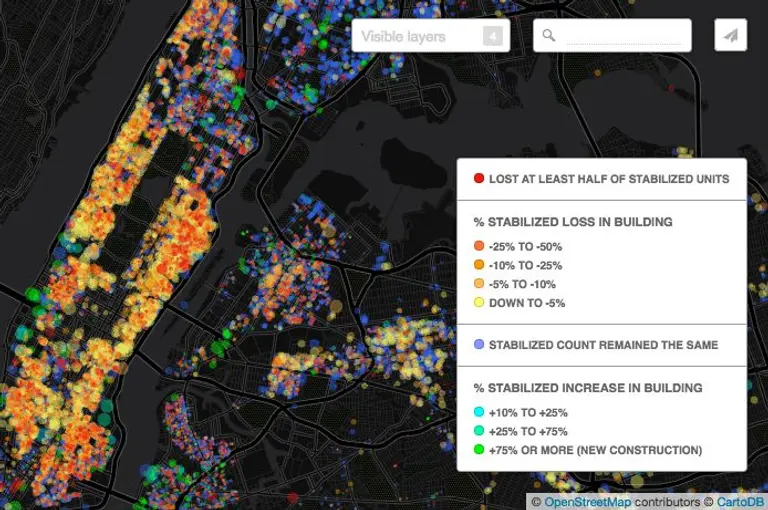
In New York City there are currently about one million rent stabilized apartments–about 47 percent of the city’s rental units. So why is it so hard to snag one? What are the benefits of having one (other than affordable rent, of course)? According to the New York City Rent Guidelines Board nearly 250,000 rental units have lost the protections of rent regulation since 1994. Why are we "losing" so many of them?
Find out the facts and how they could affect you
March 16, 2015

New Maps Show How Much You Need to Work in Order to Own a Home in NYC and Other Major Metros

Have you been thinking about buying a home in NYC? Well if you're single, get ready for a life of mortgage-gouging hardship. A new study conducted by the Martin Prosperity Institute takes a look at how much Americans spend on housing, where in the United States we're spending the most, and how many years we'll need to put in if we want to own a home in a big city.
maps and results here
March 16, 2015

5,484 Affordable Housing Units Could Be Lost if 421-a Abatement Isn’t Renewed, Says New Report

This morning the Real Estate Board of New York (REBNY) released a report today saying if the city fails to renew the existing 421-a partial tax exemption program, we could stand to lose thousands of affordable units. REBNY took a look at a sample of projects in the pipeline—including Essex Crossing, 5Pointz, Domino and Pacific Park, amongst others—and found that 421-a is responsible for 5,484 affordable apartments and 13,801 market-rate units in these developments. They argue that without the abatement the theses units would be in jeopardy and be "immediately be sent back to the drawing board." They add that some of the units could even end up as high-end luxury condominiums and some of the middle- and low-income housing now in the works would be lost forever.
Find out more
March 11, 2015

City Proposes New Zoning Plan to Increase Affordability, Current Height Limits to Be Lifted

On the surface it sounds like a great idea: Adjust zoning regulations to better accommodate the Mayor's goal of preserving and creating 200,000 units of affordable housing. But some are angered that the proposal would lift current zoning protections and height limits by as much as 20 to 30 percent. According to the Department of City Planning, the newly released plan, called Housing New York: Zoning for Quality and Affordability, addresses the city's outdated zoning regulations that don't reflect today's housing needs or construction practices. However, an email from the Greenwich Village Society for Historic Preservation asserts: "The proposal would change the rules for ‘contextual’ zoning districts throughout the city–zoning districts which communities frequently fought hard to secure, to limit the height of new development and keep it in character with the surrounding neighborhood."
More information ahead
March 6, 2015

REVEALED: Massive Mixed-Use Development at Red Hook’s Revere Sugar Factory Site

The housing-design experts at Magnusson Architecture and Planning (MAP) have hashed out a feasibility study to redevelop the Revere Sugar Factory site in Red Hook with a 1.7 million-square-foot development to include more than 900 apartments, 250,000 square feet of retail, and 400,000 square feet of parking. The six-acre site at 280 Richards Street is owned by the Joesph Sitt-led, Thor Equities, who purchased the parcel back in 2005 to the tune of $40 million, according to the New York Observer. The vacant parcel juts out 700 feet into the Erie Basin, and sits between the Ikea parking lot and the Red Hook Stores building home to Fairway Supermarket (and Michelle Williams, of course). Though MAP's rendering date back to 2007, they have yet to be publicized, and we have the first look here.
More information on the project here
March 4, 2015

New Website Will Help New Yorkers Find Out if Their Apartment Is Rent Stabilized

Let's face it, we all feel that we're paying too much for our tiny NYC apartments, and while for most of us that's just the name of the game, for others who are living in a rent-stabilized unit but being charged market-rate rent, it's actually true. Want to know if you fall into that boat? A new website called amirentstabilized.com will help you find out. The site allows renters to search their building to see if it's on the city's list of addresses with rent stabilized units. Unfortunately, it can't tell you if your specific apartment is one of them, but it's a great first step and provides resources for confirming your unit's status, as well as filing a complaint if you're being overcharged.
Find out more here
March 3, 2015

New Ruling: Landlords Can’t Kick a Bankrupt Tenant Out of Their Rent-Controlled Apartment

Going broke will no longer mean losing out on your rent-controlled apartment in NYC. According to Bloomberg, city tenants who file for bankruptcy will now be able to keep the keys to their affordable apartments as public assistance. The decision is taken from two opinions formed by the New York State Court of Appeals and the Manhattan-based U.S. Court of Appeals for the Second Circuit. Previously bankrupt tenants faced a threat of eviction even when they were current on rent.
Find out more here
March 2, 2015

Where Will Mayor de Blasio Land on the 421-a Tax Abatement Debate?

Developers have been rushing to break ground on projects before June, when the controversial 421-a tax abatement is set to expire, as it provides incentives to developers for up to 25 years when they reserve at least 20 percent of a building’s units for low- and moderate-income tenants. However, those against the 40-year-old program criticize it for using working people's tax dollars to build swimming pools and pet hotels for the world's billionaires; after all, the construction of One57, where a penthouse recently sold for $100 million, was built using subsidies from the program. But on what side of the debate does Mayor de Blasio, whose goal is to implement "the largest affordable housing program that any city, any state has attempted in a ten-year time span in the history of the republic," fall? Though many of his supporters oppose 421-a, in order to reach his goal of building 80,000 new affordable housing units–especially in places like East New York where a rezoning would be necessary to allow for denser construction that mandates the inclusion of permanently affordable apartments–de Blasio says he needs the program, according to Capital New York.
More on the 421-a debate here
February 27, 2015

City Council Proposes New Law That Would Allow Tenants to Sue Landlords for Using Airbnb

One week ago we learned of the landmark ruling to evict a rent-stabilized tenant from his ultra-luxe 450 West 42nd Street building for listing the unit on Airbnb for nearly triple what he was paying, a show of just how serious the city is about the issue. Now they're getting even more aggressive, as two City Council members want to pass a new law that would let tenants sue their landlords for renting out neighboring apartments as illegal hotels through Airbnb.
More details ahead
February 20, 2015

Rent-Stabilized Tenant Gets Evicted for Listing His Apartment on Airbnb in a Landmark Decision

If you were questioning how truly serious the city is about its beef against Airbnb, look no further than this landmark ruling to evict a rent-stabilized tenant from his ultra-luxe 450 West 42nd Street building. The Post reports that Henry Ikezi was just given the boot by a Manhattan Housing Court judge for posting his 46th-floor Hell's Kitchen apartment on the site for $649 per night, about triple what he was paying at $6,670 per month. The home's market value is upwards of $9,000.
More on the landmark case here