Search Results for: when were nav apartments built

February 17, 2017

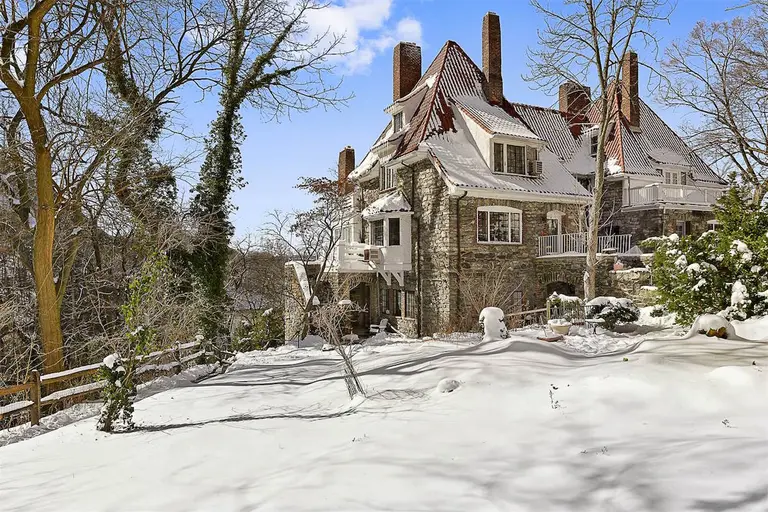
1924 cliffside Riverdale castle-cottage has magical river views, a Broadway pedigree and a $2.6M ask

In case you need another reason to love New York City, this singular gem of a seven-unit apartment building perched on a wild cliff overlooking the Palisades where the Harlem River meets the mighty Hudson just hit the market. Built in 1924 as a co-operative by a super-literary lawyer/developer who also happened to be the first editor-in-chief of the Harvard Law Review, the Villa Rosa Bonheur at 2395 Palisade Avenue in Riverdale, the Bronx, is one of three; her sister buildings go by Villa Charlotte Brontë and Villa Victoria. Their creator, John J. McKelvey, was looking beyond the bottom line when he built what would be the first apartment buildings in the Bronx. Ms. Rosa is now on the market for a mere $2.595 million. There's more: Her current owners are the family of the late "Beatlemania" creator Robert Rabinowitz.
Get a closer look
December 12, 2016

Historic 1865 Chelsea firehouse was Andy Warhol’s 1949 refuge, now renting for $33K

The Chelsea Firehouse at 323 West 21st Street would be an historic icon based on its origins alone, beginning in the late 19th century as an actual firehouse, built to accommodate a shiny new horse-drawn steam pumper engine (h/t Daytonian in Manhattan). The mid-Victorian era structure not only survived the ensuing decades, but in 1999, Architectural Digest featured the duplex shown here, by then one of three luxury apartments, calling it "indisputably one of a kind." In the years between, the building was home to free-spirited performers and artists, including Andy Warhol and Philip Pearlstein who sought refuge here from seedy lodgings in the East Village. The designer-renovated, uniquely-configured 4,000 square-foot duplex in this storied building is now on the rental market for $33,000.
Find out more about this iconic home
October 26, 2016

My 630sqft: Inside ‘Store Front’ photographers Karla & James Murray’s East Village home of 22 years

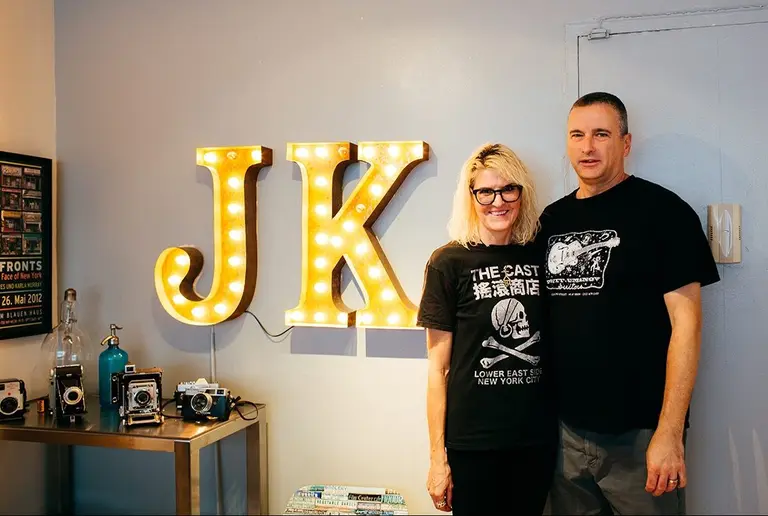
You might not immediately recognize their names, but there is no doubt you know their work. Photographers James and Karla Murray burst onto the scene back in 2008 with the release of their seminal book "Store Front: The Disappearing Face of New York," a work culling hundreds of images of the bygone retail graphics that once covered the city—and jointly, the mom and pop businesses that vanished alongside them. Since then, the Murrays have released two more tomes of the same vein, and collected countless awards and accolades for their documentary work along the way. In fact, their photographs can now be found in the permanent collections of major institutions around the world, including the Smithsonian Center for Folklife and Cultural Heritage and the New York Public Library. Their images also decorate the homes of countless celebrities, among them Sarah Jessica Parker, Ralph Lauren, Alicia Keys and Roseanne Barr. In this week's My sqft, 6sqft visits this warm and spunky husband-and-wife team in their East Village home to talk about their tenure in the city (they moved downtown in the 80s—though Karla is from the Bronx) and their ongoing efforts to chronicle what remains of "old New York." We also get a peek inside their studio apartment/workspace of 22 years, which as Karla and James share ahead, has some crazy stories of its own.
go inside their home here
September 21, 2016

The Bronx’s Lambert Houses may be replaced with 1,665 affordable housing units

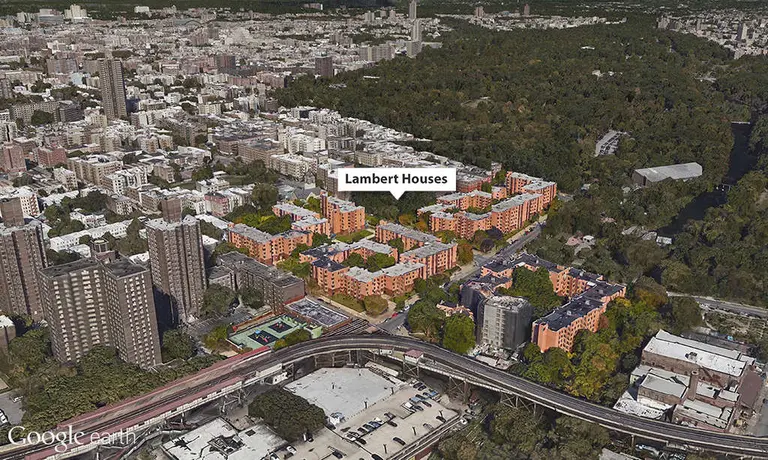
When it comes to the Mayor's affordable housing push, the Bronx is a force to be reckoned with. Not only were more than 43 percent of these units constructed in the first half of the year in the borough, but the City Council recently approved the La Central development, which will bring nearly 1,000 affordable units to Melrose under de Blasio’s mandatory inclusionary housing legislation. Though not part of MIH, another new project may one-up this, ushering in a whopping 1,665 affordable apartments on the site of the Bronx Zoo-bordering Lambert Houses. As CityRealty.com explains, "If proposals are approved, the new mega-development will feature more than double the affordable housing units and triple the existing retail space, create a new public school, and better integrate the community into the surrounding neighborhood."
Find out more
August 29, 2016

Like father like son: The Trump legacy of housing discrimination

Black potential tenants who just wanted a decent place to live were routinely turned away at the Trump family’s Queens housing complexes and others. Housing activists and equal housing organizations took note, and in 1973 Trump Management was sued by the Justice Department for discrimination. Some of those tenants who stood firm remember the indignities all too well. The New York Times took a look at the early days of the Trump empire, when Donald's father, Fred C. Trump, built and managed middle-income residential complexes like the Wilshire Apartments in Jamaica Estates, Queens. A former employee of the elder Trump tells the Times that when receiving applications from potential tenants who happened to be black he was told, "Take the application and put it in a drawer and leave it there."
Get a closer look at the Trump legacy
June 7, 2016

Brooklyn Design Firm Creates Dramatic Living Spaces Inside a Williamsburg Loft

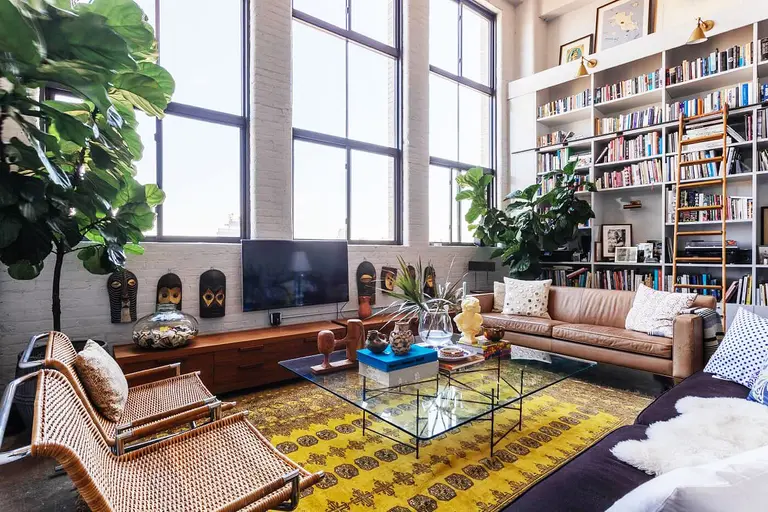
Loft apartments have naturally good bones for dramatic living spaces, with those big windows and high ceilings, but the renovation of this 1,300-square-foot Williamsburg pad truly resulted in some breathtaking spaces. The work is by Greenpoint-based design and architecture firm Space Exploration and general contractor Tristan Warner Studios Inc. According to Brownstoner, Space Exploration was initially hired to create a wall-length book shelf for the living room, where the ceiling surpasses 18 feet. The success of the bookshelf -- which was built by a high-end millwork firm in Brooklyn -- inspired the owner to “go forward with the full monte,” said founder of Space Exploration Kevin Greenberg. His full reno enlarged the lofty mezzanine space, while decked out the interior with truly unique custom design touches.
Take a look
May 16, 2016

Not Tall Enough! On the World’s Stage, New York’s Supertalls Are Ungraceful Runts

Carter Uncut brings New York City’s latest development news under the critical eye of resident architecture critic Carter B. Horsley. Ahead, Carter brings us his ninth and final installment of “Skyline Wars,” a series that examines the explosive and unprecedented supertall phenomenon that is transforming the city’s silhouette. In this post Carter takes at aim the quality of design of those towers rising around the city right now, and how they fail to inspire when compared to those found internationally. The explosive transformation of the New York City skyline now underway is occurring without any plan in a very haphazard fashion. Some of the new towers are not ugly but compared to many new ones elsewhere, especially those that are free-standing, they’re not going to win many top honors. Many are very thin, mid-block incursions. Others arrogantly abut and loom over landmarks with nary a thought to context. Some clearly are aimed at one-percenters and offer lavish amenities and layouts. But many others are squeezing potential residents like sardines into very small apartments in attempts to set new “density” records.
The towers that got it wrong, and right
May 4, 2016

East River Skyway Proposal Gains Steam, Would Only Cost Riders $25/Month

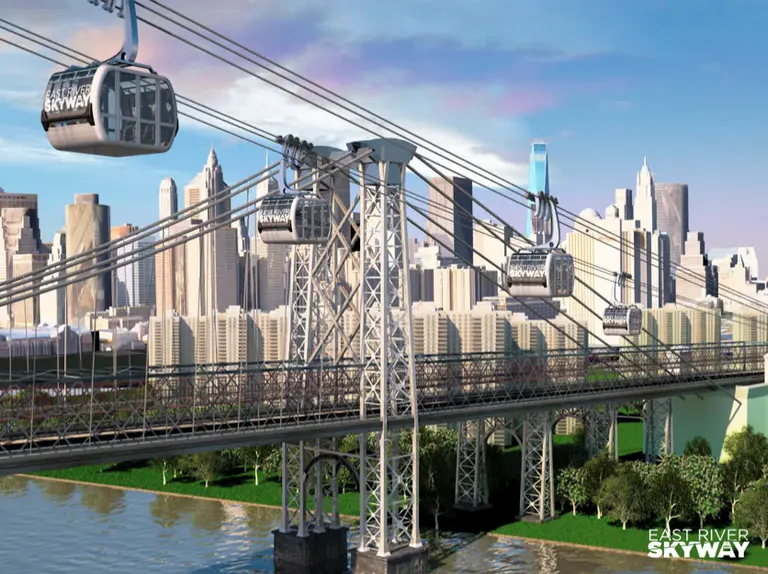
With public meetings about the impending L train shutdown beginning this week, much of the conversation is centered around alternate ways to shuttle people between downtown Manhattan and Brooklyn. One solution is the East River Skyway, an aerial gondola system that would run along the Brooklyn waterfront and into Manhattan, bringing commuters over the river in just 3.5 minutes. The proposal from Dan Levy, president and CEO of CityRealty*, first surfaced in 2014, then referencing the Brooklyn development boom that will bring tens of thousands of new residential units to the borough in the coming years. But now with a possible years-long shutdown of the L, along with skyrocketing subway ridership, the Skyway is drumming up support from investors, DNA Info reports. Levy told 6sqft, "We've completed some preliminary engineering and design work around the cars and the stations and how they could meld with their respective locations — and more broadly the city skyline. Given their high visibility we want to be context sensitive." He also revealed that, although the project would cost up to $134 million (per estimate from engineers), an unlimited monthly pass would cost only $25.
READ MORE
May 3, 2016

Skyline Wars: New Jersey’s Waterfront Transforms With a Tall Tower Boom

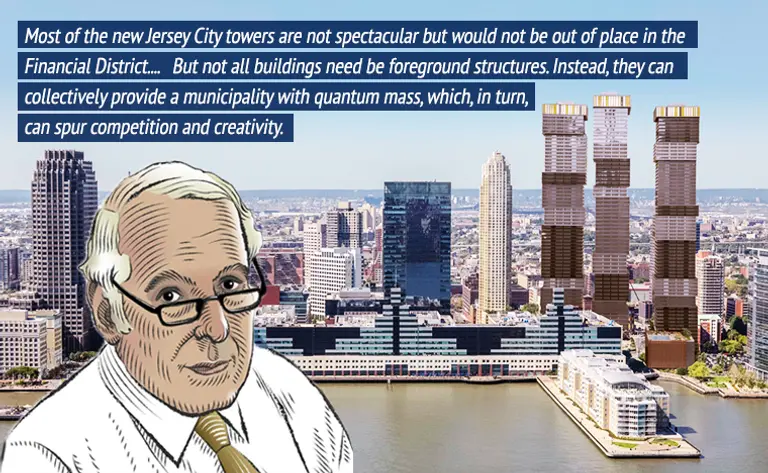
Carter Uncut brings New York City’s latest development news under the critical eye of resident architecture critic Carter B. Horsley. Here, Carter brings us his seventh installment of “Skyline Wars,” a series that examines the explosive and unprecedented supertall phenomenon that is transforming the city’s silhouette. In this post Carter looks at the new New Jersey skyline. The hulking, 781-foot-high Goldman Sachs tower at 30 Hudson Street in Jersey City is like the Rock of Gilbraltar to Lower Manhattan’s famed skyline: massive and impressive. To some, perhaps, it conjures a Monty Python catapult or a very steep cliff on which to mount the Guns of Navarone for an assault on Lower Manhattan. It dominates the Jersey City skyline, which is a bit Spartan, especially in comparison with Brooklyn’s. Most of the skyscrapers in Brooklyn, however, are not directly on the waterfront and the Goldman tower is very much “in your face” on the water. Furthermore, all of a relative sudden, Jersey City is about to explode with three taller towers, which I can only describe as delirious, dancing, shimmy-shimmy-shake buildings with drop-dead vistas of Manhattan and the Hudson.
read more from carter here
April 20, 2016

Skyline Wars: Brooklyn Enters the Supertall Race

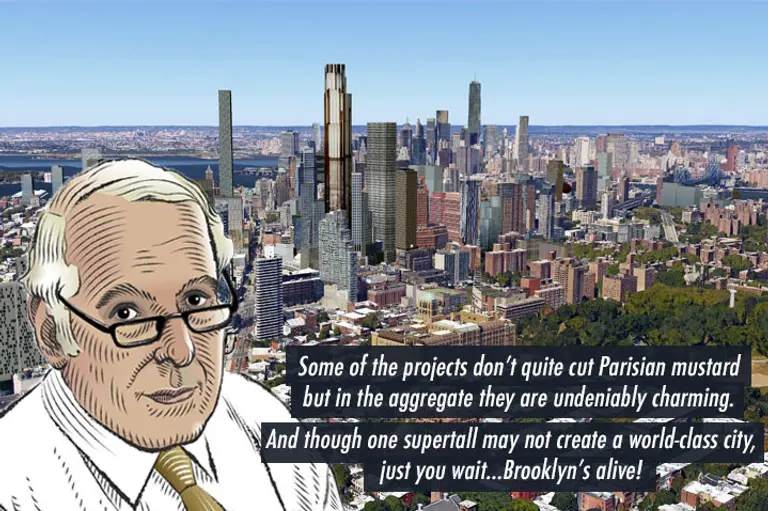
Carter Uncut brings New York City’s latest development news under the critical eye of resident architecture critic Carter B. Horsley. Here, Carter brings us his fifth installment of “Skyline Wars,” a series that examines the explosive and unprecedented supertall phenomenon that is transforming the city’s silhouette. In this post Carter looks at Brooklyn's once demure skyline, soon to be Manhattan's rival. Downtown Brooklyn has had a modest but pleasant skyline highlighted by the 350-foot-high Court & Remsen Building and the 343-foot-high great ornate terraces of 75 Livingston Street, both erected in 1926, and the 462-foot-high flat top of the 1927 Montague Court Building. The borough’s tallest building, however, was the great 514-foot-high dome of the 1929 Williamsburg Savings Bank Tower, now known as One Hanson Place, a bit removed to the east from Downtown Brooklyn. It remained as the borough’s tallest for a very long time, from 1929 until 2009. A flurry of new towers in recent years has significantly enlarged Brooklyn’s skyline. Since 2008, nine new towers higher than 359 feet have sprouted there, in large part as a result of a rezoning by the city in 2007. A few other towers have also given its riverfront an impressive frontage. Whereas in the past the vast majority of towers were clustered about Borough Hall downtown, now there are several clusters with some around the Brooklyn Academy of Music and the former Williamsburg Savings Bank Tower and some around the Williamsburg riverfront.
more on Brooklyn's skyline here
July 14, 2015

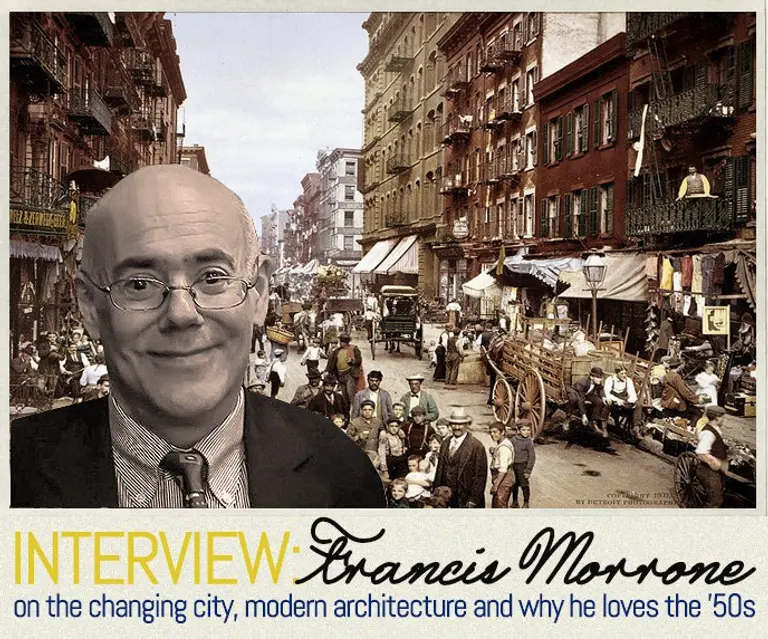
INTERVIEW: Historian Francis Morrone on the Changing City, Modern Architecture and Why He Loves the ’50s

For the man who knows seemingly everything about New York City history, look no further than Francis Morrone. Francis is an architectural historian best known for his writings and walking tours of New York. Of his 11 books, he wrote the actual guidebook to New York City architecture—aptly titled "The Architectural Guidebook to New York City"—as well as the "Guide to New York City Urban Landscapes," "An Architectural Guidebook to Brooklyn," and "10 Architectural Walks In Manhattan." For six and a half years, Francis served as an art and architecture critic for the New York Sun, and he now teaches architectural and urban history at the New York University School of Professional Studies. As for walking tours, Francis was named by Travel + Leisure magazine as one of the 13 best tour guides in the world. You can catch his various tours, which sell out quickly and cover everything from "Midtown Manhattan's Side Streets" to the "Architecture and Changing Lifestyles in Greenwich Village," through the Municipal Art Society. We caught up with Francis recently after he published a much buzzed-about article for the Daily News entitled, "No, New York City Is Not Losing Its Soul," to talk about his life and work in the city, his opinions on modern architecture and development, and his favorite time period of New York City history.
Our conversation with Francis this way
February 10, 2015

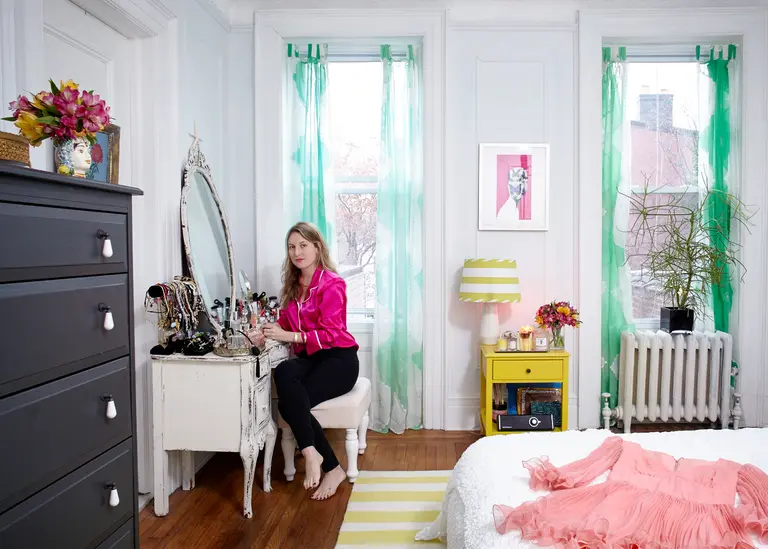
My 3,900sqft: Four Ladies Turn a Clinton Hill Townhouse into a ‘Pop-Up Mansion’

What happens when you let four ladies run loose in a four-story Clinton Hill townhouse? Closets, corners and a pantry spilling over with shoes and coats, apparently. "There are shoes lining the kitchen pantry shelves; the tiny third bedroom upstairs that resembles a Swiss chalet in the twilight zone is filled with racks of vintage frocks, coats and designer handbags. You can really tell almost everyone in this house either works in fashion or hoards it," says owner and 6sqft writer extraordinaire Michelle Cohen.  We recently visited Michelle in her Brooklyn home to see the pretty amazing setup she has created for herself. Michelle, whose house you've certainly seen on our site before, is currently undertaking a major renovation that will turn her and her fiance Stanley's brick-clad buy into a modern-meets-historic home with a rental garden apartment. But while Michelle's poring over drawings with her architect, she's found a few friends to share the journey, and the house; namely three fabulous women with wonderfully different personalities. "Stanley likes to call it a sorority for outstanding ascendant young creative professional women," she muses. Jump ahead to meet Michelle and the girls—who range from a Vogue fashion stylist to a creative producer to a journalist who covers evolution, disease and health policy—in their home to get a closer look.
See more here
November 20, 2014

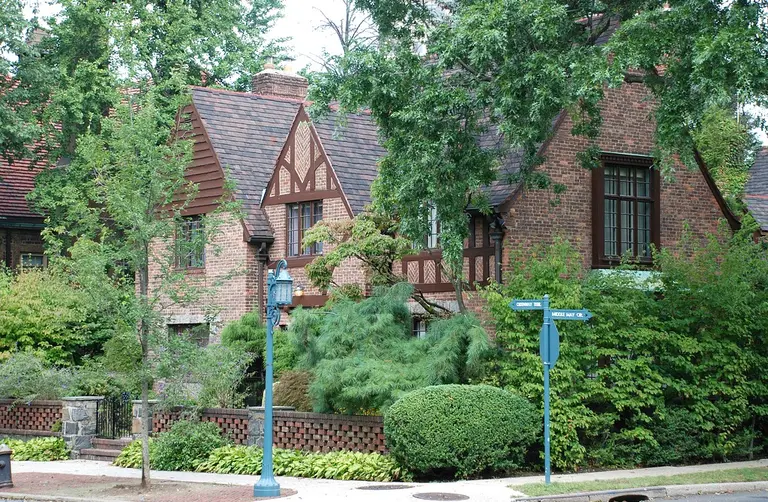
Forest Hills Gardens: A Hidden NYC Haven of Historic Modernity

This unique sheltered enclave might be the perfect spot for residents who can handle the rules; just don't call it FoHiGa. Occupying a 175-acre wedge just south of the Forest Hills LIRR station and within the greater Queens neighborhood of Forest Hills, Forest Hills Gardens is one of America’s oldest planned communities. Modeled after England’s “garden cities,” originally intended to create an ideal environment that incorporated shared green space with urban convenience for the working classes, the Gardens (as it's known) is home to about 4,500 residents. The private community is managed by the Forest Hills Gardens Corporation, an organization made up of property owners. This unique community consisting of over 800 free-standing and attached houses and 11 apartment buildings as well as churches, parks and storefronts, dates from 1909, when architect Grosvenor Atterbury and landscape architect Frederick Law Olmsted Jr.–-son of Frederick Law Olmsted, landscape architect who helped design Central Park–-were commissioned to plan a new town. Though the community lies within the boundaries of one of the world’s most modern and populous cities, it has retained much of its co-operative, idyllic nature.
Find out more about this unique community
October 3, 2014

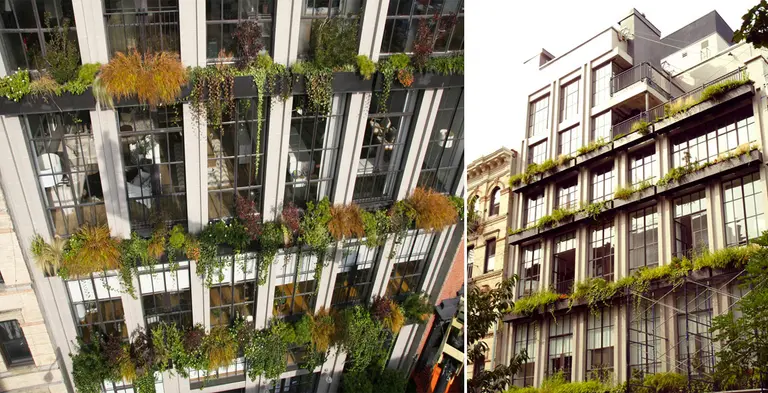
The Flowerbox Building: A Sustainable Gem in a Storied Setting

Built in 2007, The Flowerbox condo building at 259 East Seventh Street, about mid-way between Avenues C and D, is considered by many to be one of the city’s most beautiful new developments–and definitely a neighborhood standout, featuring a vertical garden that waters itself. The building boom that started with the 21st century and has continued apace since the end of the most recent economic downturn has given Downtown Manhattan an impressive collection of starchitect-designed creations, complete with Sky Garages, Boxwood Mazes and plenty of glass curtain walls. But the Flowerbox Building continues to charm with its design, quality and curb appeal.
Find out about the vertical