NYC needs 700,000 new homes: See the unit target for every district
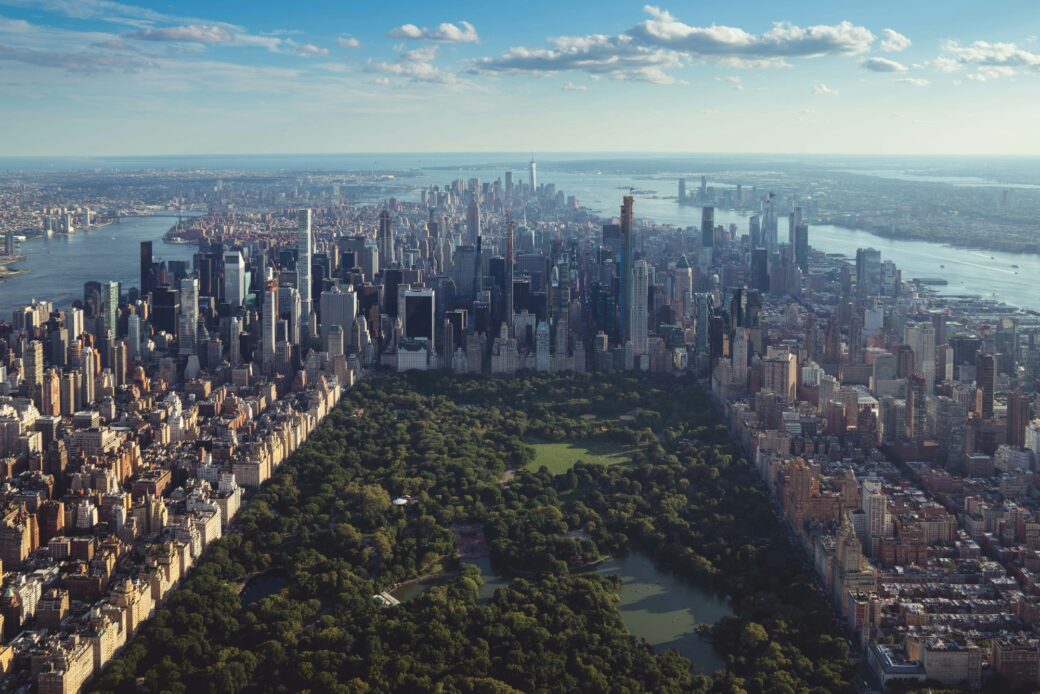
Photo by Joshua Armstrong on Unsplash
New York City must create roughly 700,000 new homes over the next decade to address its housing shortage, according to a draft city report. Released Wednesday, the Fair Housing Growth Strategy report is an analysis of the city’s housing crisis, mandated under a 2023 City Council bill that called for an assessment of the city’s overall need for new housing. The report finds that the city’s current shortage is among the worst in recorded history, with a rental vacancy rate of just 1.4 percent. Among apartments with asking rents below $1,100, fewer than 0.4 percent are available.
The Local Law 167 mandated the city’s Departments of Housing Preservation and Development (HPD) and City Planning (DCP) to produce a long-term housing needs assessment, five-year housing production targets, and a strategic equity framework every five years.
The Fair Housing Growth Strategy seeks to answer two questions: How much housing does NYC need to support a healthier, more affordable housing market, and how should housing be distributed to advance fair housing goals?
According to the report, decades of underproduction have led to one of the most limited housing markets in city history. With only 1.41 percent of apartments available to rent, lower-income households face even greater risks of severe rent burdening, poor housing conditions, overcrowding, displacement, and homelessness.
These figures are reflected in similar reports, such as the Coalition for the Homeless’ annual “State of the Homeless” report, released in June, which found that 194,531 individuals used the city’s shelter system over the course of 2024, the most in its history.
Scarcity amplifies fair housing barriers, according to the report, which include both intentional discrimination and structural practices that disproportionately limit housing opportunities for certain people and populations based on factors such as race.
For example, in a highly competitive housing market, source-of-income discrimination and bias based on family status, race, language, disability, or immigration status can become more prevalent and difficult to challenge. Additionally, structural barriers like restrictive zoning can curtail where, how much, and what types of housing can be built.
In order for the city to address this looming crisis, the long-term housing needs assessment says it needs to create roughly 700,000 additional homes over the next 10 years.
The figure was calculated by combining the city’s current housing shortage of 290,000 homes with 240,000 homes needed to accommodate projected population growth and another 170,000 homes that could be created as the city moves toward a healthier housing market.
The report also notes the Mamdani administration’s commitment to building affordable housing. As part of his “Block by Block” housing plan, the mayor has committed to building 200,000 new affordable homes, including 90,000 deeply affordable units and 28,000 units for formerly homeless households.
Local Law 167 also required the creation of five-year housing production targets (HPT), which translate the 10-year housing goals into five-year targets at the citywide and community district levels and inform strategies to overcome local barriers to fair housing.
By 2030, the city must build 350,000 new homes to meet half of its long-term housing needs, including 85,000 affordable units, 25,500 deeply affordable units and 12,750 units for formerly homeless households. It must also preserve 100,000 existing affordable homes while improving housing quality.
The report also found that most community districts have added relatively little housing over the past several decades, a rate insufficient to meet the city’s long-term needs. To meet these goals, all districts must contribute, according to the report.
Each community district offers “unique opportunities” to create new housing while facing “unique challenges.” Local stakeholders and conditions will help determine the best path toward meeting these goals.
2030 Targets for the Bronx:
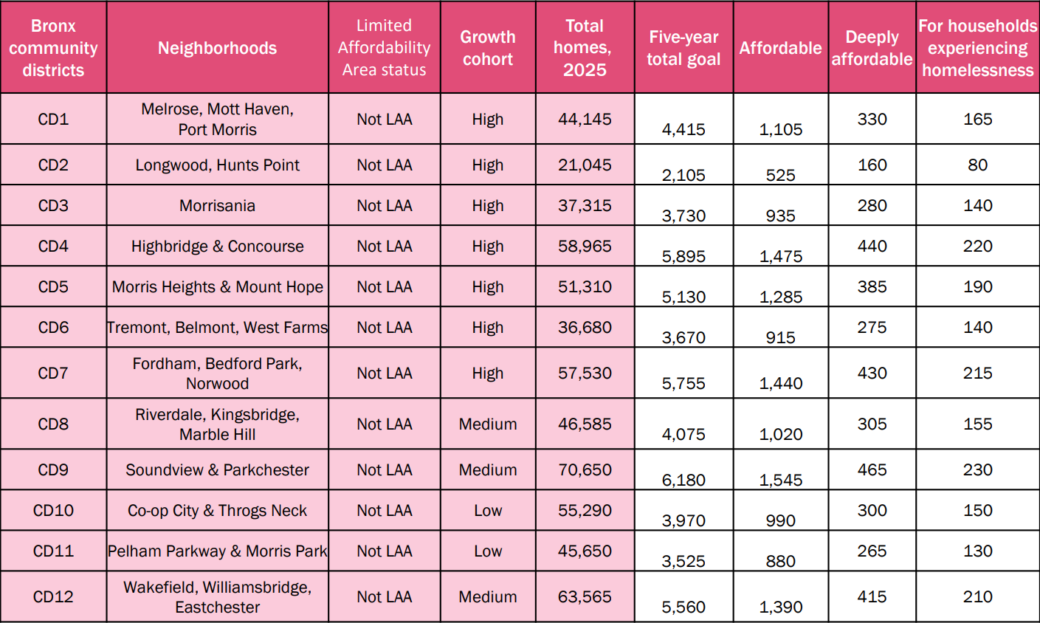
To determine how much housing each district should create, the report first assesses how much growth it has experienced over the past decade relative to the total number of homes in the district.
2030 Targets for Queens:
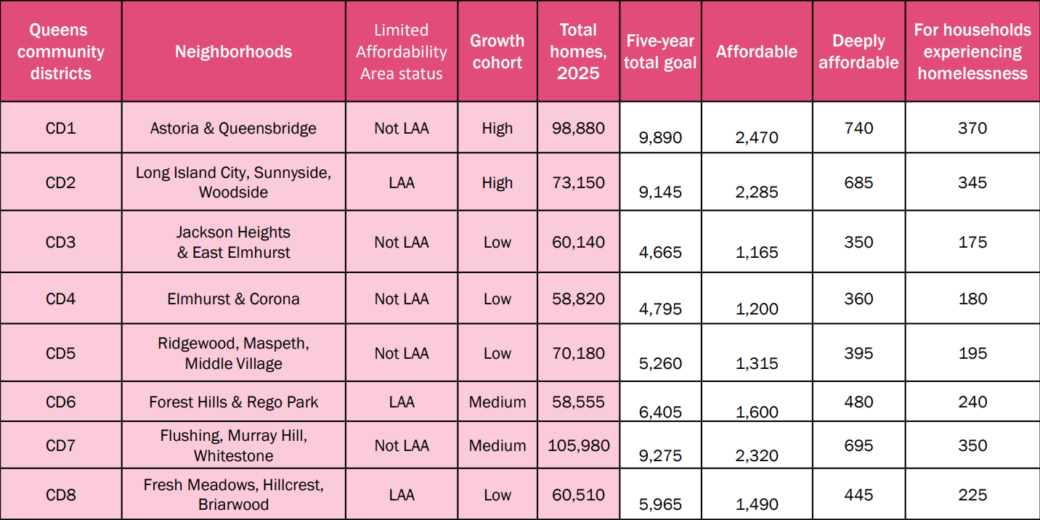
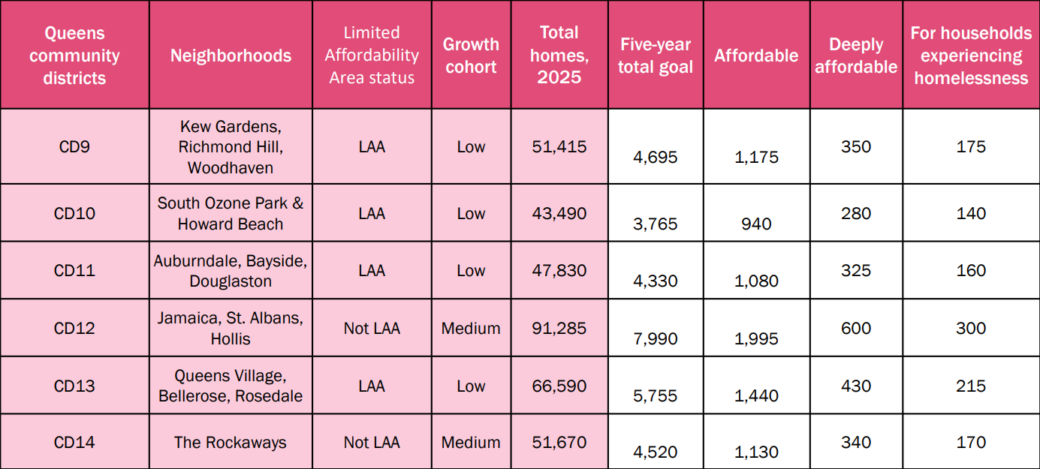
Low-growth districts, with annual growth rates between 0.07 and 0.33 percent, would need to increase their production the most. Their targets are calculated by adding 6.5 percentage points to their recent growth rates.
2030 Targets for Manhattan:
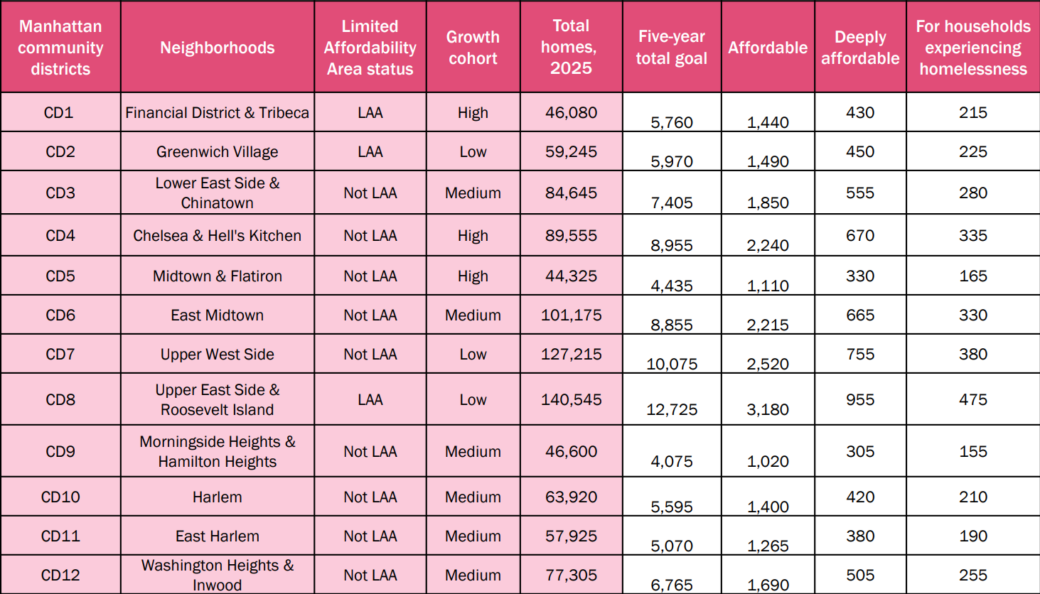
Medium-growth districts, with annual growth rates between 0.34 and 1.07 percent, would have a target growth rate of 8.75 percent. High-growth districts, with annual growth rates between 1.09 and 3.27 percent, would need to sustain their recent growth, with a target growth rate of 10 percent.
2030 Targets for Brooklyn:
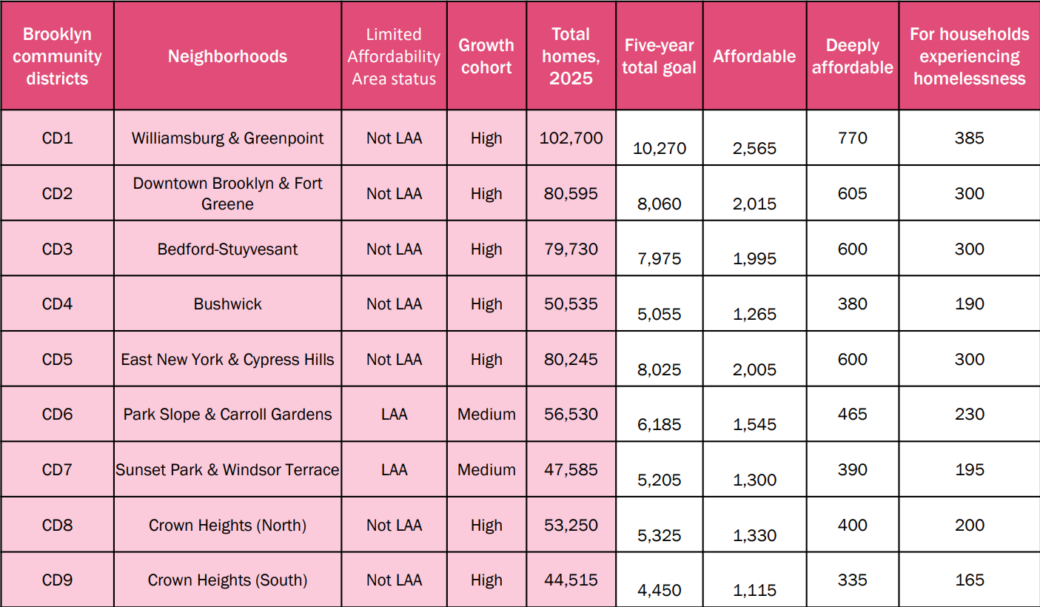
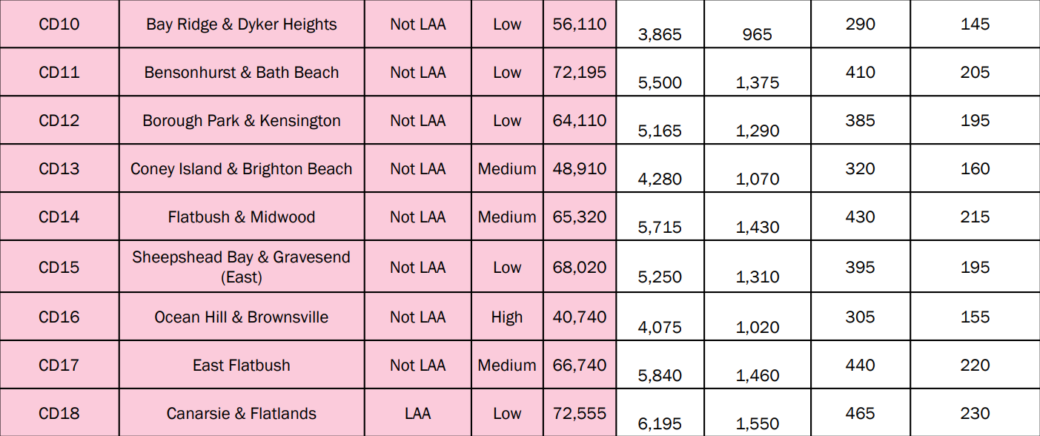
In Manhattan, Community District 8, which includes the Upper East Side and Roosevelt Island, must create 12,725 homes over the next five years, the most of any district in the borough. In the Bronx, Community District 9, which includes Soundview and Parkchester, has the highest target in the borough, with 6,180 homes over the next five years.
In Brooklyn, Community District 1, which includes Williamsburg and Greenpoint, must build 10,270 new homes over the next five years, while Queens’ Community District 1, which includes Astoria and Queensbridge, has a target of 9,890 new homes.
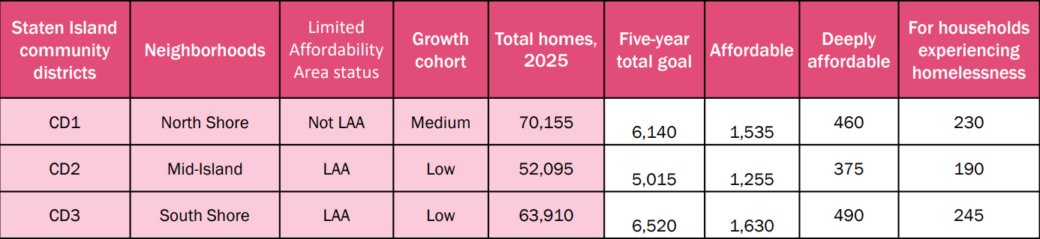
In Staten Island, Community District 3, which includes the South Shore, must create 6,520 homes over the next five years.
“The work undertaken by the City Council to establish a Fair Housing Growth Strategy is essential to identifying where housing development is most needed and addressing the longstanding disparities that have shaped our neighborhoods,” Council Member Farah N. Louis, chair of the subcommittee on zoning and franchises, said.
“This strategy affirms that even in communities like Central Brooklyn, where we have seen consistent housing production, we must do more to ensure that new homes are truly affordable and accessible to the neighbors who call these communities home,” she added.
2030 Targets for Staten Island:
A strategic equity framework (SEF) is another component of the report. It identifies strategies needed to overcome barriers to fair housing, ensure the benefits of growth give New Yorkers access to every neighborhood, and help those who struggle most. It uses a three-pronged approach to assess fair housing in NYC: mobility, stability, and neighborhood equity.
To improve mobility, the report says the city must create high-quality shared housing near job centers with high demand from young professionals and households in transition, as well as expand low- and moderate-cost homeownership opportunities, including co-ops with community land trusts, in areas where homeownership is rare and existing options are unaffordable.
One hundred percent affordable housing must also be financed in low-growth areas with very few existing low-cost homes. To achieve this goal, these areas can be rezoned to require new permanently affordable housing projects.
To improve stability, the city should build on recent commitments to tenant protections by improving outreach to New Yorkers who are less likely to seek help, such as those who distrust the government or have uncertain immigration statuses, while also targeting buildings with high rates of distress.
In order to protect older adults, people with disabilities, and children from unhealthy heat conditions, the city should provide financial assistance to help these populations purchase air conditioners and cover related utility costs, while ensuring New Yorkers have easy access to safe spaces during heat emergencies.
Additionally, for people with physical mobility challenges, the city should make it easier and less costly to install elevators in new housing, even when they are not legally required, while finding new ways to retrofit existing walk-up buildings to improve accessibility.
Neighborhood equity can be achieved through investment in streets, sidewalks, and public spaces, as well as increased access to services in areas with abundant affordable housing. It also includes investments in climate resilience measures to protect neighborhoods from flooding and other extreme weather events.
The report released this week is a draft, and over the coming weeks, HPD and DCP will gather public feedback to inform the final report. New Yorkers can learn more and comment on the draft by attending one of two virtual public hearings, scheduled for August 26 and September 2, scheduling a one-on-one conversation with city staff, or submitting written comments.
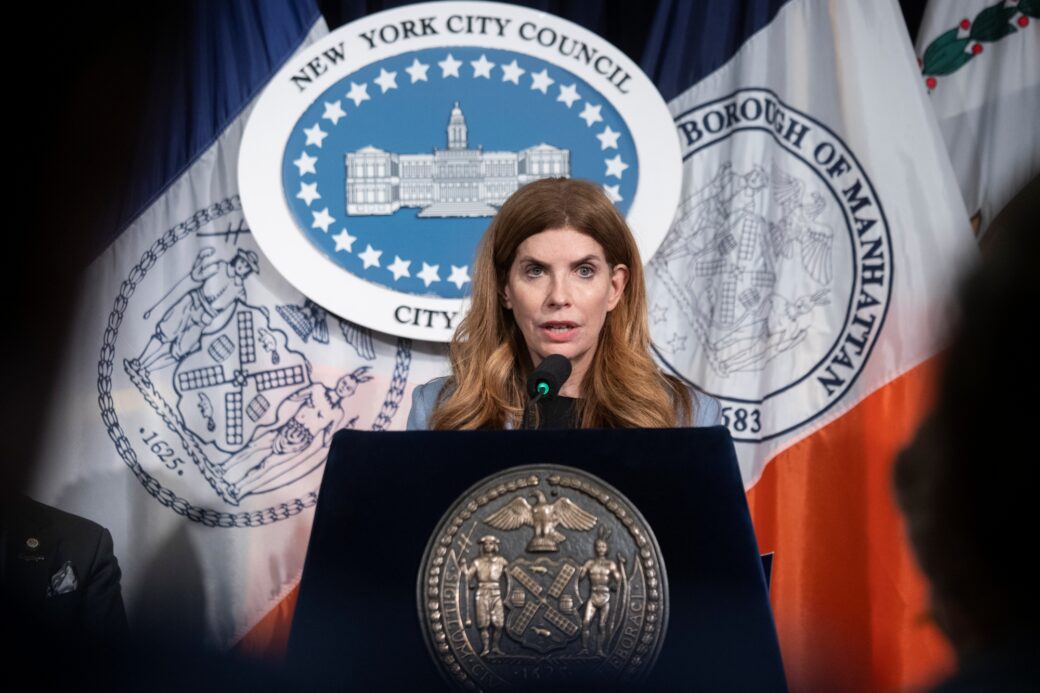
“To overcome our housing crisis, we need every neighborhood in every borough to do its part,” Dina Levy, commissioner of HPD, said. “The Fair Housing Growth Strategy is a roadmap to a fairer and more affordable city. We’re excited to engage with our neighbors across the city as we draft our final report.”
RELATED: