Nearly 195,000 people slept in NYC shelters in 2025, the most ever
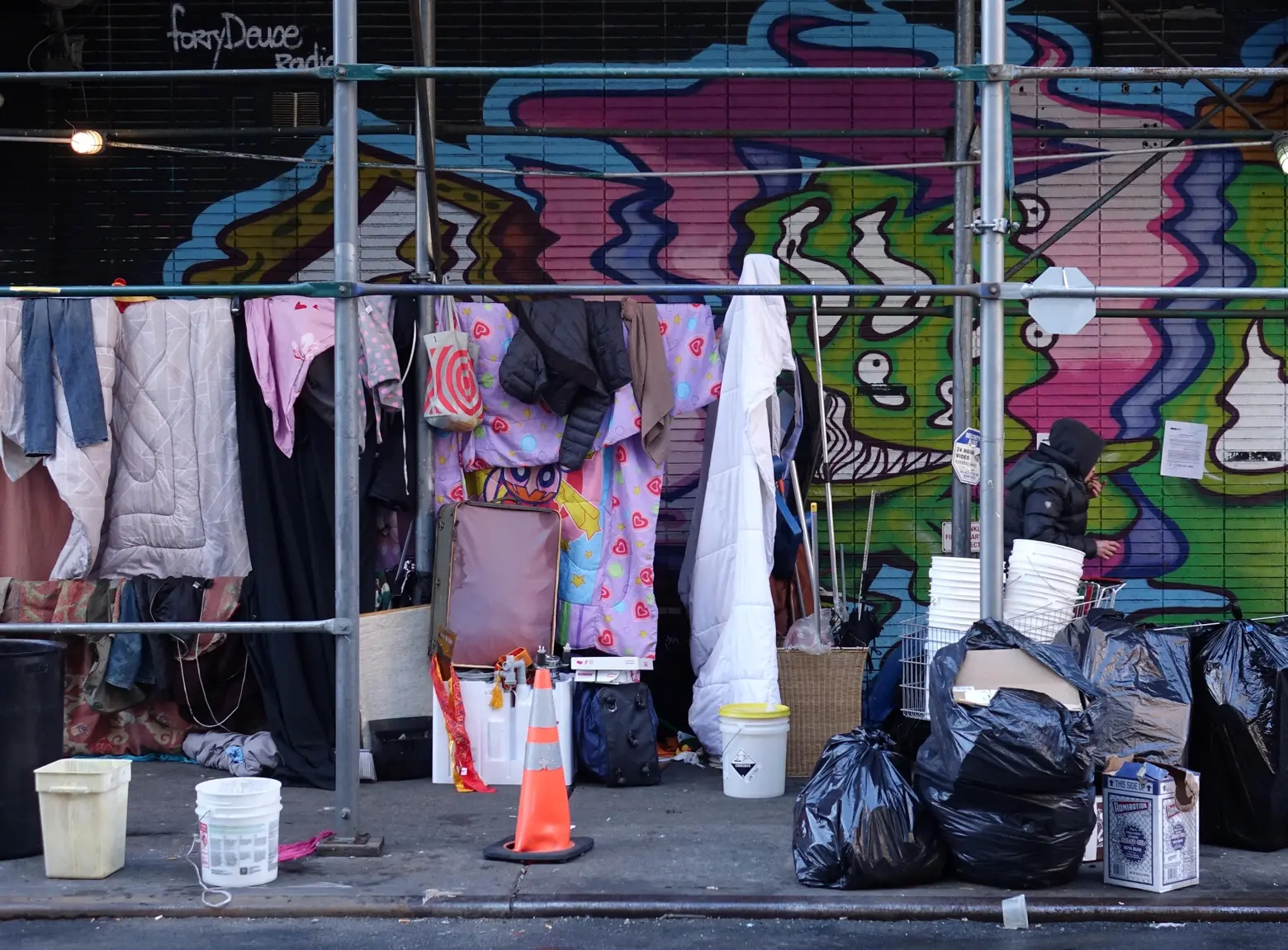
Credit: Felton Davis on Flickr
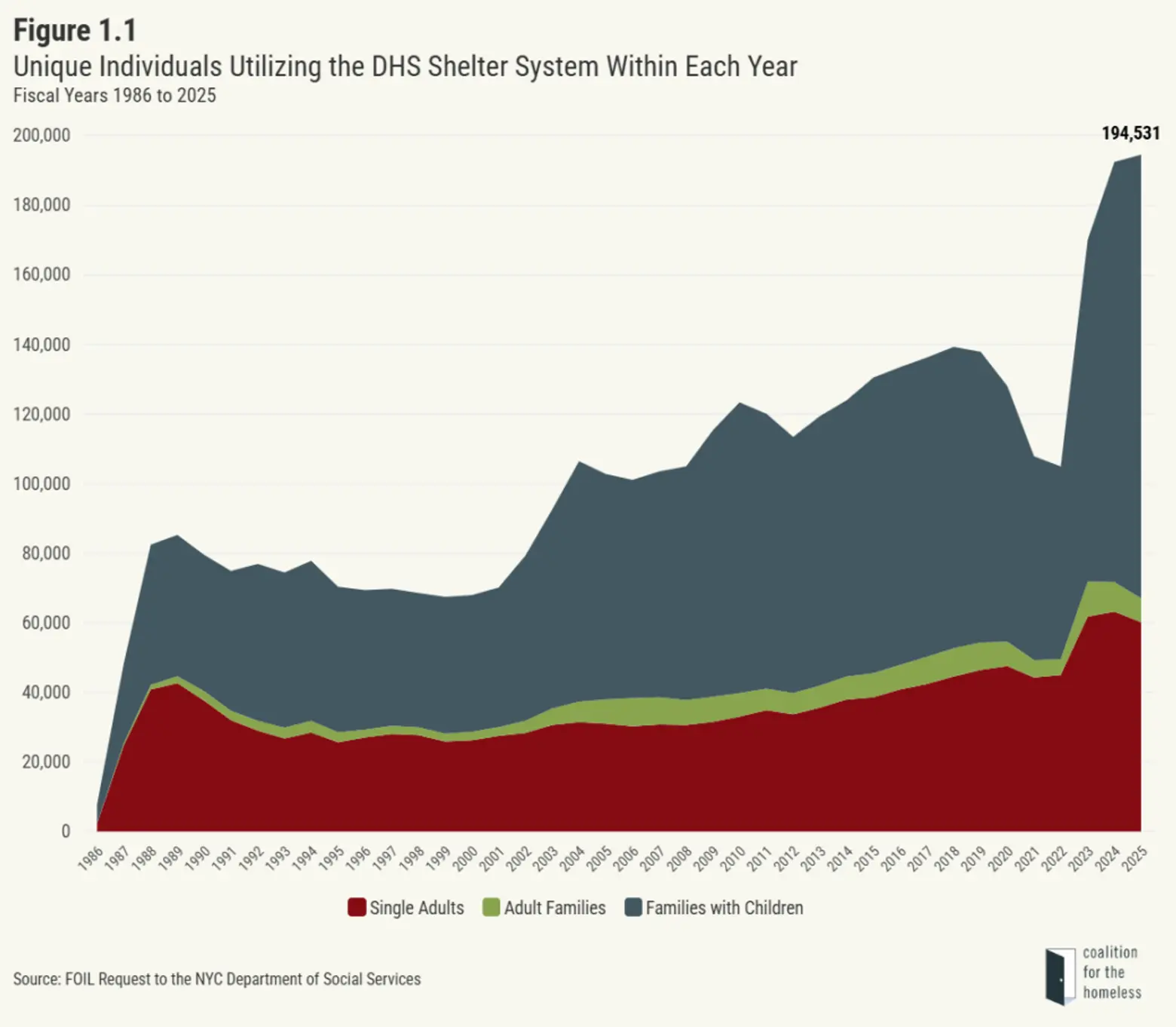
The number of New Yorkers sleeping in homeless shelters rose 27 percent under Mayor Eric Adams’ four years in office, driven by overcrowded housing conditions and evictions, according to a new report. The Coalition for the Homeless released its annual “State of the Homeless” report, which found that the number of non-migrant New York City residents needing shelter grew by more than 12,000 between January 2022 and December 2025. Plus, last year, 194,531 individuals used the city’s shelter system over the course of the year, the most in its history. The increase excludes asylum seekers and other new arrivals who entered the shelter system during that period.
While the Coalition recognizes the city’s Department of Social Services’ efforts to move more New Yorkers from shelters into permanent housing through subsidies and support, the group says the number of people entering the shelter system continues to outpace those leaving.
The report estimates that nearly 100,000 people sleep in homeless shelters each night, including disabled New Yorkers and people who are working but still cannot afford rent. Thousands more are unsheltered on the streets, while about 250,000 are “doubled up” in the homes of others.
In 2025, 194,531 unique individuals used the city’s shelter system, the highest number in a single year in the system’s history. The number of schoolchildren living doubled-up increased 29 percent from 2022 to 2025.
Eviction filings rose from a pandemic low of 42,110 in 2021 to 114,832 in 2025, resulting in 17,821 marshal-executed evictions that year, surpassing the 17,036 recorded in 2019. Meanwhile, the number of extremely low-income (ELI) households grew by more than 91,000 during the Adams administration, while only about 10,000 ELI units were financed.
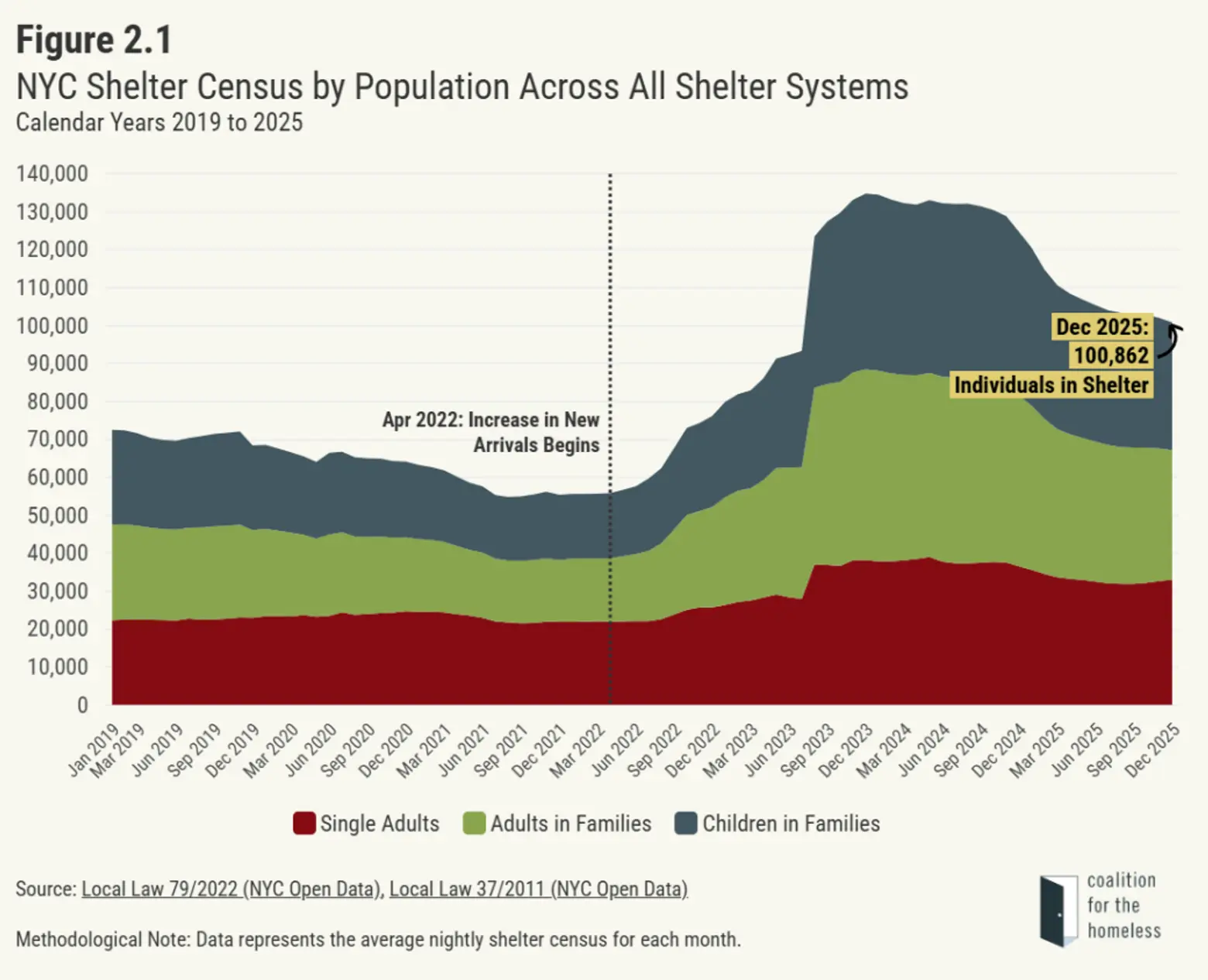
According to the Coalition, the surge in homelessness can be attributed to rising housing costs in the five boroughs, where more than half of New Yorkers are rent-burdened, meaning they spend more than 30 percent of their income on rent.
These issues are further exacerbated by continued threats from the federal government under President Donald Trump, who has proposed major cuts to the Continuum of Care program, the nation’s largest homeless assistance program, which could put 7,000 formerly homeless New Yorkers at risk of returning to the streets.
Trump has also cut funding to the Supplemental Nutrition Assistance Program (SNAP), which more than 1.7 million New Yorkers facing economic strain rely on for food assistance. Last July, he approved $186 billion in cuts to the program over 10 years, and in March, he instituted new work requirements that could affect eligibility for millions of New Yorkers.
The Coalition said Adams and Gov. Kathy Hochul “squandered” an opportunity to build on the city and state’s previous success in reducing chronic veteran homelessness. Instead of expanding a model centered on permanent supportive housing and mental health services, city and state officials relied on approaches aimed at moving unhoused people out of public view.
The group also called on Mayor Zohran Mamdani to pay more attention to homeless New Yorkers and criticized the mayor for backtracking on campaign promises.
Notably, in March, the mayor reneged on a previous promise to support the expansion of the CityFHEPS housing voucher program, one of the nation’s largest rental assistance programs, which serves as a lifeline for roughly 65,000 New Yorkers, or about 140,000 people. Mamdani has also overseen encampment sweeps despite previously pledging to end the practice under the former administration.
“The lesson of the last four years could not be more clear: if the City continues to ignore the fundamental causes of mass homelessness, the number of people sleeping in shelters and on the streets will just keep going up. And no one in our city wants to see that happen,” Dave Giffen, executive director of the Coalition for the Homeless, said in a press release.
“Mayor Mamdani won the election on a promise of affordability, and we share that goal. But the ‘affordability agenda’ must include the nearly 100,000 people sleeping in shelters tonight, the thousands on the streets and in the subways, and the quarter-million more doubled up in someone else’s home. The mayor cannot reduce mass homelessness without targeting resources where they are most needed and building on the approaches proven to work.”
However, the report also highlights several housing-related actions taken by the Mamdani administration. The mayor’s Streamlining Procedures to Expedite Equitable Development (SPEED) reforms, unveiled in May, are credited with helping accelerate housing production and could allow new affordable homes to be developed up to two years faster.
Last month, Mamdani also announced a plan to build 200,000 new affordable homes over the next decade, the most ambitious target set by an NYC mayor. The plan calls for $22 billion in capital investments over the next five years to fund new affordable housing and preserve an additional 200,000 existing homes.
According to the report, the data show that Adams and Hochul did not achieve positive outcomes in addressing the surge in homelessness. It argues that policymakers should move away from unsuccessful approaches and instead expand affordable housing and increase access to permanent housing and mental health services for unsheltered New Yorkers.
The report concludes with a series of recommendations. The Coalition says the city must build at least 12,000 new deeply subsidized affordable housing units for homeless and ELI households annually over the next five years, while also accelerating placement timelines into homeless set-aside units and other housing financed by the city’s Department of Housing Preservation and Development to ensure shelter residents can access those units.
The group also urges Mamdani to connect 2,000 unsheltered people with serious mental illness living in the transit system to a portion of the roughly 5,000 vacant supportive housing units, and to allocate $98 million to create 2,000 new single-occupancy safe haven beds for unsheltered New Yorkers.
RELATED: