MTA unlikely to meet 2040 goal for 100% zero-emission bus fleet, audit finds
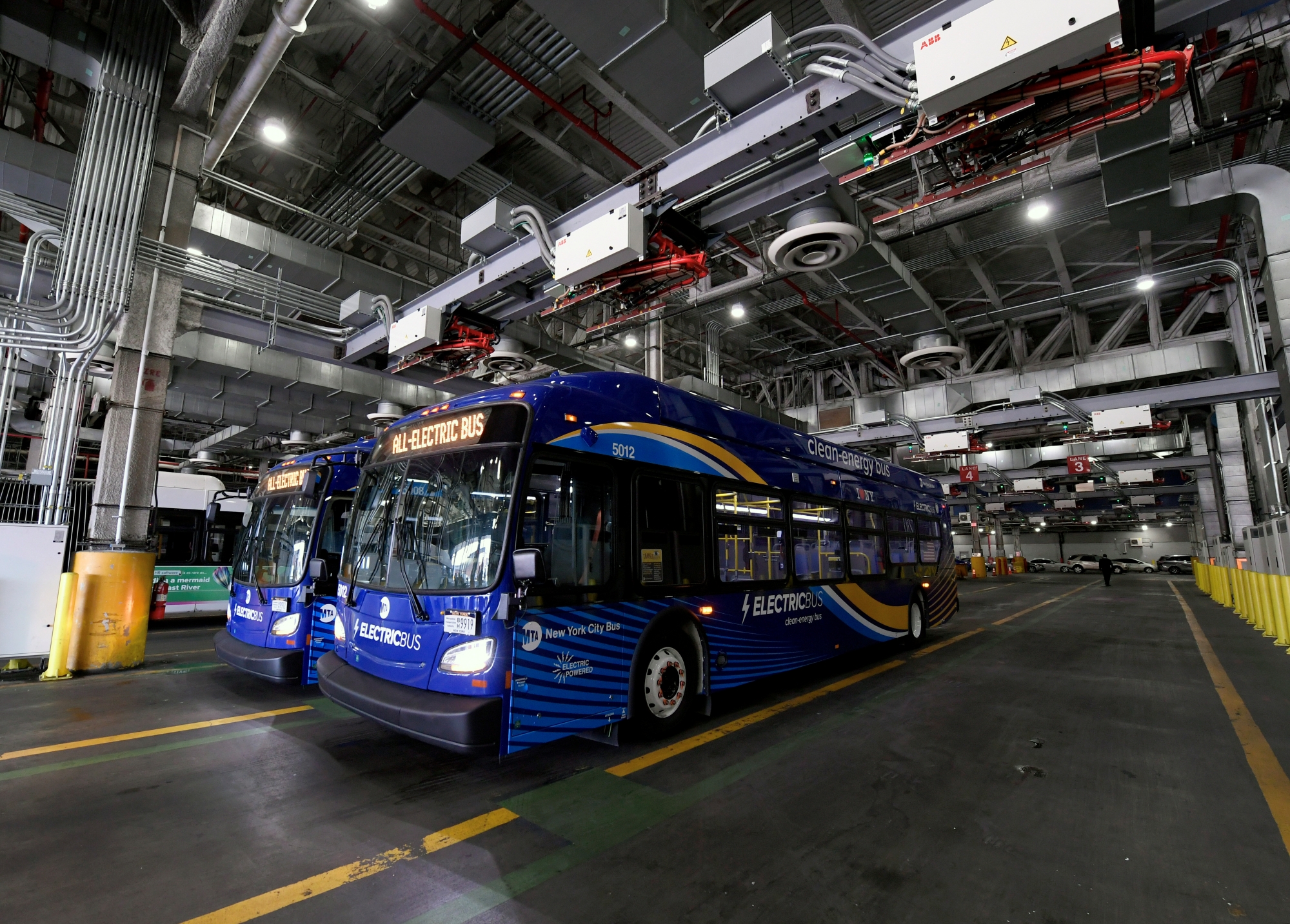
Credit: Marc A. Hermann / MTA on Flickr
The Metropolitan Transportation Authority is falling behind on its plan to replace New York City’s public bus fleet with zero-emission vehicles by 2040, according to the state comptroller. In the audit published on Wednesday, New York Comptroller Thomas P. DiNapoli found that the MTA’s reliance on single manufacturers with limited production capacity has led to delays, while the cost of producing electric buses has risen substantially. The MTA’s four-stage plan called for the next 485 of 500 buses to be delivered by the end of 2024, but only one had been delivered by June 2025. The agency has since reduced its next order from 1,000 to 500 buses.
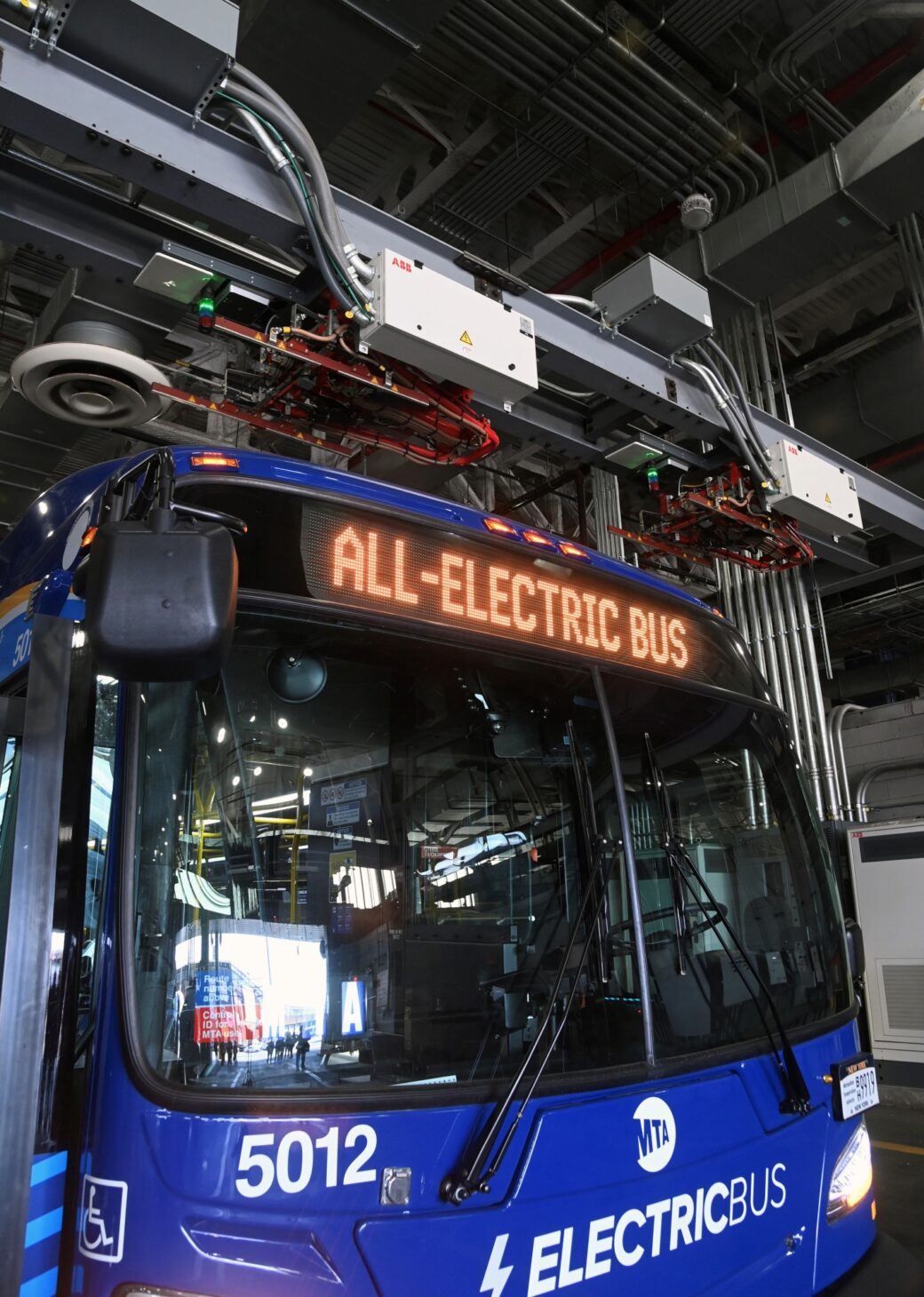
In 2018, the MTA first committed to replacing its roughly 5,800 diesel-burning buses on a one-to-one basis with zero-emission models over the next 22 years.
A 2022 state executive order required “affected entities” like the MTA to have “100 percent of their light-duty non-emergency vehicle fleets” be zero-emission by 2034 and 100 percent of their medium- and heavy-duty vehicle fleets be zero-emission by 2040.
The agency’s Zero-Emission Transition Bus Plan, released the same year, laid the groundwork for the transition, while an updated plan in 2024 focused on three main areas: fleet, facilities, and workforce. The plan is divided into four stages: “Learning at Scale,” “Expansion Challenge,” “Steady Growth,” and “Final Push.”
Across the four stages, the authority planned to purchase 560, 1,000, 1,970, and 3,300 zero-emission buses, respectively. Many of the buses purchased during the first two stages are expected to be battery-electric (BEB), while the agency also plans to test hydrogen fuel cell electric buses to determine whether the technology could be deployed on a larger scale.
However, according to the audit, the MTA is “at risk” of not meeting its 2040 goal. The agency currently has only one battery-electric bus (BEB) manufacturer, which is facing limited production capacity and a backlog of orders from the MTA and other customers.
Additionally, the availability and reliability of the 75 electric buses already deployed could put the MTA’s goal further at risk, according to the audit. The BEBs at five depots were available for service less than 60 percent of the time the MTA had planned for them to be in operation.
Reliability issues have been exacerbated by problems with both the BEBs and their chargers, as well as limitations on the distance the buses can travel on a single charge.
The 2024 plan found that BEBs have higher failure rates, lower availability, and require more time to repair than existing buses. Several MTA officials have echoed those concerns, saying that with the current batteries, BEBs “do not last as long in service” as diesel buses.
For example, the batteries must be at least 70 percent charged for a bus to be deployed, and buses must return to the depot once they reach 30 percent. As a result, BEBs are typically assigned to shorter trips, while extreme hot and cold weather can further reduce their range.
During visits to several bus depots, officials at Depot 1 said that 21 of 32 BEBs had been out of service for an average of 18 days. At Depot 2, 17 of 28 BEBs had been out of service for an average of 23 days. Several other BEBs at Depots 3 and 4 had also been out of service, for averages of 23 and three days, respectively.
As a result, the audit says it is “unlikely” that the MTA will be able to replace its existing buses on a one-to-one basis as previously planned. Instead, the agency would need to increase its fleet size, resulting in additional costs.
In addition to supply and reliability issues, BEBs cost substantially more than traditional buses. The 2022 plan estimated that a 40-foot standard diesel bus and a 60-foot articulated diesel bus cost $635,000 and $835,000, respectively. By comparison, BEBs of the same sizes cost an estimated $1.033 million and $1.388 million, respectively.
Those costs were projected to rise to $1.4 million and $1.83 million by 2024, respectively, while the MTA estimated that the total capital cost of transitioning to a fully zero-emission fleet would reach $11.9 billion.
While environmental justice is also a stated priority of the MTA’s plan, DiNapoli writes that it has not been reflected in the transition plan so far. Because MTA buses serve a disproportionate share of low-income and minority communities, one of the agency’s goals for deploying BEBs was to improve air quality in these historically underserved communities.
To decide where the buses would be deployed, the MTA developed an Environmental Justice Score, a combination of equity and air quality considerations intended to ensure that the most vulnerable communities affected by emissions would be the first to receive the new buses.
However, of the 60 buses that arrived between 2024 and 2025, 45 were placed in two depots with environmental justice scores lower than those of other depots in the borough. One Manhattan depot ranked last among the four in the borough, while another in Brooklyn ranked fifth out of six.
Additionally, the report found that MTA safety officials were not involved in developing safety plans for BEBs and their use of lithium-ion batteries, which can produce rapidly spreading and difficult-to-extinguish fires in some circumstances.
BEB bus drivers and maintainers have also not received adequate training, according to DiNapoli. The MTA and NYC Transit require bus operator training that includes a classroom orientation on safety procedures.
DiNapoli found that there were no attendance sheets to support that 53 of the 247 bus operators and one of the 35 maintainers received the required training. For the attendance sheets that were available, the audit found that the training completion dates did not match the dates in the MTA’s timekeeping system for 49 bus operators.
In response to the findings, the MTA provided attendance sheets for 38 of the 53 bus operators who initially lacked documentation. Still, agency officials failed to provide sufficient documentation showing that 21 bus operators and one maintainer received the required training.
“The MTA has set an ambitious goal to transform the nation’s largest bus fleet to 100 percent zero-emission,” DiNapoli said. “Unfortunately, this audit identified multiple challenges that have put its 2040 target in jeopardy. It is encouraging that the MTA has announced steps to address these issues.”
To address these looming concerns, DiNapoli outlined a series of recommendations for the MTA.
The first encourages the agency to develop a contingency plan in case it fails to meet its 2040 target and to address milestones that have yet to be met. This includes revisiting the timeline for zero-emission bus purchases and deployment in the next phase of the transition plan.
He also suggested that the MTA review alternative technologies that could improve the range and performance of its existing zero-emission buses. Finally, he recommended that the agency establish clearer priorities and monitoring controls to ensure the plan’s outcomes align with its goals.
For now, the MTA has purchased lower-emission hybrid and “clean-diesel” buses as it continues working to reduce emissions, according to Gothamist.
In May, the MTA board approved the purchase of 92 clean-diesel express buses for $120.8 million to replace an aging fleet on Staten Island. In December, the board approved another $97.6 million purchase of 100 new clean-diesel buses for local service, according to Gothamist.
During a Wednesday news conference, MTA Chair and CEO Janno Lieber acknowledged the report’s findings, saying it “repeats what has already been said” in several board meetings. He also said the agency is taking action to deploy other lower-emission alternatives.
“The electric buses we have tested so far have not been up to standards,” Lieber said. “They break down too frequently. We put the manufacturer on notice: In order for us to continue purchasing electric buses, we need that reliability standard to be met.”
“In the meantime, we have taken aggressive action to make sure that other low-emission technologies on the buses are deployed,” he added.
RELATED: