Policy

March 11, 2015

POLL: Can #SaveNYC Win the Small Business Battle?

On Monday, we took a look at #SaveNYC, a new campaign helmed by Jeremiah Moss of Jeremiah’s Vanishing New York that’s fighting to save the city from the superrich. Moss’ end goal is to get the Small Business Jobs Survival Act passed, “which would give businesses an opportunity to negotiate lease renewals and reasonable rent increases, […]

March 9, 2015

Owner of $100M Apartment at One57 Only Pays $17,268 in Property Taxes

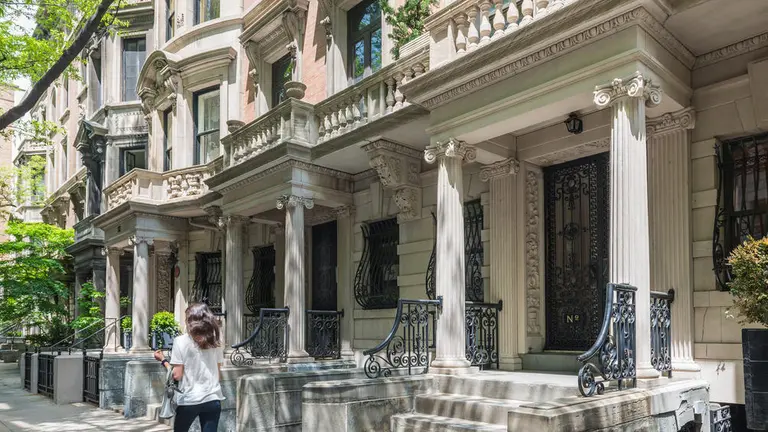
Remember the $100 million apartment at One57, the most expensive ever in New York City? Well, the (presumably) billionaire buyer pays just $17,268 in annual property taxes on the unit, or 0.017 percent of its sale price, as if it were worth only $6.5 million, according to the New York Post. In contrast, the owner of a $1.02 million condo nearby at 224 East 52nd Street is paying $24,279, or 2.38 percent of its sale price. This is just one example of the fact that the owners of the city's ten most expensive apartments pay effective rates that are unbelievably lower than those paid on cheaper properties. How is this possible? It's in part due to the 421-a tax abatement, but more so due to the city's convoluted method of assessing market value for condos and co-ops.
More on the tax inequality here
March 9, 2015

#SaveNYC: Campaign Urges New Yorkers to Band Together to Save City from Superrich

"Small businesses in New York City have no rights. You’ve been here 50 years and provide an important service? Tough luck—your space now belongs to Dunkin’ Donuts. You own a beloved, fourth-generation, century-old business? Get out—your landlord’s putting in a combination Chuck E. Cheese and Juicy Couture." – Jeremiah Moss in today's Daily News. With out of control rents, insane land prices, and properties trading hands for tens of millions–if not hundreds of millions–New York has become a playground (and a bank) for the ultra-rich. While most of us complain about the rising the cost of living with little action beyond a grumble, others are far more affected, namely the "mom and pop" shops forced out to make way for high-rent-paying tenants such as Duane Reade, Chase and Starbucks. But all is not lost. The issue of small business survival seems to be gaining some traction, particularly with a new campaign called #SaveNYC launched by Jeremiah Moss of Jeremiah’s Vanishing New York.
READ MORE
March 9, 2015

What if NYC Offered Subway Riders Free E-Books?

Here's a cool idea we'd love to see implemented in Manhattan: A free e-library for folks who ride the subway. Earlier this year, Beijing subway operator Beijing MTR rolled out a new digital library that would allow its underground commuters to download a book, at no cost, by simply scanning a QR code inside a train car. As you may have guessed, the initiative is looking to get citizens to spend more time reading over mindlessly watching videos or playing games.
More on the new program
March 9, 2015

City Launches Educational Website to Mark the 50th Anniversary of the Landmarks Law

In celebration of the 50th anniversary of the creation of the New York City Landmarks Preservation Commission, and thereby the Landmarks Law, the city has launched a new educational website, landmarks.nyc, that will grow its content throughout the year. The site offers digital features, a schedule of free- and low-cost events at landmarked sites throughout the city, slide shows from the agency's historic photo archives, various blog posts, and walking tours.
READ MORE
March 4, 2015

New Website Will Help New Yorkers Find Out if Their Apartment Is Rent Stabilized

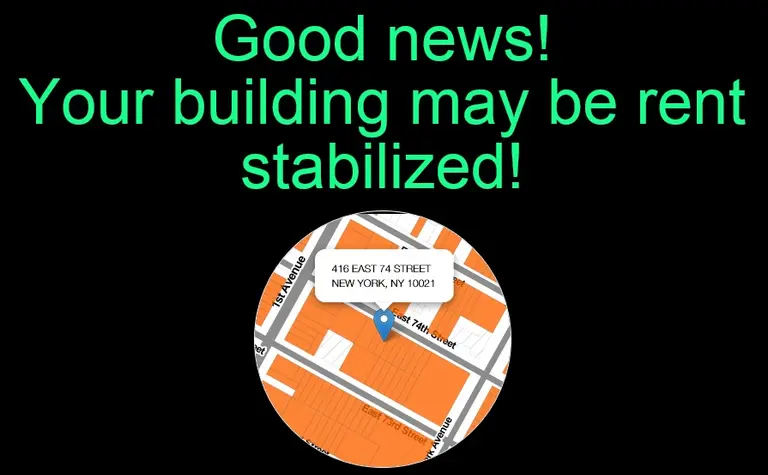
Let's face it, we all feel that we're paying too much for our tiny NYC apartments, and while for most of us that's just the name of the game, for others who are living in a rent-stabilized unit but being charged market-rate rent, it's actually true. Want to know if you fall into that boat? A new website called amirentstabilized.com will help you find out. The site allows renters to search their building to see if it's on the city's list of addresses with rent stabilized units. Unfortunately, it can't tell you if your specific apartment is one of them, but it's a great first step and provides resources for confirming your unit's status, as well as filing a complaint if you're being overcharged.
Find out more here
March 3, 2015

New Ruling: Landlords Can’t Kick a Bankrupt Tenant Out of Their Rent-Controlled Apartment

Going broke will no longer mean losing out on your rent-controlled apartment in NYC. According to Bloomberg, city tenants who file for bankruptcy will now be able to keep the keys to their affordable apartments as public assistance. The decision is taken from two opinions formed by the New York State Court of Appeals and the Manhattan-based U.S. Court of Appeals for the Second Circuit. Previously bankrupt tenants faced a threat of eviction even when they were current on rent.
Find out more here
March 2, 2015

Ikea Releases Furniture Collection That Will Wirelessly Charge Your Phone

The latest trend in the electric world is USB outlets, which allow you to charge your devices right there in the wall socket without a plug. That still requires getting off the sofa and walking the probably two feet over to the outlet, though, which can really put a cramp in one's "House of Cards"-binge-watching style. But thanks to a new furniture collection from Ikea, you can power up your phone without having to search for a cord and while still in the reclined position. The new line of lamps, bedside tables, and desks features integrated charging pads that allow users to simply place their wireless gadget on top.
Learn more about the new collection
March 2, 2015

Where Will Mayor de Blasio Land on the 421-a Tax Abatement Debate?

Developers have been rushing to break ground on projects before June, when the controversial 421-a tax abatement is set to expire, as it provides incentives to developers for up to 25 years when they reserve at least 20 percent of a building’s units for low- and moderate-income tenants. However, those against the 40-year-old program criticize it for using working people's tax dollars to build swimming pools and pet hotels for the world's billionaires; after all, the construction of One57, where a penthouse recently sold for $100 million, was built using subsidies from the program. But on what side of the debate does Mayor de Blasio, whose goal is to implement "the largest affordable housing program that any city, any state has attempted in a ten-year time span in the history of the republic," fall? Though many of his supporters oppose 421-a, in order to reach his goal of building 80,000 new affordable housing units–especially in places like East New York where a rezoning would be necessary to allow for denser construction that mandates the inclusion of permanently affordable apartments–de Blasio says he needs the program, according to Capital New York.
More on the 421-a debate here
February 27, 2015

City Council Proposes New Law That Would Allow Tenants to Sue Landlords for Using Airbnb

One week ago we learned of the landmark ruling to evict a rent-stabilized tenant from his ultra-luxe 450 West 42nd Street building for listing the unit on Airbnb for nearly triple what he was paying, a show of just how serious the city is about the issue. Now they're getting even more aggressive, as two City Council members want to pass a new law that would let tenants sue their landlords for renting out neighboring apartments as illegal hotels through Airbnb.
More details ahead
February 25, 2015

The Only Two Living Things in NYC to Have Been Landmarked Are Trees

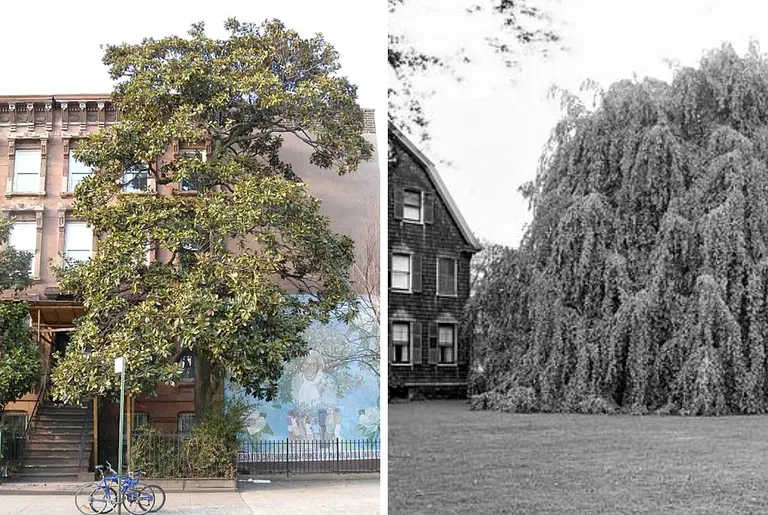
Last week we looked at the city's oldest and tallest tree in Alley Pond, Queens, which got us thinking about one of the questions at the Preservation Trivia night we recently attended. What are the only two living things in NYC to have ever been landmarked? We'll admit, we were stumped. We guessed Peter Stuyvesant's pear tree and the World Trade Center Survivor Tree, which were both wrong. But they are trees: the Weeping Beech Tree in Flushing, Queens and the Magnolia Grandiflora in Bed Stuy, Brooklyn. And to make it even more exclusive, only the latter still survives; the Beech Tree died and was cut down in 1999.
Find out the history of how these landmarks came to be
February 25, 2015

POLL: Will the NYU Expansion Plan Move Ahead?

After years of contention, we learned yesterday that opponents of the controversial NYU expansion plan would receive their final day in court to try to block the massive redevelopment. While Villagers have long been known as preservation pioneers (Jane Jacobs’ successful fight against Robert Moses’ destructive plans for the area is probably the best-known example), […]

February 24, 2015

NYU Expansion Plan Opponents Will Get Final Day in Court

In October, the appellate court overturned a previous decision by the New York Supreme Court that prohibited NYU's $6 billion, 1.9 million-square-foot Greenwich Village expansion plan, but community groups vowed to appeal the decision. And they most certainly kept their word. In a press release sent today by the Greenwich Village Society for Historic Preservation (GVSHP), we've learned that the New York State Court of Appeals agreed to hear an appeal by GVSHP, Assemblywoman Deborah Glick, NYU Faculty Against the Sexton Plan, Community Board 2, actor Mark Ruffalo, and other local concerned parties.
More info here
February 20, 2015

Rent-Stabilized Tenant Gets Evicted for Listing His Apartment on Airbnb in a Landmark Decision

If you were questioning how truly serious the city is about its beef against Airbnb, look no further than this landmark ruling to evict a rent-stabilized tenant from his ultra-luxe 450 West 42nd Street building. The Post reports that Henry Ikezi was just given the boot by a Manhattan Housing Court judge for posting his 46th-floor Hell's Kitchen apartment on the site for $649 per night, about triple what he was paying at $6,670 per month. The home's market value is upwards of $9,000.
More on the landmark case here
February 18, 2015

In 2080 NYC Will Be Hotter, Rainier, and 39 Inches Underwater

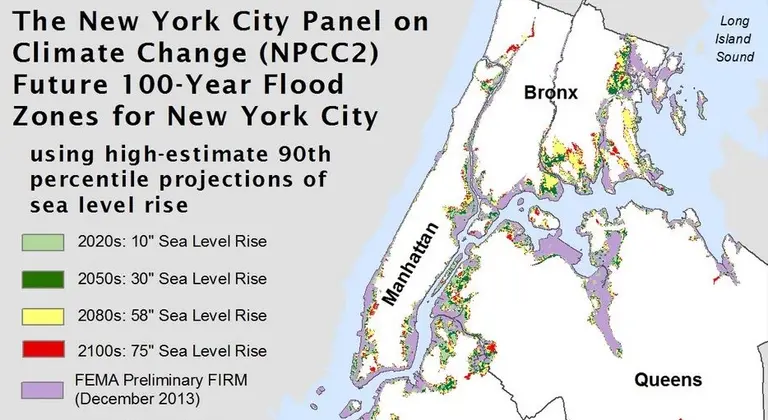
Or at least that's what a report released today by the New York City Panel on Climate Change says. Looking at the next century, the startling analysis finds that average temperatures could rise 4.1 to 5.7 degrees by the 2050s and as much as 8.8 degrees by the 2080s; yearly heat waves will triple in occurance; there will be many more days over 90 and 100 degrees; annual precipitation will increase by 5 to 13 percent by the '80s; the Northeast will see more intense hurricanes with extreme winds; and sea levels are expected to rise 18 to 39 inches by the '80s and 22 to 50 inches by 2100, meaning the amount of land within FEMA's proposed flood insurance rate maps will double, covering 99 square miles of the city. But don't start planning your exodus just yet. The Mayor's Office is well aware that their findings "underscore the urgency of not only mitigating our contributions to climate change, but adapting our city to its risks."
More on the report and see the full map
February 11, 2015

New Research Shows More Than 58 Percent of NYC Airbnb Listings Possibly Illegal

Airbnb has been under constant scrutiny in recent months, whether for its potential threat to the affordable housing market or the fallout for bed and breakfasts forced to shutter in the wake of the battle. Now, new research from Capital New York shows that more than 58 percent of New York City's Airbnb listings could be illegal, as they are for "entire apartments or houses, meaning no one else would be present during a stay." According to a state multiple dwelling law that was introduced in 2010, it's illegal to lease homes (excluding one- and two-family homes) for less than 30 days when the owner or tenant isn't present. But Capital found that of the 15,977 apartments listings on Airbnb, only one cites a requirement for a stay longer than a month. While the data isn't conclusive on how many listings could be exempt from the law, more than 10,000 listings are in Manhattan where single-family residences are less likely.
More on the findings ahead
February 10, 2015

50 Building Inspectors and Contractors to Be Charged in Bribery Scheme

It's not going to be a good day for up to 50 city building inspectors and contractors, as well as two mob associates, who are expected to be charged today in "one of the biggest corruption crackdowns in years." After a year-long investigation into projects that have been fast-tracked and received certificates of occupancies in return for cash, the Department of Investigation (DOI) and the Manhattan district attorney plan to charge 12 crooked city inspectors and nearly 40 contractors, according to the Daily News. Early this morning, the charged parties surrendered to authorities
More details on the charges
February 4, 2015

Map Revealed for de Blasio’s City-Wide Ferry System

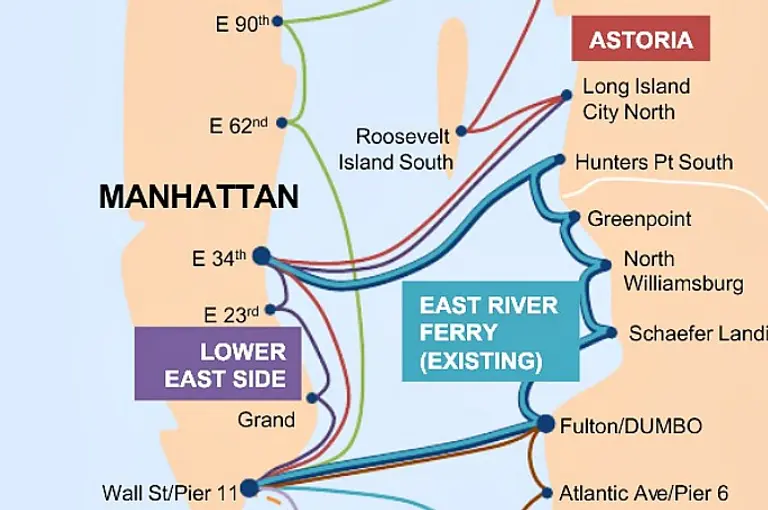
While there were plenty of highlights in Mayor de Blasio's State of the City address yesterday–from affordable housing to raising the minimum wage–it was undoubtedly the announcement of a city-wide ferry system that really got New Yorkers talking. De Blasio said that the ferry service will open in 2017, with pricing on par with the Metrocard, as a way to accommodate the growing population of New York. It will serve neighborhoods including the Lower East Side, Astoria, the Rockaways, Sunset Park, Brooklyn Army Terminal, Bay Ridge, Red Hook, and Soundview, among others. A new map released today shows the entirety of the system, breaking down existing ferry lines, those planned for 2017 and 2018, and those proposed.
More details and the full interactive map ahead
February 4, 2015

Govert Flint’s Futuristic Computer Chairs Allow You to Click with a Kick

Although our bodies are designed to move, the furniture we possess is usually based on a monofunctional posture. Day to day, we tend to segregate our basic bodily needs and just stare at screens, often forgetting how important it is to keep joints and muscles moving. To compensate for this inertia, we'd like to introduce you to "Segregation of Joy" by Govert Flint. This innovative skeletal seat allows you to take different postures and move freely, and boost your health and happiness, all from the comfort of your chair.
Learn more about this interactive seat
February 3, 2015

HIGHLIGHTS: De Blasio Announces Plans for More Affordable Housing and a New City-Wide Ferry Service

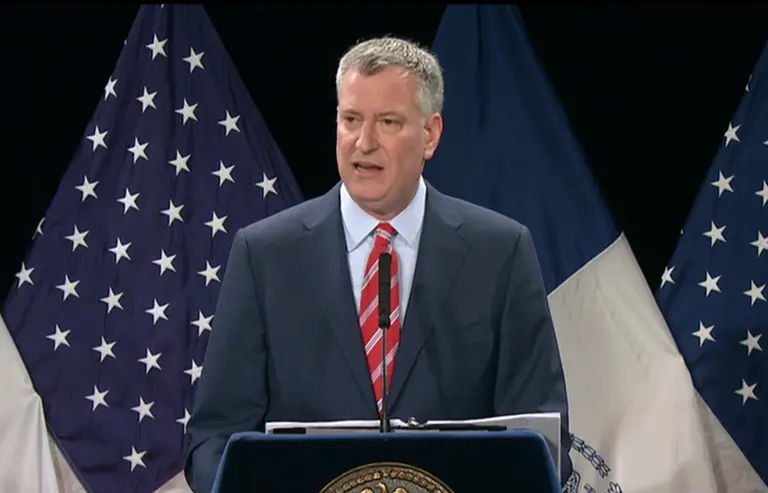
Mayor Bill de Blasio just wrapped up his State of the City address, and in addition to focusing in like a laser beam on affordable housing, the mayor also unveiled a number of additional improvements that certainly had us sitting up straight in our seats. In his address, De Blasio emphasized that his plan would look to creating denser, economically diverse affordable residential communities for not only low-income New Yorkers, but also for chronically homeless vets, seniors and artists. “While the state of our city is strong, we face a profound challenge,” de Blasio said during his speech. "If we fail to be a city for everyone, we risk losing what makes New York, New York…Nothing more clearly expresses the inequality gap—the opportunity gap—than the soaring cost of housing." The mayor also spoke about the administration's plan to raise minimum wage and expand public transit, which would include adding more Bus Rapid Transit lines to the outer boroughs, and, most notably, a brand new city-wide ferry system that would serve areas such as the Lower East Side, the Rockaways and Red Hook for the same cost as a subway ride. Keep reading for more highlights.
Highlights from de Blasio's speech here
February 3, 2015

7,279 NYC Homes Are Valued at More Than $5 Million

If you think that statistic is jaw-dropping, consider this, too–those 7,279 homes valued at more than $5 million amount to a total fair market value of $65.2 billion, according to data from the city’s Independent Budget Office. The Wall Street Journal requested the data to take a closer look at the proposal to impose higher property taxes on pied-à-terre owners, and the findings show that "the city’s most expensive homes would generate less money from a higher tax surcharge than what its advocates have suggested."
More details here
February 2, 2015

What Would Happen if New York Let Everyone Ride the Subway for Free?

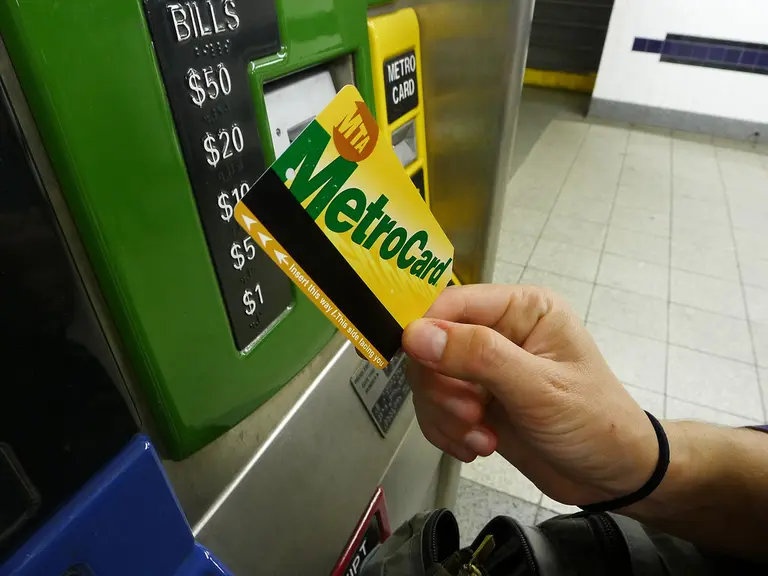
With the MTA fare hike just over the horizon, the question of whether or not all of New York has fair access to affordable public transportation comes into play. The hike, effective March 22nd, will push the cost to $2.75 per ride and $116.50 for a 30-day MetroCard, an increase of a quarter and $4.50, respectively. Like New York, cities across the globe are struggling with the same issue, but there are more than a handful of rogue riders in each taking matters into their own hands. About 500 riders in Stockholm have banded together to create Planka.nu (translation: "Dodge the fare now"), a scheme that has members pay $12 in monthly dues (an unlimited ride pass for 30 days costs about $120) which results in a cash reserve that can more than cover any fines that a member may occur. While illegal, the actions of these few scamps shed light on one important policy that's already being taken on by cities across the U.S.: subsidies. As noted in a recent article by The Atlantic, in the U.S., where government subsidies cover between 57 and 89 percent of operating costs for buses and 29 to 89 percent of those for rail, many public transit systems are quite affordable, costing in most cases less than $2, on average. So they ask, why not make the whole system free?
Is free transportation in New York unthinkable?

February 2, 2015

Developers Rush to Break Ground and Add Affordable Housing Before Tax Incentives End

It would be nice to think that developers added affordable housing to their projects out of the goodness of their hearts, but it probably has more to do with the construction bonuses and tax incentives afforded for up to 25 years to developers when they reserve at least 20 percent of a building's units for poor and moderate-income tenants. But this real estate tax break, known as the 421a abatement, is set to expire on June 15, lighting a fire under developers to break ground on new projects. The concern, though, is that some development sites receive 421a benefits as of right (meaning solely for putting up a new building), while others are required to include affordable housing. The difference is based on geographic location. For example, Manhattan between 14th and 96th Streets and the waterfronts of Brooklyn and Queens must include affordable housing. According to Crain's, some housing advocates "want projects to get abatements only if they create affordable units—which are priced for renters who earn 60 percent or less of the area's median income."
What does this mean for the future of affordable housing?
January 29, 2015

Wishbone: The World’s Smallest Smart Thermometer Checks Body, Object, and Environment Temperature

There's only so much our iPhones can do when it comes to thermometer functions. They can tell us the temperature in a specific geographic location, but not in the exact spot where we're standing, and they can't read our personal body heat or that of a pot of water. Enter Wishbone, the world's smallest smart thermometer that can accurately check body, object, or environment temperature in two seconds (compared with 30 seconds for a traditional thermometer) just by hooking up to your smart phone. And it requires no contact at all.
More info ahead