
‘Before New York’ pop-up exhibition recreates NYC’s landscape as it looked 400 years ago
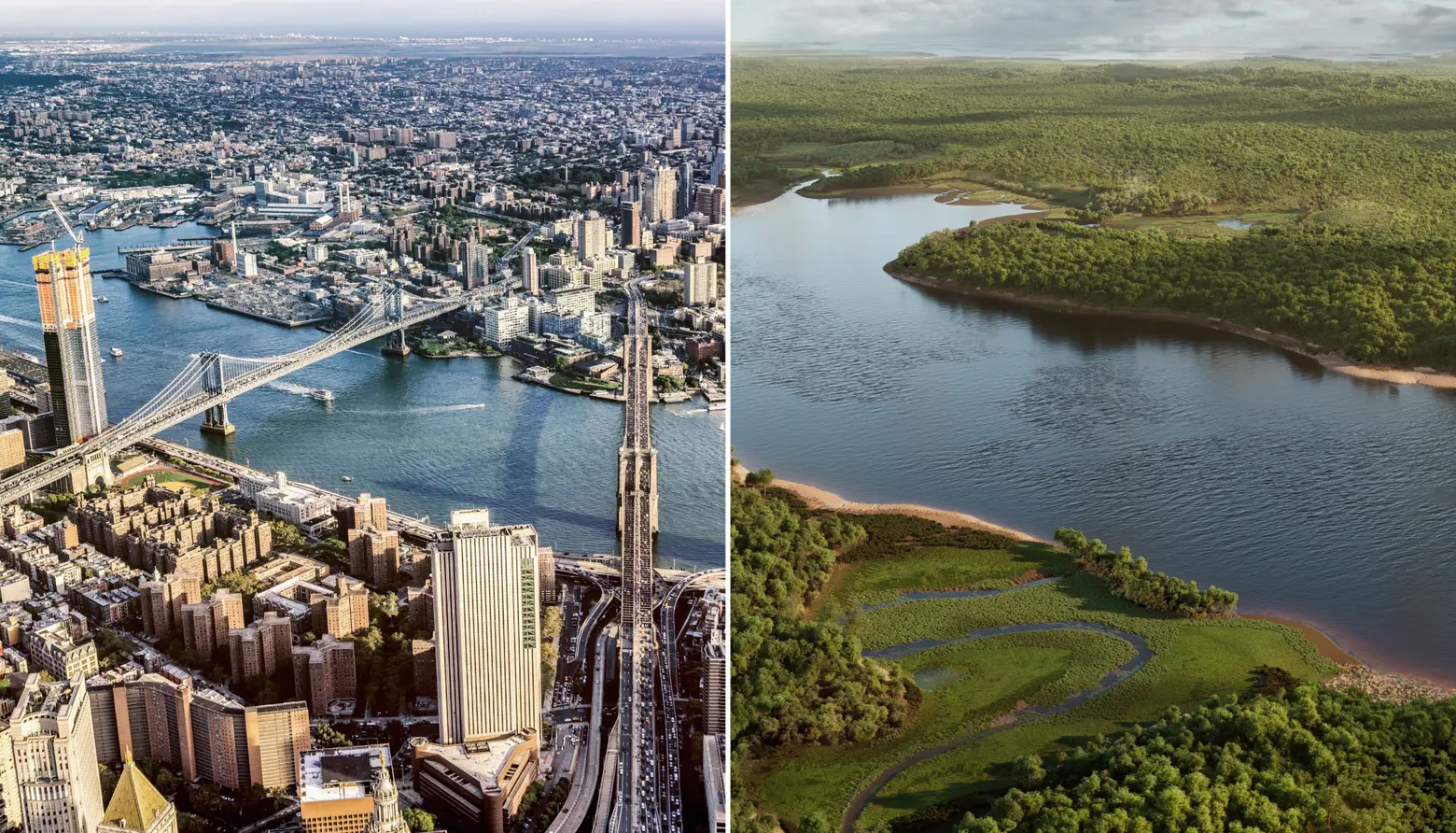
(L) Credit: Getty Images / Eloi Omella (R) Credit: “Before New York: The Natural Geography of the City (2026)”
A new traveling pop-up exhibition from the New York Botanical Garden (NYBG) will recreate New York City’s natural landscape as it appeared 400 years ago. Running Saturday, April 25 through November 15, “Before New York” will be on display in every borough, featuring digital renderings, large-scale photographs, and soundscapes that reconstruct the city’s landscape as it existed before Henry Hudson arrived in 1609, with experiences tailored to each borough. The exhibition will open at the garden’s Ross Gallery, with additional pop-up locations and programming expected to be announced in the coming weeks.
“Before New York” will feature panoramic images rendered using scientific data, depicting landmark features, plants, and landscapes as they appeared 400 years ago, before colonization, when the region was home to the Indigenous Lenape people. These images will be presented alongside current photos, offering context into how drastically nature has changed.
Data-driven soundscapes, including reconstructed bird calls, will evoke the region’s prehistoric geography and natural environment as it existed before the modern street grid. The exhibition will also examine how neighborhoods developed in relation to the landscape and natural features, alongside ongoing efforts to create a more sustainable urban environment.
The exhibition is based on research by NYC ecologist Dr. Eric W. Sanderson, vice president of urban conservation at the NYBG’s Center for Conservation and Restoration Ecology.
“I am immensely excited to bring ‘Before New York’ to NYC. The natural history of our own backyard has so much to teach us, in the face of grave threats to our Earth and biodiversity and the opportunities we all have to make a difference,” Sanderson said.
“It is my hope that this exhibition will bring to life the people, plants, animals, and landscape who have shaped our city’s past, present, and future—and inspire everyone who sees it to champion the conservation of nature into the future.”
Sanderson, as detailed in his book “Mannahatta: A Natural History of New York City,” describes 17th-century Manhattan as having biodiversity per acre that rivaled modern national parks like Yellowstone and Yosemite. The landscape that became New York City, called “Welikia,” meaning “my good home” in the Munsee-Lenape language, was home to thousands of species and the Indigenous Lenape people for 8,000 to 10,000 years before Hudson arrived.
Sanderon’s The Welikia Project, an online resource maintained by the Urban Conservation team at NYBG, illustrates block-by-block ecosystems and geologic foundations of the land prior to colonization, pairing current landmarks with a rendering of what the site looked like 400 years ago. The project extended ecology studies from Manhattan to all five boroughs.
Sanderson will lead the opening lecture for “Before New York” on April 28 at 11 a.m. in Ross Hall. He will discuss how he and his colleagues spent 25 years reconstructing the Bronx’s features, plant life, and landscape as it existed four centuries ago.
Admission is free with garden grounds access. Register here.
The Urban Conservation team will also host special events at pop-up locations across the city, tailored to each borough. Programming will include a public lecture by Sanderson on the borough’s historical ecology, a guided neighborhood walking tour focused on restoration, and an arts program interpreting each borough’s ecological history and restoration efforts through creative practice.
“Before New York” is also informed by Sanderson’s 2009 book “Mannahatta: A Natural History of New York” and his forthcoming atlas and gazetteer, “Before New York: The Natural Geography of the City,” which is slated for release on November 3.
RELATED:
Interested in similar content?
Leave a reply
Your email address will not be published.






Please let me know when and where the pop up events are.