
NYC’s creative industry at risk amid affordability crisis, report finds
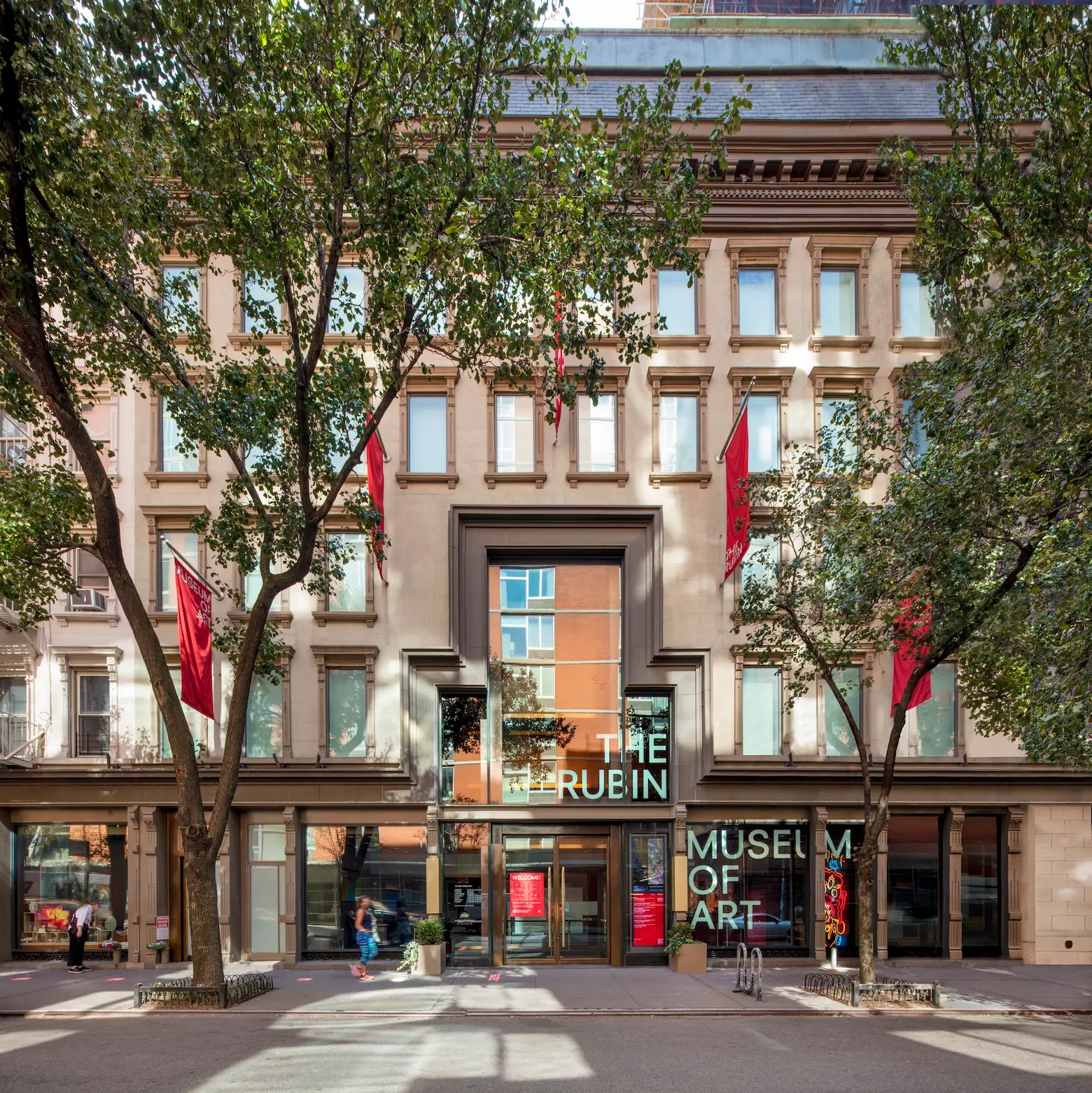
The Rubin Museum in Chelsea closed in 2024. It now operates as a global institution with traveling exhibitions. Photo by David de Armas, courtesy of the Rubin Museum of Art.
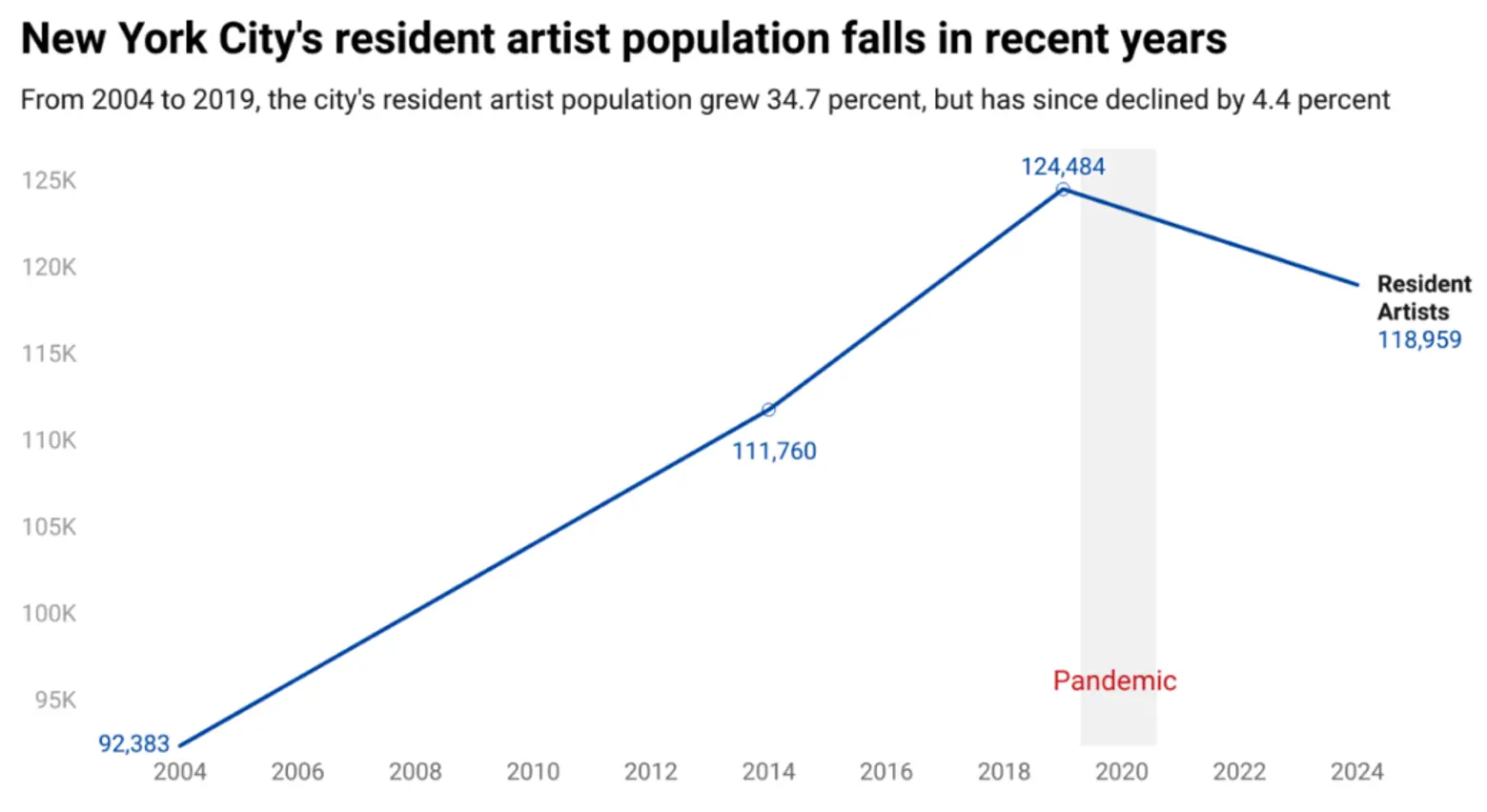
The future of New York City’s celebrated creative scene is in jeopardy, as rising living costs make sustaining a career in the industry increasingly unfeasible, a new report says. Released this month by the Center for an Urban Future (CUF), the “Creative New York” report finds that despite the creative sector’s importance to the city’s economy, the number of people working in creative fields has decreased substantially since the pandemic, following decades of growth. Employing more than 326,000 New Yorkers and attracting millions of tourists each year, the city’s creative sector is an integral part of its character, but without reform, this trend could drive a large portion of the industry out of the five boroughs, according to the report.
Funded by grants from the Rockefeller Brothers Fund, Howard Gilman Foundation, Ford Foundation, and Mellon Foundation, the report is guided by more than 120 interviews with artists, cultural leaders, creative entrepreneurs, community-based organizations, business leaders, and elected officials across the city.
It also incorporates extensive analysis of employment, wage, and industry data from the U.S. Census Bureau, the Bureau of Labor Statistics, the State Department of Labor, Lightcast, and city, state, and federal budget documents.
According to the CUF, which also produces the annual “State of the Chains” report tracking chain-store trends in NYC, the city’s creative industry is at a “crossroads,” with the affordability crisis casting uncertainty over its future.
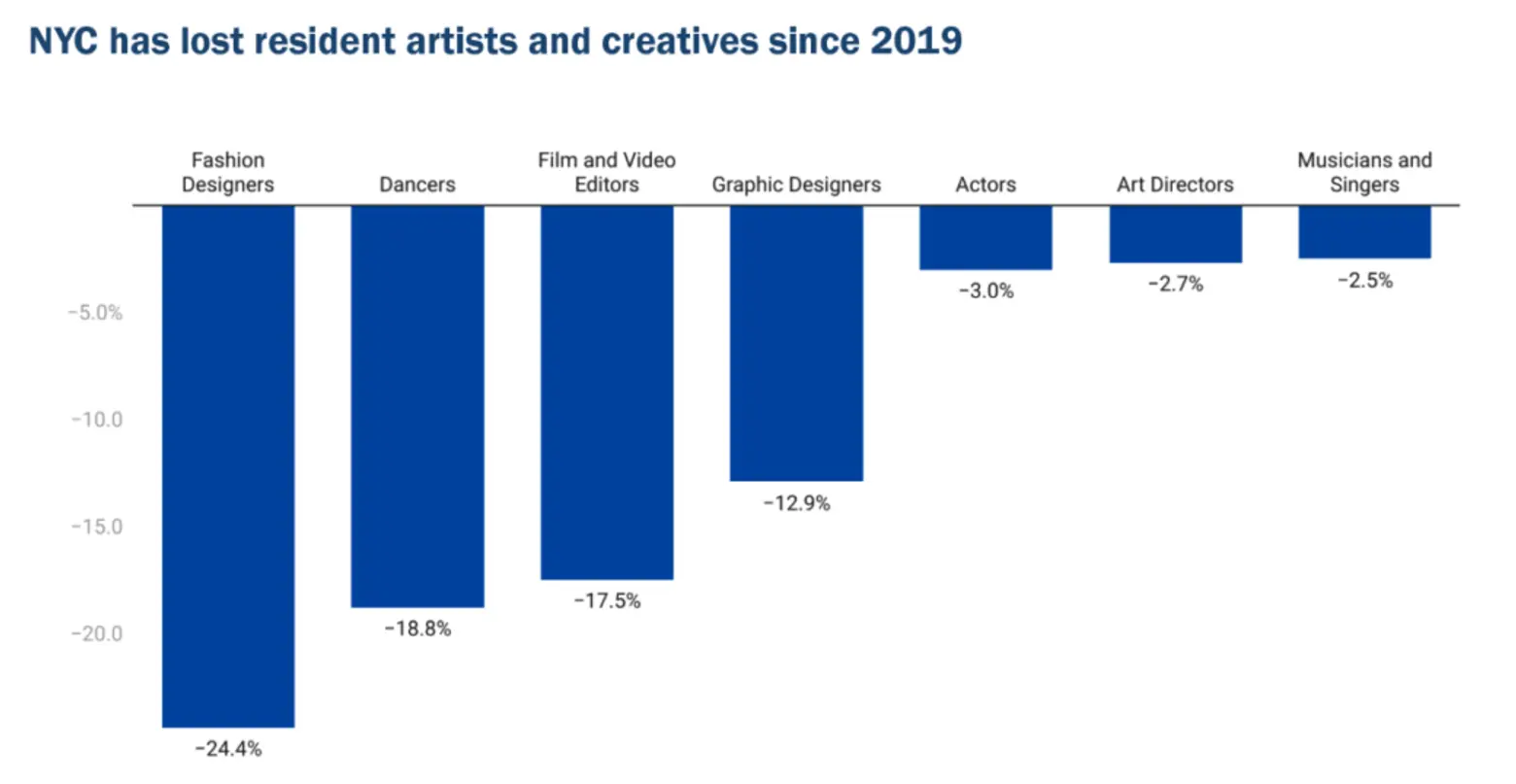
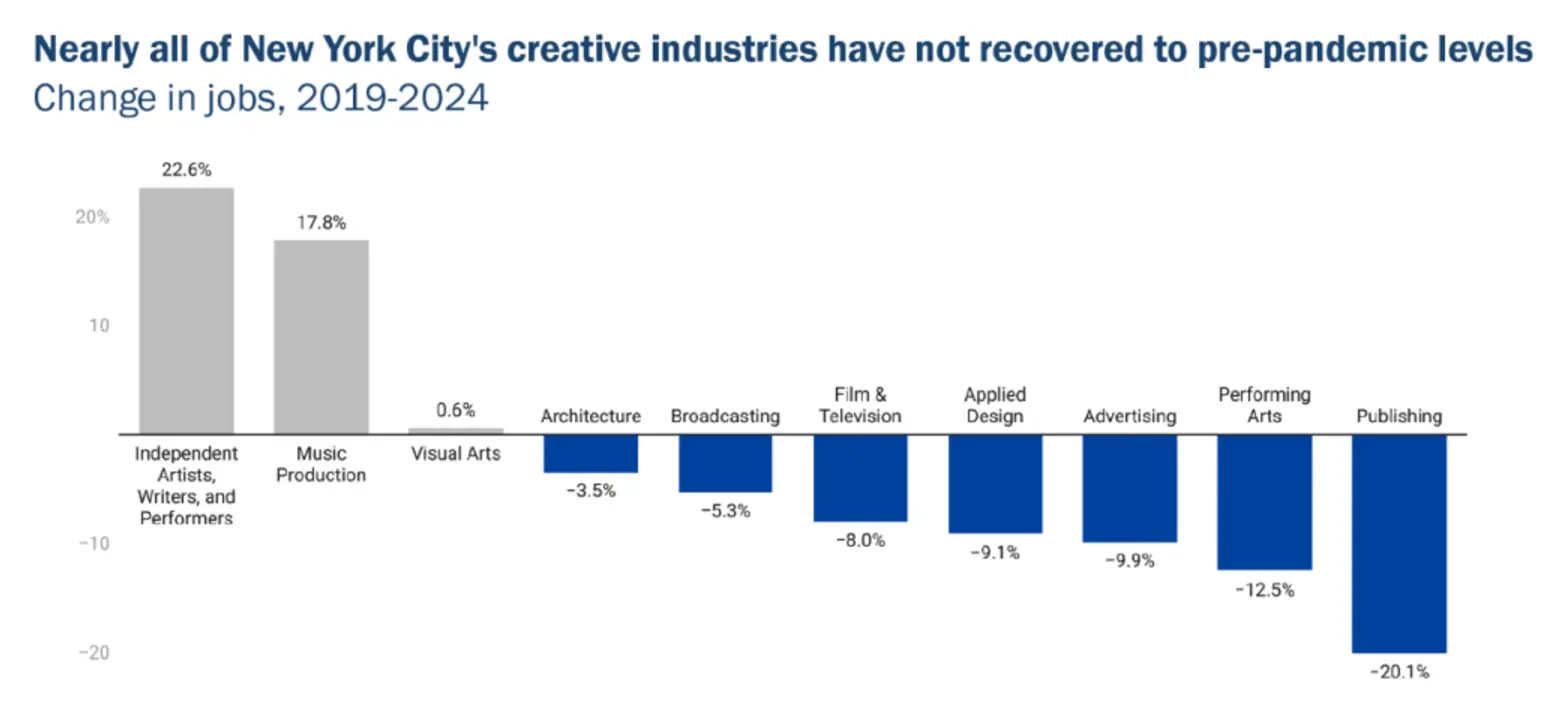
NYC’s creative scene is central to what makes it unique—a haven for the arts and a muse for countless aspiring musicians, actors, and other creatives. However, despite decades of constant growth, the industry is seeing a reversal. Since 2020, the city has witnessed an 18.8 percent decline in dancers, an 8 percent drop in actors, and a 2.8 percent decrease in musicians.
The decline extends beyond the stage: fashion designers are down 28.9 percent, film and video editors by 18.5 percent, graphic designers by 13.8 percent, and art directors by 6 percent.
At the same time, creative industries that had been some of the city’s fastest-growing sectors before the pandemic are now stalling too. Between 2005 and 2020, employment in the city’s film and television industry increased by 113.7 percent, but since 2020, are now down by 19.1 percent.
Similar trends are down across other fields: advertising by 14.3 percent, architecture by 9.4 percent, applied design by 14.3 percent, performing arts by 6.4 percent, and visual arts by 1.3 percent. Overall, the number of people working in the city’s creative economy, including both jobs and self-employment across more than a dozen cultural and creative fields, has fallen by 6.1 percent since 2019.
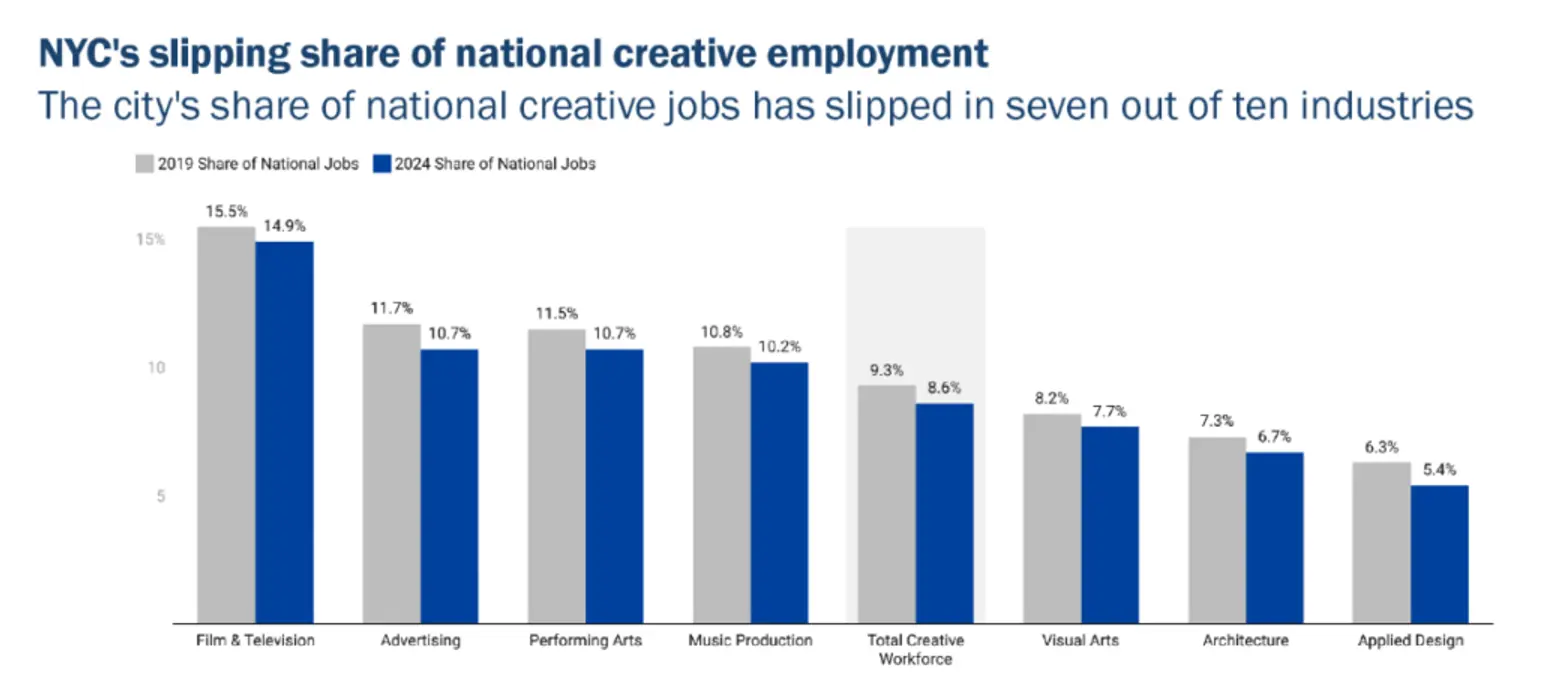
The city is also losing its share of the national creative workforce. Since 2019, the city’s share of all people working in the creative economy nationwide has dropped from 9.3 percent to 8.6 percent. Nonprofit arts organizations report being more at risk than ever, and nearly 50 theaters, music clubs, museums, and galleries have closed since 2020.
Other U.S. creative hubs with much lower costs of living—such as Nashville, Tennessee, and Dallas, Texas—have seen their creative workforces grow by 17.4 percent and 14.3 percent, respectively, since 2019, the report notes.
While it has long been difficult to afford living in NYC as an artist, these affordability pressures are extending across the entire creative economy, making it hard for people in advertising, design, and fashion to sustain themselves. Creative workers in NYC now earn roughly 23 percent less than the national average after adjusting to the city’s high cost of living, down from 15 percent less than a decade ago, while housing and studio rent prices continue to rise.
Nonprofit and commercial venues have seen the cost of labor and materials rise, while many venues have experienced significant declines in revenue from ticket sales, as the pandemic caused many to prefer watching at home versus in-person attendance.
Insurance premiums for venues are particularly cumbersome. At one Brooklyn music venue, Barbès, annual insurance costs have increased from $4,000 to $10,000 over the last decade, while at the now-shuttered TBA Brooklyn venue in Williamsburg, the space saw its premiums skyrocket from $25,000 to $125,000 before it closed.
“New York is just so freaking expensive,” Sade Lythcott, CEO of the National Black Theatre, said in the report.
“It’s more expensive to produce shows. It’s more expensive to retain staff. And the city in general—with inflation and cost of living increases across the board—is more expensive to live in.”
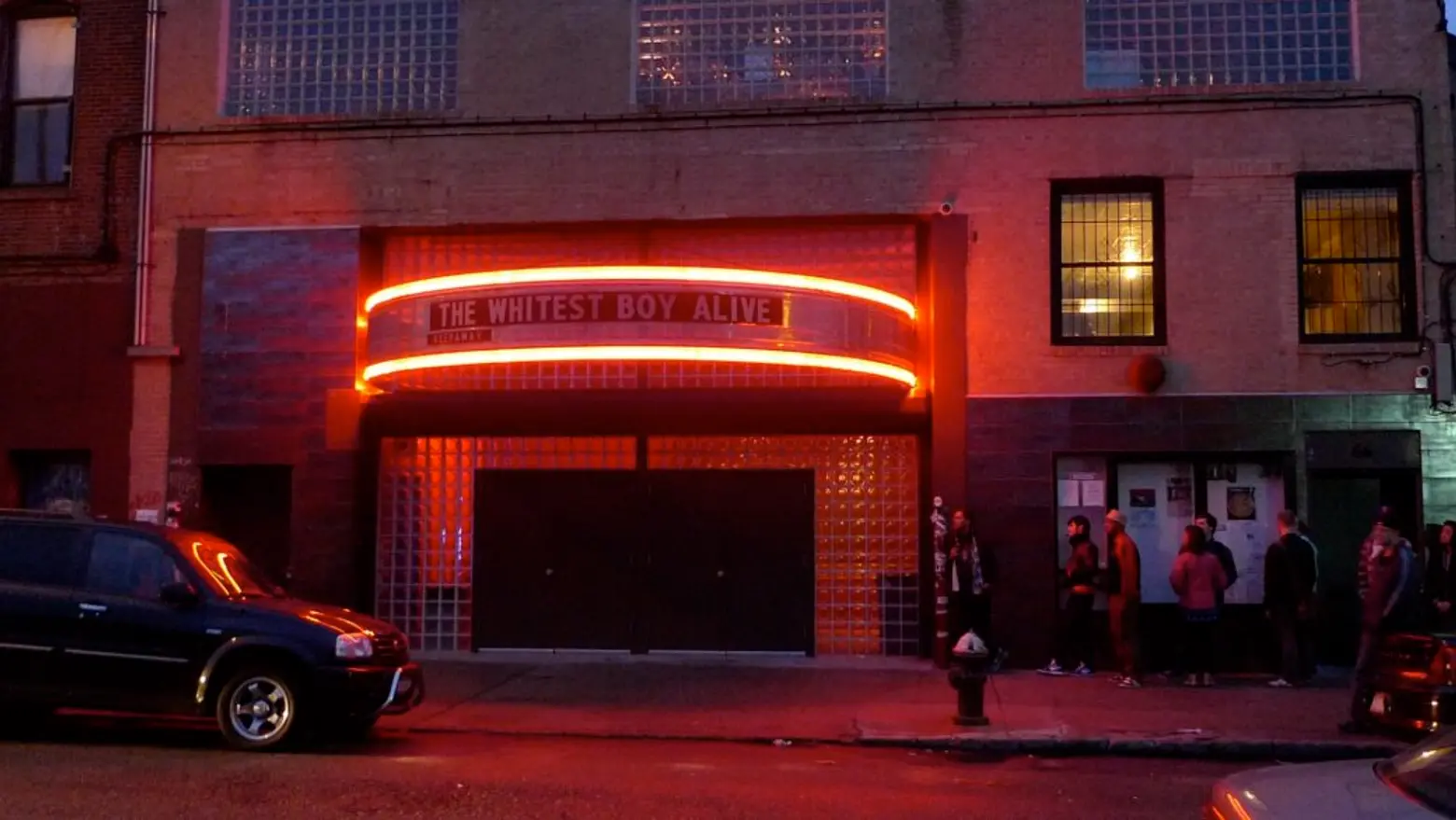
On Wednesday, the Music Hall of Williamsburg, a nearly two-decade-old music venue, announced it would not be renewing its lease at the end of 2026 and will either close or relocate, according to Pitchfork. While it’s unclear if financial struggles are behind the decision, the move reflects a growing trend of long-standing NYC music venues shuttering in recent years.
In August 2024, St. Vitus, a popular Greenpoint music venue known for showcasing both up-and-coming and high-profile heavy metal acts, announced its permanent closure after 13 years in business, according to the New York Post. Notably, the venue hosted a special 2014 “reunion” show for the remaining members of Nirvana. St. Vitus had faced multiple fines from the city’s Department of Buildings (DOB) over alleged certificate-of-occupancy violations.
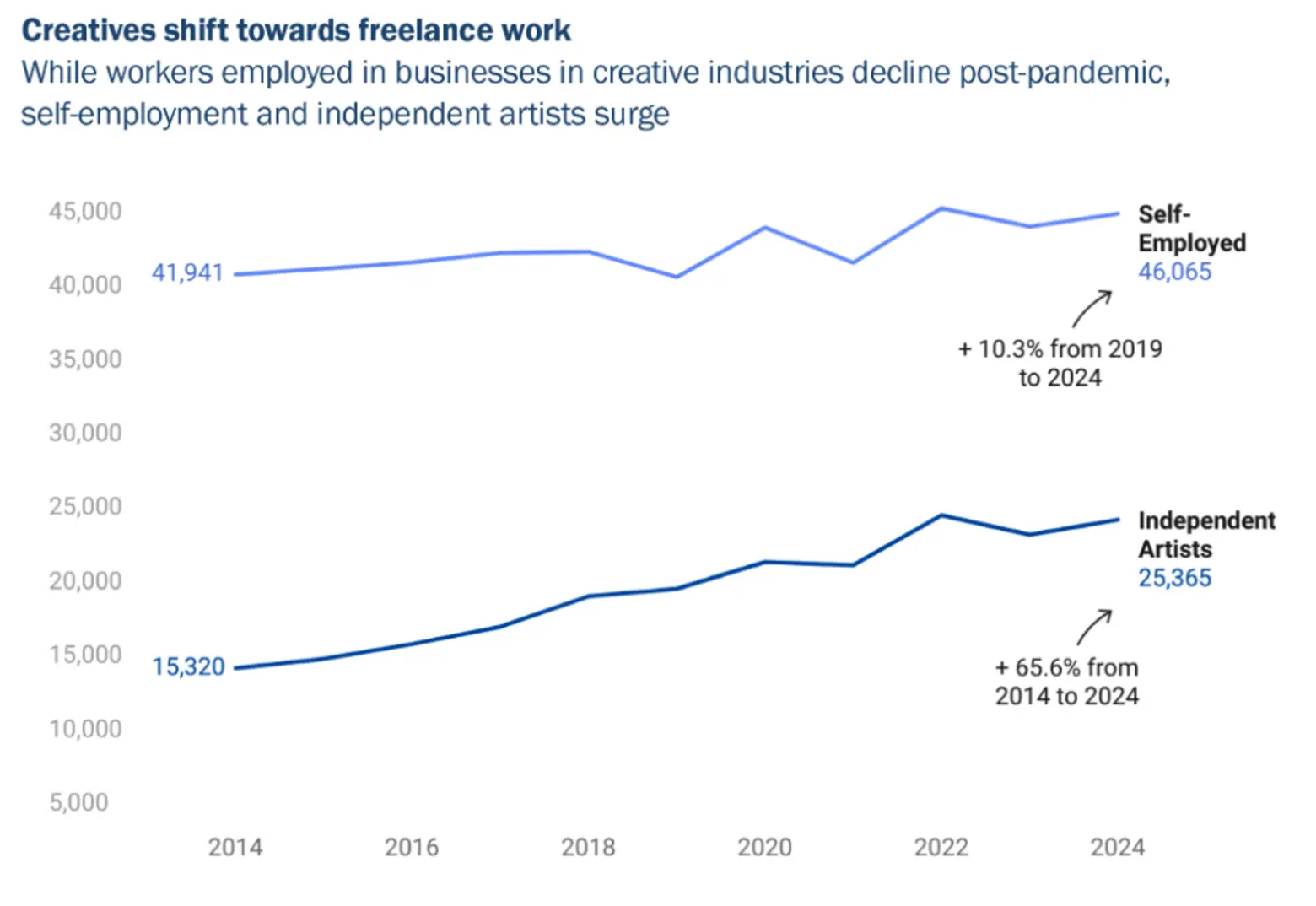
Simultaneously, creative work is increasingly shifting toward freelance and contract positions, with self-employment in creative fields growing 10.3 percent since 2019. Over the past decade, the number of independent artists, writers, and performers has risen by 65.6 percent, creating even more economic insecurity. Artists of color, who earn roughly 37 percent less than their white counterparts, face even greater financial hardships.
On a brighter note, nightlife across the five boroughs remains in a good state, many museums are expanding, and new cultural spaces, such as the Bronx Music Hall and the revamped Studio Museum in Harlem, are emerging.
Additionally, the city in recent years has made historic investments in arts and culture, including the largest-ever budget for the Department of Cultural Affairs and new permanent funding. It has also expanded the Cultural Institutions Group and launched efforts like the City Artists Corp to support working artists.
However, CUF asserts that far more must be done to sustain this momentum. According to the report, city officials have been slow to address the affordability crisis, which is increasingly pushing creatives out of the five boroughs.
Rising housing and studio costs, insurance, the instability of freelance work, and the growth of artificial intelligence demand a bolder, multi-pronged approach. Without it, the city risks losing its creative core and a vital engine of its economy, the report warns.
To renew NYC’s “creative spark,” the report outlines a series of recommendations for the incoming Mamdani administration. To address the affordability crisis, CUF urges city officials to build on the reforms included in Mayor Eric Adams’ “City of Yes” housing plan by expanding as-of-right zoning in transit-rich areas, fully eliminating remaining parking mandates for new developments, streamlining permitting and environmental review processes, and legalizing accessory dwelling units such as basement and attic apartments.
Policymakers should also expand opportunities for small-site and “missing-middle” infill development, establish a viable financing framework to support new rental housing production, and strengthen preservation tools to help stabilize the city’s existing affordable housing stock.
CUF also recommends that the city catch up with the rest of the state and country by building or designating 5,000 artist-preference housing units by 2030. The report suggests this could be achieved by setting aside a small number of units in new affordable housing developments and office-to-residential conversions.
The city’s human rights law bans housing discrimination based on housing, making it difficult for developers to build housing specifically for artists. Last month, Council Members Keith Powers and Erik Bottcher introduced legislation that would amend the city’s administrative code to clarify that this type of housing does not violate human rights laws, allowing for more artist housing to be built.
The center’s report also calls for the creation of a biennial “NYC Artist Survey” to collect data on artists’ housing and workspace needs, along with the development of effective zoning and building code models to support safe mixed-use housing.
The city could also launch its first five-borough cultural festival, modeled after Austin’s SXSW or Vienna’s Biennale, activating hundreds of venues and organizations citywide, elevating New York’s creative community, and generating millions of dollars in economic impact.
To strengthen protections for freelance and contract workers, CUF recommends the next mayor implement a “portable benefits system” providing independent workers with essential benefits—such as health insurance and paid leave—that move with them between jobs.
Additionally, CUF suggests the mayor create a city-run pooled insurance program, enabling cultural organizations to access affordable coverage through collective purchasing power. The program would operate like group health purchasing alliances, in which organizations join voluntarily, the city negotiates better prices and stronger underwriting, and a nonprofit administrator manages enrollment and compliance.
To help cultural organizations retain their spaces and gain greater flexibility, the state could launch a Cultural Ownership Fund. This fund would support these small and mid-sized groups in maintaining their current homes, while also assisting those with the resources to relocate or acquire new permanent spaces.
Policy reforms, such as scaling back shared back-office services like accounting, payroll, and benefits, could also help reduce costs. CUF further recommends that the city expand existing cooperative models, such as ArtsPool, and support shared-space arrangements that allow multiple organizations to use rehearsal, performance, and fabrication facilities together, enhancing flexibility.
The report recommends that the city’s Economic Development Corporation (NYCEDC) take a more active role in supporting the creative economy. While the agency currently provides some support, its efforts are limited compared with the resources it directs toward the life sciences, green technology, and manufacturing sectors.
CUF recommends that NYCEDC treat the creative sector as a core pillar of its economic strategy, allocating at least 1 percent of capital budgets to public art or creative placemaking in every capital project. This approach could also involve hiring dedicated staff and integrating creative workforce development into the agency’s training and entrepreneurship programs.
The agency should also expand shared production hubs for music, podcasting, and small creative businesses, while introducing signature initiatives like Independent Film Week and a global NYC Music Summit to showcase the city’s status as a worldwide creative hub.
To integrate creatives into city agencies, the city should expand the existing Public Artists in Residence (PAIR) program by creating full-time civic artist positions within influential departments, including Housing Preservation and Development, Transportation, Youth and Community Development, City Planning, and DOB—none of which have previously hosted a PAIR artist.
Furthermore, each agency should launch a “+Art” initiative, pairing artists with public servants to co-design creative projects, community engagement campaigns, and civic improvements.
Elected officials should also establish recurring revenue streams dedicated to arts and culture. One approach could be a voluntary surcharge on overnight hotel stays, with proceeds directed to a “Parks and Culture Fund” to support public art and recreation. The city could also pilot designated “Cultural Districts,” funded through assessments on nearby property owners, to sustain programming and maintenance in key cultural areas.
Finally, the city should tackle a major equity issue in its creative economy: it does not yet reflect the diversity of its communities. To expand access to well-paying careers in the arts and design, city leaders should launch a “Creative Pathways” program and a “Talent Pipeline Initiative” across public schools and the CUNY system.
For grades K–12, the next administration should build on the FutureReadyNYC initiative by establishing “Creative Schools NYC,” which would ensure high-quality arts and creative-skills instruction in every grade. The program would also expand opportunities with small nonprofit organizations, integrate creative careers into the city’s youth apprenticeship programs, and boost participation from the creative sector in the Summer Youth Employment Program.
At the college and early-career level, the city should create a “Creative Economy Talent Pipeline” to connect CUNY students and adult learners with paid internships, mentorship opportunities, and clear pathways into a wide range of creative careers.
RELATED:
Interested in similar content?
Leave a reply
Your email address will not be published.












Artists can’t afford to live in the Village or Soho anymore. Millionaires are buying apartments and lofts there and changing the neighborhoods which attracted them to begin with.