New York unveils plan to speed up NYC buses across 50 priority corridors
Riders on 50 bus routes across New York City could see their commutes cut by up to six minutes under a new proposal aimed at boosting bus speeds. Mayor Zohran Mamdani, Gov. Kathy Hochul, and the MTA on Wednesday released “Next Stop: Fast Buses, Better Service,” a plan outlining service upgrades that transit officials say will improve speed, reliability, and the rider experience citywide. Through a combination of service changes, traffic enforcement upgrades, and road redesigns, officials say the plan could reduce travel times by 20 percent across at least 50 bus corridors.
Buses serve as a lifeline for millions of New Yorkers, with more than 2.75 million trips taken daily across the city’s bus network, which spans roughly 1,600 miles of city streets.
However, despite their critical role, the city’s buses remain among the slowest in the nation. The average city bus travels at just 8 miles per hour, and more than 90 percent of city streets with bus routes lack dedicated bus lanes. According to the plan, buses spend 21 percent of their time stopped at traffic lights.
Despite significant investments in the bus system in recent years, the city says more work remains. The plan, a joint effort between the city’s Department of Transportation and the MTA, aims to address longstanding challenges such as slow speeds and unreliable service by setting a series of ambitious goals for the coming years.
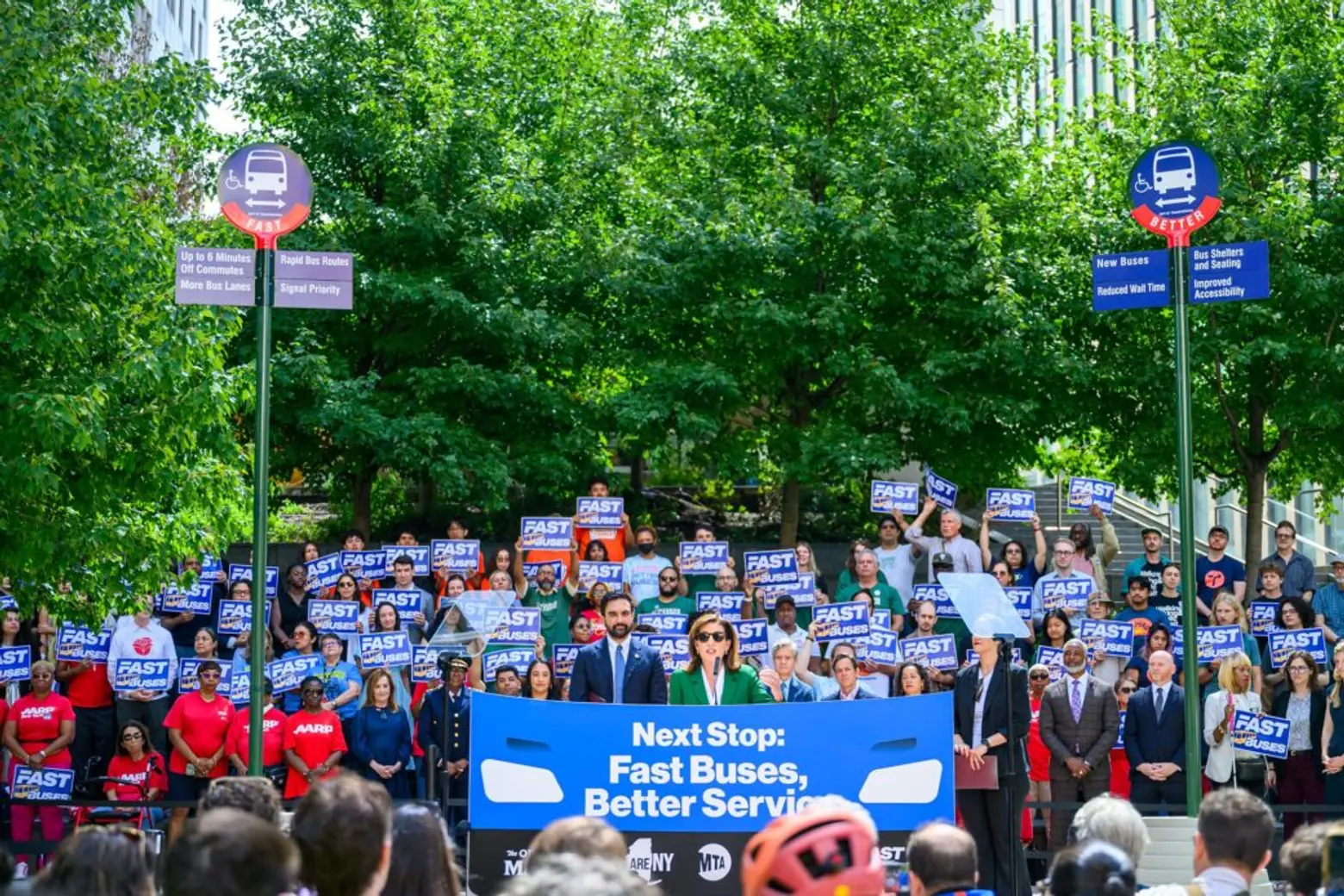
“Every day, millions of New Yorkers rely on buses to get around this city, but for far too long, making their journeys faster and their lives easier has seemed out of reach. That all changes today,” Hochul said.
“New York is in the midst of a transit renaissance, with historic investments being made to improve the lifeblood of our city,” she added. “Now, working with Mayor Mamdani, we are advancing a bold and ambitious plan to move buses faster, dramatically expand bus priority, reduce delays and make our bus system the envy of the world.”
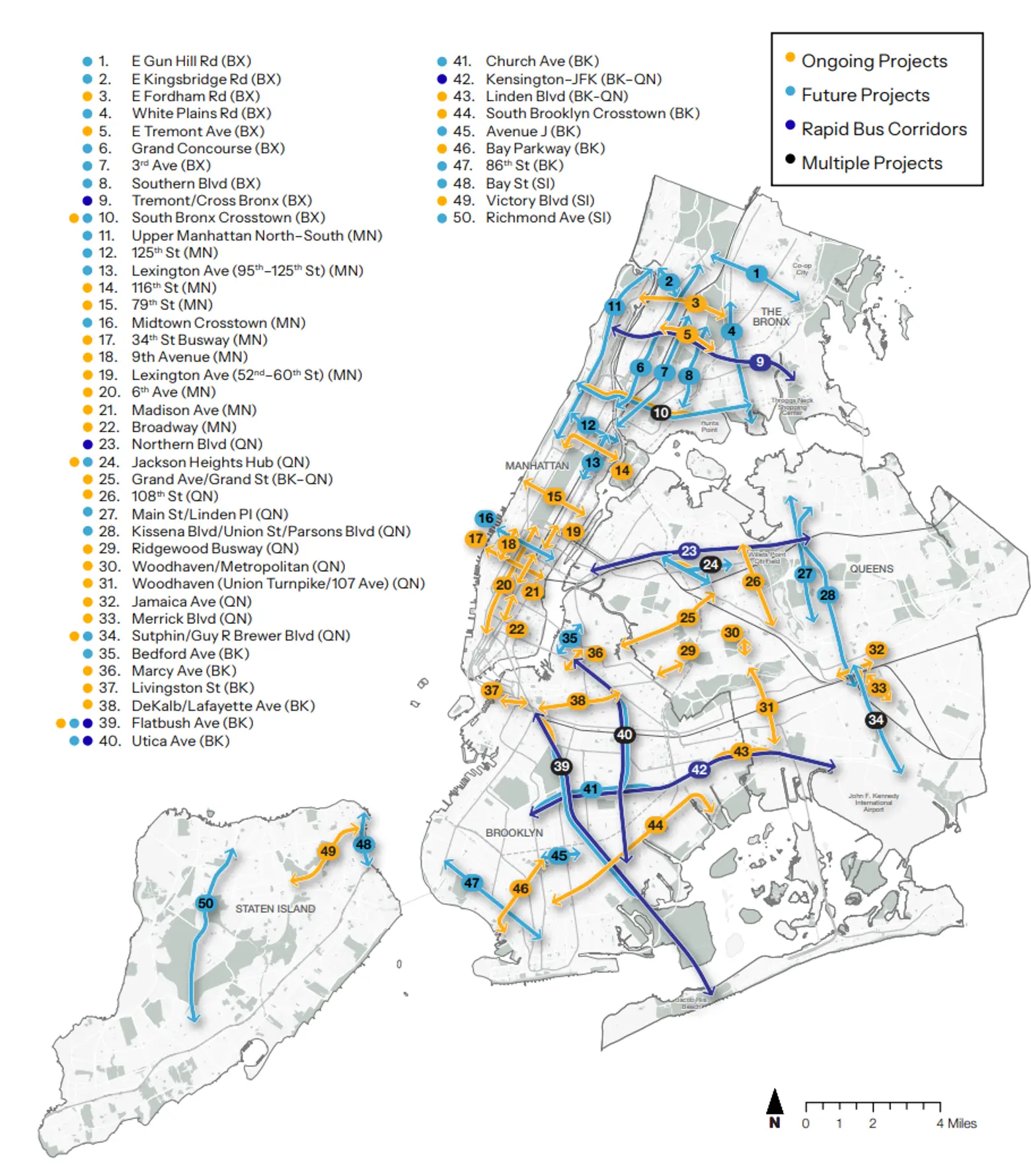
A central component of the plan is improving speeds on 50 “priority corridors,” which currently include 25 of the city’s slowest bus routes. These corridors were selected based on where riders experience the greatest delays, ridership levels, on-time performance, trip length, and access to other forms of public transit.
Many of the selected corridors have ongoing projects to improve bus infrastructure, such as Flatbush Avenue and Linden Boulevard in Brooklyn, and Madison Avenue and 34th Street in Manhattan. Just last month, the DOT unveiled a proposal for a dedicated 63-block bus lane stretching from Watts Street in Soho to 58th Street in Midtown.
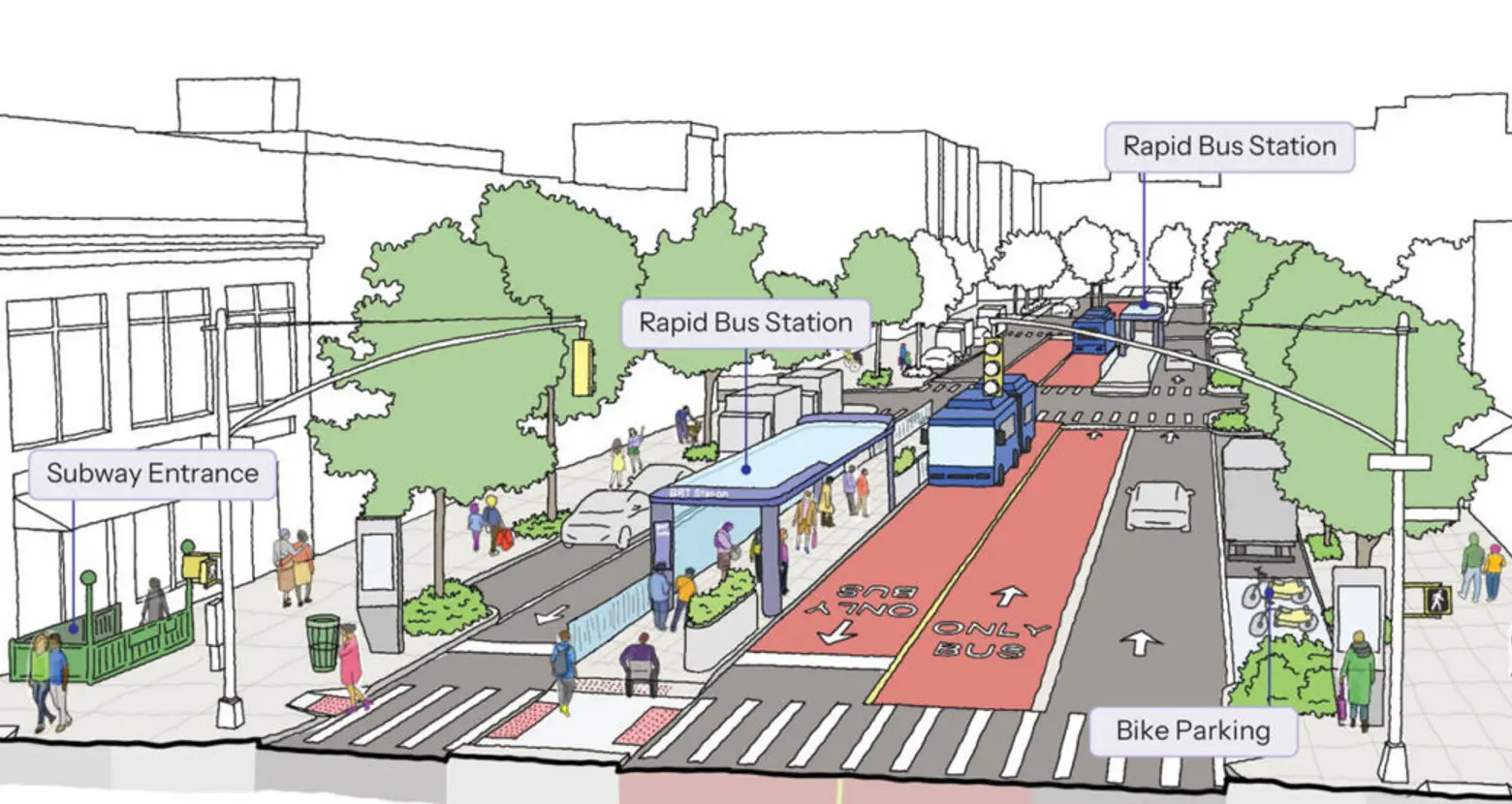
Of the 50 priority corridors, the city would designate five as “rapid bus corridors,” prioritizing routes in historically underserved areas. These routes would feature bus-only infrastructure such as busways, fully separated lanes, or center-running lanes that use transit signal priority at intersections and limit cross traffic.
According to the plan, rapid bus corridors across the country and throughout the Americas have been shown to expand job opportunities near stations, reduce business vacancies, and increase development investment.
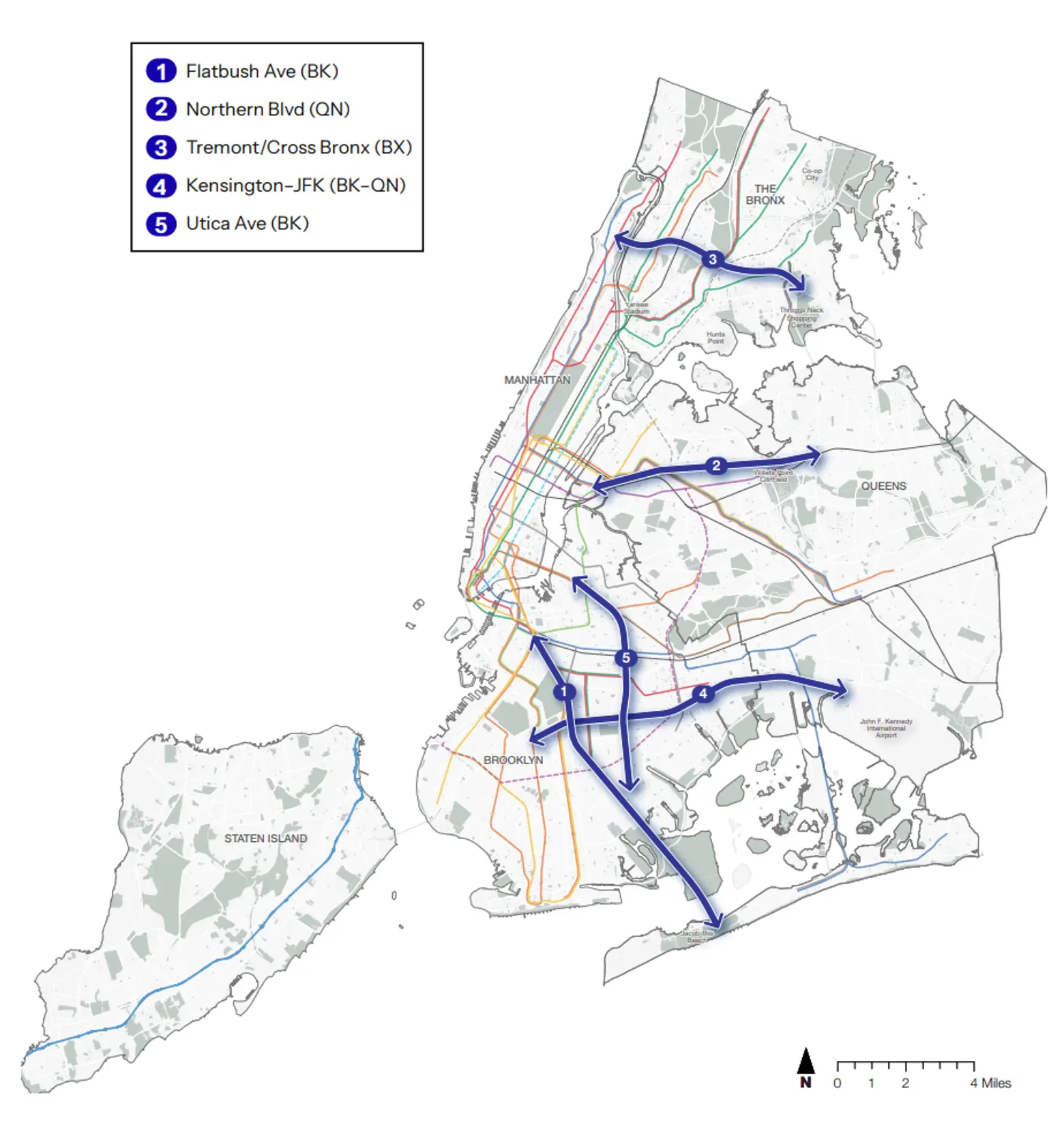
Building on the center-running bus lane project on Flatbush Avenue, the city would deliver new rapid bus service along the full length of the avenue by 2030. On Northern Boulevard in Queens, the DOT and MTA will engage residents to study options for future rapid bus service.
In the Bronx, the agencies will build on the Tremont Avenue Busway and launch community engagement efforts to explore new rapid bus options aimed at improving cross-borough travel.
Later this year, the agencies will launch engagement efforts to explore rapid bus options along Church Avenue, Linden Boulevard, New Lots Avenue, and Conduit Avenue, including connections to John F. Kennedy International Airport. The agencies will also study potential rapid bus upgrades on Utica Avenue in Brooklyn.
Another major component of the plan is modernizing the city’s bus fleet. Fully funded through the MTA’s 2025–2029 Capital Program, the agency will purchase roughly 2,500 new buses, replacing about 40 percent of its aging fleet.
The MTA will also introduce “all-door” boarding in 2027 following the complete transition to the OMNY tap-and-go fare payment system, allowing riders to pay and board through all doors of the bus rather than only the front. The change will reduce the amount of time buses spend at stops, helping them move more efficiently throughout the city.
Transit officials had previously been hesitant to implement all-door boarding, citing concerns that it could lead to increased fare evasion, according to amNY. The city’s bus system has one of the highest fare evasion rates among major transit systems worldwide.
However, as the city pilots a new fare enforcement system using “onboard validation devices,” the MTA is moving forward with the program.
Bus stops will also become safer, more comfortable, and more accessible. The MTA will expand its bus stop accessibility program to reach 65 stops per year by 2030 and install 300 new bus shelters by 2028. It will also add seating at 875 bus stops annually, ensuring every feasible stop has seating by 2035.
The agency will also plant 30 trees at bus stops this year and pilot shelter design improvements aimed at combating extreme heat. Ninety new real-time passenger information displays will be installed this year, expanding to 2,900 displays citywide by 2030.
To keep bus lanes free of illegal traffic, the MTA will expand its Automated Camera Enforcement (ACE) system. The technology has increased bus speeds by as much as 30 percent while reducing collisions by 20 percent. To build on these improvements, the MTA and DOT will expand bus-mounted ACE to 25 additional routes each year in 2026 and 2027.
The agencies will also install 200 additional stationary bus lane cameras by 2027, while the NYPD will expand targeted bus lane enforcement from 14 to 20 corridors starting this year.
Working alongside the Mayor’s Office of Mass Engagement and other city agencies, the DOT and MTA will host community events, conduct surveys, and collaborate with advocacy organizations and community groups before projects begin. These efforts aim to put bus riders at the center of conversations surrounding upcoming upgrades.
The two agencies will publicly release performance data within six to 12 months after projects are completed, assessing impacts on travel times, reliability, and rider experience while identifying opportunities for further improvements.
Wednesday’s announcement raises questions about the status of one of the mayor’s campaign pledges of making buses fast and free. While the mayor has advanced other campaign priorities, including universal childcare and a rent freeze for the city’s rent-stabilized tenants, efforts to deliver free and faster bus service have yet to move forward.
During the press conference, Mamdani was asked whether the “Next Stop” plan would delay his broader goal of making buses free. He said the administration remains committed to that pledge and that the new bus plan will deliver the “fast” part of his promise.
“I’ve been very clear with New Yorkers that my commitment is to make buses fast and free,” he said. “Today, we stand together on how we deliver the fast.”
“I want to be very clear that that speed is something New Yorkers can depend on and see on the bus, and also the investments we’re making around the whole bus system,” he added. “We’ll continue not only to believe, but to work towards making our buses free as well.”
RELATED: