MTA to replace more than 2,000 NYC subway cars, largest order in agency history
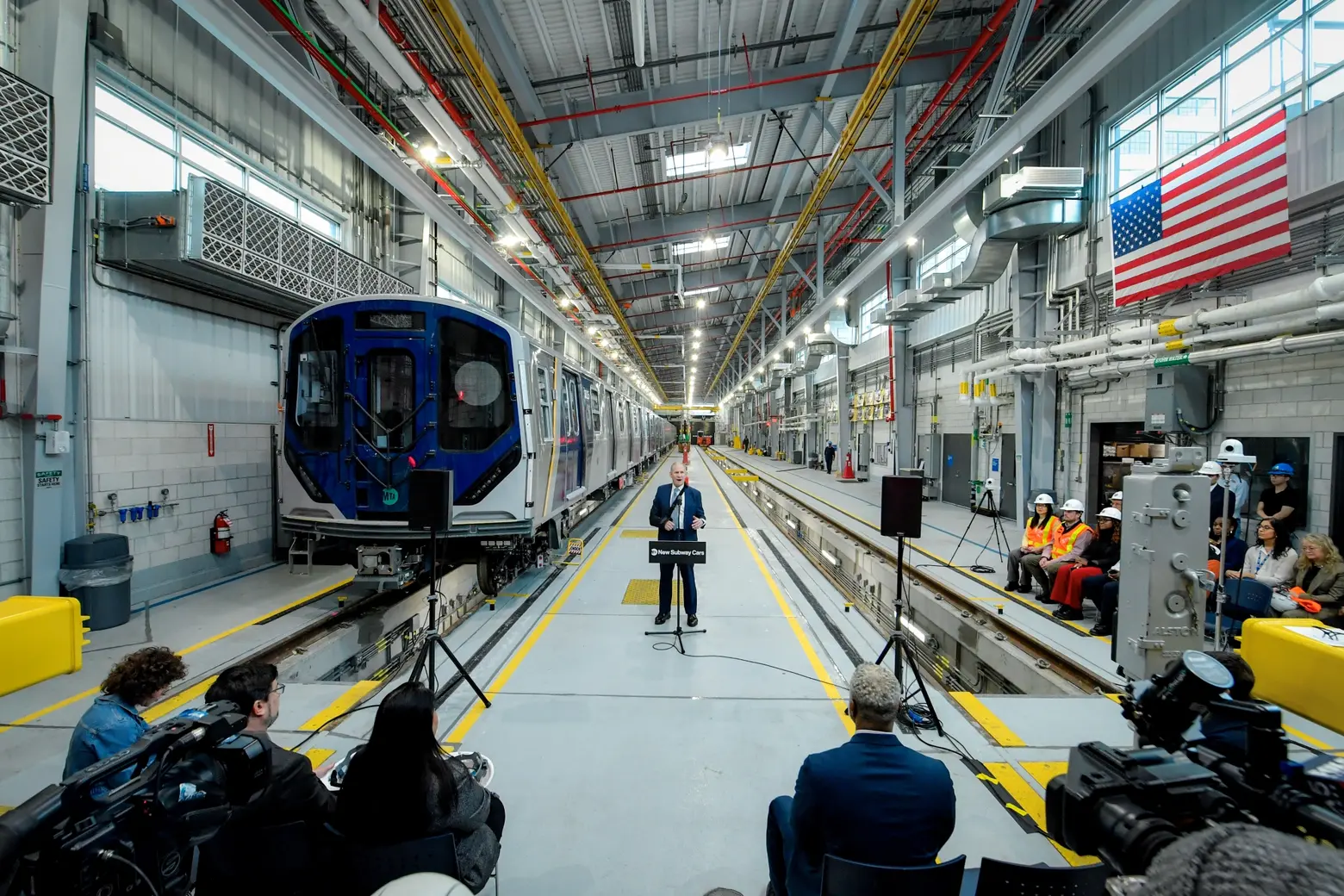
Credit: Marc A. Hermann / MTA on Flickr
The Metropolitan Transportation Authority is seeking a manufacturer to deliver 2,390 new subway cars, the largest order in the transit system’s history. Gov. Kathy Hochul announced the request for proposals (RFP) on Friday, which calls for a base order of 1,140 R262 cars to replace the R62 and R62A fleets on the 1, 3, and 6 lines. An additional 1,250 cars could be ordered to replace the R142 and R142A fleets on the 2, 4, and 5 lines.
The order includes more cars than the Chicago Transit Authority and Massachusetts Bay Transportation Authority’s fleets combined. The new cars would be funded under the MTA’s 2025–29 Capital Plan, which received $68 billion in funding from Hochul in the fiscal year 2026 enacted state budget, representing the largest investment in new rolling stock in MTA history.
“Thousands of new subway cars running better service and a more reliable ride for millions every day—that’s what we can achieve when we fully invest in transit,” Hochul said. “We are in the midst of a public transit renaissance in New York, with growing ridership, the best service in a generation and historic investments to modernize the lifeblood of our city.”
With the new rolling stock program, the agency has taken a different approach to the contract, modernizing the terms and conditions while encouraging innovation by giving manufacturers more flexibility to propose new ideas, according to a press release.
More than 60 percent of the technical specifications are now performance-based rather than design-driven, and applicants are required to submit total cost of ownership projections. The changes are intended to streamline the contract process, address existing contractual challenges, and ensure the timely delivery of the new cars.
The historic contract could replace up to 36.4 percent of the subway’s entire fleet—6,574 cars—and 17.3 percent with just the base order alone. The new cars will significantly improve reliability with a higher mean distance between failure (MDBF), which measures how long a car can operate without issues, repairs, or maintenance.
The R262 has an MDBF requirement of 200,000 miles, compared to the R62 and R62A’s average of 89,000 miles. This upgrade is expected to reduce service disruptions and decrease the amount of time cars are taken out of service.
Other technical specifications included in the RFP aim to improve efficiency, security, performance, and customer experience, including better announcement systems and assisted listening devices that allow hearing-impaired passengers to connect to personal devices such as hearing aids.
Efficiency upgrades include automatic passenger counting systems and electric braking controls, which reduce costs by minimizing the number of parts required. Security specifications include onboard cameras, like those installed on the existing subway fleet, platform-edge CCTV, and electronic locks to prevent unauthorized cab access.
Additionally, the RFP notes that future orders will contain a “to-be-determined amount” of open gangway cars, which would be a first in the A Division or the numbered subway lines.
While replacing the cars should improve service for New Yorkers, some may be disappointed to learn that the end of the R62 means the end of the classic yellow and orange seats that have long evoked nostalgia for generations of riders. However, those seats will remain on the 7 line, as the contract does not include replacing cars on that line, according to Spectrum News NY1.
The RFP follows last month’s announcement, when MTA Chair and CEO Janno Lieber appointed Jessie Lazarus to lead a new organization focused on the agency’s rolling stock strategy and on managing the acquisition and lifecycle costs of its most strategic assets—buses, subway cars, and commuter rail trains.
Lazarus and her team now manage the agency’s purchases of all new subway, bus, and railroad cars, including the $12 billion investment from the MTA’s latest five-year capital plan to replace its aging fleets.
“This will be the largest order of new subway cars in MTA history, and we’re modernizing our approach to attract as many qualified firms as possible,” Lazarus said. “We’re asking the industry to come with their best ideas—technical and commercial—to meet our performance standards and help the MTA deliver the world-class transit experience our customers deserve.”
Proposals are due by September 8, 2026, and a contract is expected to be awarded by early 2028.
Replacing aging trains and infrastructure is a top priority for the MTA. A September report revealed that over a quarter of subway cars are past their 40-year lifespan, while major service disruptions linked to car issues nearly tripled, from 27 to 77 in the first six months of 2025.
In November, the MTA announced it would spend $1.5 billion on a new fleet of modern subway cars as part of its ongoing efforts to modernize its fleet and signal system. The funds will go towards the purchase of nearly 400 new subway cars, which will feature signals compatible with the agency’s transition to Communication-Based Train Control (CBTC) technology. Those trains are expected to begin arriving in fall 2028.
Signal modernization is also underway on the G line, though it has faced significant delays. The line is undergoing a $624 million project to replace its 1930s-era signal system with CBTC. Work is scheduled to be completed north of Hoyt-Schermerhorn by the end of 2027, and between Hoyt-Schermerhorn and Church Avenue by 2028.
However, the upgraded system will not be activated until 2029 due to delays in installing 5G radio technology on subway cars, a requirement for CBTC to function across both trains and tracks.
RELATED: