
Mamdani releases blueprint to build 200,000 new affordable homes, target bad landlords
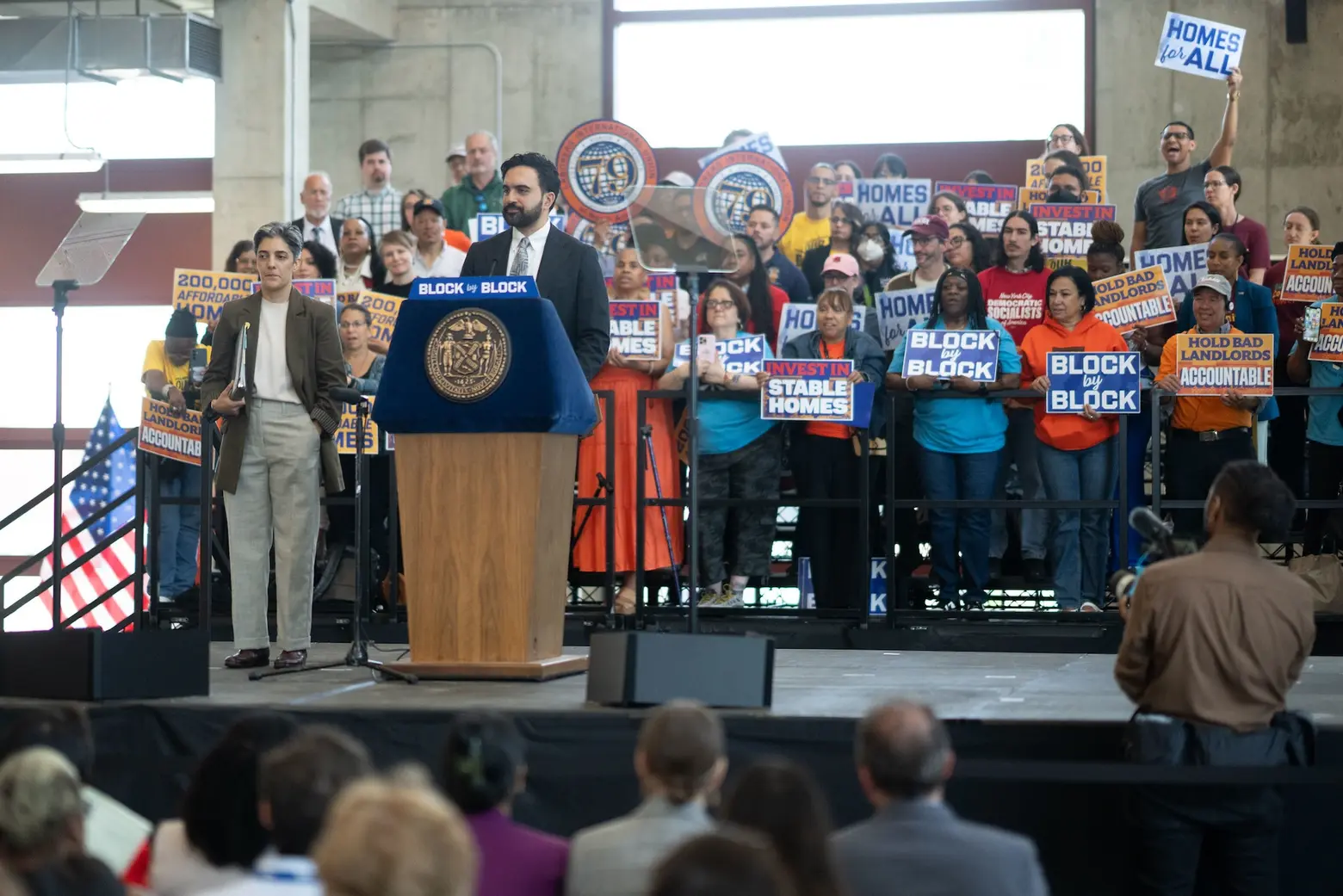
Photo by Michael Appleton/ Mayoral Photography Office on Flickr
Mayor Zohran Mamdani on Tuesday released a comprehensive plan to address the city’s current housing crisis, detailing a goal to build 200,000 new affordable homes over the next decade, the most ambitious target by a New York City mayor ever. The housing plan, dubbed “Block by Block,” says $22 billion in capital investments over five years will fund new affordable housing and help preserve another 200,000 existing homes. The report also details the expansion of tenant protections and homeownership opportunities, as well as the largest capital investment in NYCHA in recent history.
“Block by block, we will build once again,” Mamdani said on Tuesday. “We will prove that the belief we hold that every person deserves a dignified home is more than an ideal, it’s a responsibility that the government can, and will, fulfill.”
With the Department of Housing Preservation and Development’s expanded budget, the city expects to build 8,000 affordable homes per year for the next two years. That’s a 35 percent increase in production compared to 2024 and 2025.
The city wants to ensure New Yorkers who earn the least have access to new housing. Of the 8,000 new homes financed by the city, 30 percent will be set aside for extremely low-income households, or those who earn less than 30 percent of the area median income (AMI), which is considered $45,810 for a family of three.
Another 20 percent will serve very low-income households, which covers New Yorkers earning between 31 percent and 50 percent of the AMI.
The city also wants to lower the rent for tenants considered extremely low-income. According to the plan, the way rent is calculated for those earning less than 30 percent of AMI and who receive a new home financed by HPD will change. The city will size their monthly rent at 25 percent of their monthly income. The new rent calculation, which will not apply to households with vouchers, will be for HPD-financed projects that close on financing as of June.
Mamdani plans to boost the number of housing units for seniors, increasing production to 1,000 new homes per year for FY27 and FY28. These projects would include a new pilot that builds senior homes alongside non-age-restricted homes, creating “multi-generational communities within a single housing development,” as the report details.
In addition to the new investments, the city will rely on rezonings to build more housing as well as new tools permitted under the city charter changes approved by voters last November. Last week, the mayor announced the first two neighborhood rezoning efforts would target White Plains Road in the Bronx and areas south of Prospect Park in Brooklyn.
The administration will also explore “micro” rezoning plans, instead of larger neighborhood-wide plans, that would target several blocks or other smaller areas where a larger plan is not possible.
Other notable parts of the plan include programs to expand affordable homeownership opportunities, including doubling the size of the Open Door program, and launching “Our Home,” which will convert rental buildings into permanently affordable co-ops.
Mamdani also plans to support the city’s public housing system and its 500,000 residents by dedicating $5.6 billion over five years, the most for NYCHA in recent history, according to the mayor. The city will use the Permanent Affordability Commitment Together (PACT) program, which partners with private developers, and the Public Housing Preservation Trust, a public entity that leases NYCHA buildings, to make much-needed upgrades at NYCHA developments.
The city plans to gut-renovate 25,000 apartments, starting with Nostrand Houses in Brooklyn and Bronx River Addition in the Bronx, with direct input from residents.
The city also wants to improve the lives of renters by making it easier for the city to identify and fix housing code issues. This year, HPD will launch “Fix the City,” a new program that will take enforcement actions on landlords who “speculate on buildings, persistently disregard repairs, and refuse to improve or change their business practices.” The program will start investigations into at least 10 housing portfolios with long-standing violations.
“Mayor Mamdani’s housing plan places renewed emphasis on the vital role of NYCHA in our city and the residents we serve,” Lisa Bova-Hiatt, NYCHA Chief Executive Officer, said.
“The administration’s plan, which represents one of the largest city investments in NYCHA in recent history, will directly support our shared commitment to strengthening resident engagement, improving service delivery, and accelerating long-needed repairs and improvements across our portfolio.”
James Whelan, president of the Real Estate Board of New York (REBNY), questioned the mayor’s potential reliance on Project Labor Agreements (PLAs), which are collective bargaining agreements that establish terms and conditions of employment for workers on city-financed projects.
“Mayor Mamdani has put forward a wide-ranging housing plan that we look forward to reviewing and assessing how its pieces come together to drive production and improve affordability,” Whelan said.
“At a time when we need to build as much housing as possible, we question why the City would choose to make projects more expensive to build and finance through the addition of costly and inflexible Project Labor Agreements. New York won’t solve its housing supply crisis by undercutting its own laudable production goals.”
Read the full “Block by Block” report here.
RELATED:
Get Insider Updates with Our Newsletter!
Leave a reply
Your email address will not be published.

















yes block by block, in better off neighborhoods that need truly affordable housing for all and for our seniors out there.
Someone – the Mayor or the Comptroller probably – needs to examine the full total cost of using union labor vs. non-union labor on major developments.
Looking at cost alone ignores union workers’ greater safety record, greater training, lower work stoppages due to accidents or violations, lower “redos” for violations, potentially lower insurance costs (do insurance companies analyze payout rates for no-union vs. union jobs? They should too).
These are all documented piecemeal but AFAIK no one has added them up into a head-to-head comparison.
I am so pleased with the changes that Mayor Mamdani is making. I was seriously thinking of leaving New York but now with all the advances I’m definitely staying.